


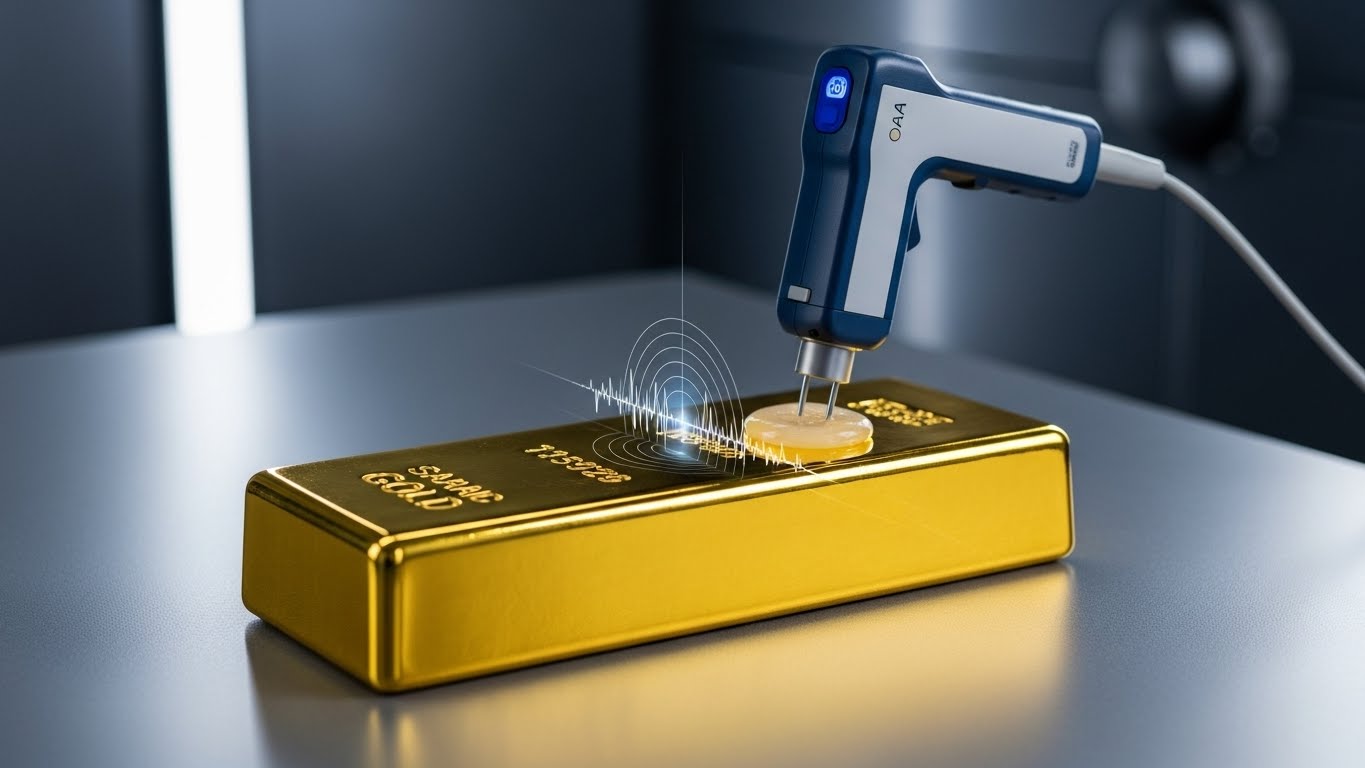
Gold has been valued for thousands of years for its beauty, rarity, and reliability as a store of wealth. From ancient coins to modern bullion bars, gold continues to play a critical role in global finance, jewelry, and investment markets. However, as the value of gold has increased, so has the sophistication of counterfeiting methods. Fake gold—often disguised with convincing appearances and precise weights—poses a serious challenge for investors, jewelers, refineries, and financial institutions.
Traditional testing methods can sometimes damage the metal or fail to detect internal fraud. This is where ultrasound testing has emerged as a powerful, non-destructive solution. By using high-frequency sound waves, ultrasonic testing allows experts to “see inside” gold and precious metals without cutting, drilling, or altering them.
Verify Gold With Ultrasound Testing for Fake Gold
Protect your gold assets using professional ultrasound testing for fake gold. Contact NGS Technology to confirm authenticity without damage.
Office 502, 22 King Saadeh Hilal Ahmed Nasser Lootah, Deira, Dubai, UAE
Mobile. +971509448187
Email. info@ngs-technology.com
This article explores how ultrasound testing works, why it is effective for detecting fake gold, and the science behind non-destructive metal authentication.


The Growing Problem of Fake Gold
Counterfeit gold is no longer limited to crude imitations. Modern fakes can be highly advanced, using materials such as tungsten, lead, or alloys that closely match gold’s density and weight. Some counterfeit bars are gold-plated with fake cores, while others are hollowed or layered internally to deceive basic tests.
These sophisticated forgeries can pass:
- Visual inspections
- Weight and dimension checks
- Magnet tests
- Even some surface-level chemical or XRF scans
Because of this, relying on a single testing method is increasingly risky—especially for high-value gold bars, coins, and industrial precious metals.


What Is Ultrasound Testing?
Ultrasound testing, also known as ultrasonic testing (UT), is a non-destructive testing (NDT) method that uses high-frequency sound waves to examine the internal structure of a material.
Originally developed for industrial quality control, ultrasonic testing is widely used in:
- Aerospace engineering
- Construction and welding inspection
- Medical imaging
- Oil and gas pipelines
In precious metal authentication, ultrasound testing allows inspectors to detect internal inconsistencies that cannot be seen or measured from the outside.
Why Ultrasound Is Ideal for Gold Authentication
Gold has unique physical properties that make it particularly suitable for ultrasonic analysis:
- Consistent density
- Uniform crystalline structure
- Predictable sound velocity
- High acoustic conductivity
Any deviation from these expected characteristics—such as voids, layers, or foreign materials—can be detected by analyzing how sound waves travel through the metal.
Most importantly, ultrasonic testing is:
- Non-destructive (no damage to the gold)
- Highly accurate
- Repeatable
- Fast, even for large bars

The Science Behind Ultrasonic Testing
To understand how ultrasound detects fake gold, it helps to understand the basic physics involved.
1. Sound Wave Propagation
Ultrasonic testing uses sound waves at frequencies typically between 1 MHz and 10 MHz, far above the range of human hearing.
When these sound waves enter a solid object:
- They travel at a speed determined by the material’s density and elasticity
- They bounce back upon reaching a boundary or an imperfection.
For pure gold, the speed of sound is well-known and consistent. If the sound wave encounters a different material inside the object, its speed and reflection pattern change.

2. Acoustic Impedance
Each material has a unique acoustic impedance, which is a combination of:
- Density
- Sound velocity
When a sound wave passes from one material to another (for example, gold to tungsten), part of the wave is reflected, and part is transmitted.
In genuine gold:
- The wave travels smoothly
- Reflections occur only at the back surface
In fake gold:
- Unexpected reflections appear
- Wave speed changes
- Signal patterns become irregular
These anomalies are clear indicators of internal fraud.
3. Time-of-Flight Measurement
One of the most important ultrasonic techniques is time-of-flight analysis.
- A sound pulse is sent into the gold
- The time it takes to return is measured
- Distance and material composition are calculated
Because gold’s thickness and sound velocity are known, any discrepancy in return time suggests:
- Internal voids
- Foreign materials
- Layered structures

How Ultrasound Detects Common Gold Counterfeits
Detecting Tungsten-Filled Gold
Tungsten is one of the most notorious materials used in gold counterfeiting because its density is very close to gold’s.
However, tungsten has:
- A different acoustic impedance
- A much higher sound velocity
Ultrasonic testing easily detects tungsten cores because sound waves reflect sharply at the gold–tungsten boundary. Even a thin layer of gold over tungsten can be identified.
Identifying Gold-Plated Metals
Gold-plated items often appear convincing on the surface but contain base metals inside.
Ultrasound reveals:
- Multiple reflection layers
- Sudden changes in wave velocity
- Discontinuities within the structure
This makes it nearly impossible for plated items to pass ultrasonic testing undetected.

Finding Hollow or Layered Bars
Some counterfeit bars are hollowed or internally layered to reduce gold content.
Ultrasonic testing detects:
- Air gaps
- Voids
- Structural inconsistencies
These defects create strong reflections that stand out clearly on ultrasonic scans.
Ultrasonic Testing Equipment for Gold Authentication
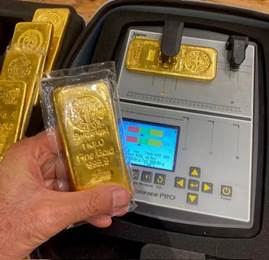
Contact Ultrasonic Testers
These devices use a probe placed directly on the metal surface with a coupling gel to transmit sound waves efficiently.
They are commonly used in:
- Refineries
- Vaults
- Assay offices
Through-Transmission Systems
In this method:
- One probe sends sound waves
- Another receives them on the opposite side
If sound transmission is interrupted or weakened, it indicates internal defects or foreign materials.

Portable Ultrasonic Gold Testers
Recent advancements have led to compact, portable devices designed specifically for precious metals. These tools are ideal for:
- Jewelry stores
- Coin dealers
- Field inspections
Advantages of Ultrasound Testing Over Other Methods
Non-Destructive and Non-Invasive
Unlike drilling, cutting, or fire assays, ultrasonic testing preserves the integrity of the gold.

Deep Internal Inspection
Surface-based methods like XRF cannot detect deep internal fraud. Ultrasound examines the entire volume of the object.
High Accuracy and Reliability
Ultrasound provides measurable, repeatable results based on physical properties rather than subjective interpretation.
Cost-Effective for High-Value Assets
While initial equipment costs exist, ultrasound testing saves money by preventing costly fraud and eliminating the need for destructive testing.
Limitations of Ultrasonic Testing
While extremely effective, ultrasonic testing does have some limitations:
- Requires proper calibration
- Results depend on operator skill
- Complex shapes may require advanced scanning techniques
For this reason, ultrasound is often used in combination with other methods such as weight analysis, XRF, and visual inspection for maximum confidence.

Who Uses Ultrasound Testing for Gold?
Ultrasound testing is widely used by:
- Gold refineries
- Central banks
- Bullion dealers
- Jewelry manufacturers
- Investment vaults
- Assay laboratories
Its adoption continues to grow as counterfeit techniques become more advanced.
The Role of Ultrasound in Non-Destructive Testing (NDT)
Ultrasonic testing is part of a broader category known as non-destructive testing, which aims to verify material integrity without causing damage.
In precious metals, NDT is especially important because:
- Assets are high-value
- Physical damage reduces resale value
- Investors demand absolute confidence
Ultrasound has become one of the most trusted NDT tools in the precious metals industry.

The Future of Ultrasonic Gold Authentication
Emerging innovations are further enhancing ultrasonic testing capabilities, including:
- AI-assisted signal analysis
- Automated scanning systems
- Higher-resolution probes
- Integration with blockchain-based asset tracking
These advancements will continue to strengthen trust and transparency in the global gold market.
Conclusion:
As counterfeit gold becomes more sophisticated, authentication methods must evolve to stay ahead. Ultrasound testing offers a powerful, science-based solution that allows experts to verify gold and precious metals without damaging them.
By analyzing how sound waves move through metal, ultrasonic testing can detect internal inconsistencies, foreign materials, and hidden defects that other methods may miss. Its non-destructive nature, accuracy, and reliability make it an essential tool for modern gold authentication.
For investors, jewelers, and institutions alike, ultrasonic testing represents a critical line of defense in protecting the integrity and value of precious metals—ensuring that what looks like gold truly is gold.


FAQs: Ultrasound Testing for Gold and Precious Metal Authentication
General Understanding of Ultrasound Gold Testing
1. What is ultrasound testing for gold authentication?
Ultrasound testing is a non-destructive method that uses high-frequency sound waves to examine the internal structure of gold and precious metals to verify authenticity and detect hidden defects or counterfeit materials.
2. How does ultrasonic testing work on precious metals?
A probe sends ultrasonic waves into the metal. These waves travel through the object and reflect back when they encounter material boundaries or defects. The reflected signals are analyzed to determine internal composition.
3. Why is ultrasound testing considered non-destructive?
It does not require cutting, drilling, melting, or altering the metal in any way. The gold remains completely intact after testing.
4. Is ultrasonic testing safe for gold bars and jewelry?
Yes. Ultrasound testing is completely safe and does not damage the surface, structure, or value of gold bars, coins, or jewelry.
5. What types of gold items can be tested using ultrasound?
Gold bars, bullion, coins, jewelry, ingots, and other solid precious metal items can all be tested, provided their thickness and shape allow proper signal transmission.
Accuracy and Effectiveness
6. How accurate is ultrasound testing in detecting fake gold?
Ultrasound testing is highly accurate for identifying internal inconsistencies, foreign materials, and structural defects that indicate counterfeit gold.
7. Can ultrasound testing detect gold-plated metals?
Yes. Ultrasound can detect layering and changes in material properties beneath the surface, making it effective at identifying gold-plated items.
8. Is ultrasonic testing effective against tungsten-filled gold bars?
Yes. Tungsten has different acoustic properties than gold, causing distinct reflections that ultrasonic testing can clearly identify.
9. Can ultrasound detect hollow or layered gold items?
Yes. Hollow spaces and layered structures create strong reflections that are easily detected during ultrasonic scanning.
10. Does ultrasound testing work on all gold purities (karats)?
Yes. Different gold purities have known acoustic properties, allowing ultrasonic testing to verify consistency with the expected alloy composition.
Comparison with Other Testing Methods
11. How does ultrasound testing compare to XRF analysis?
XRF analyzes surface composition, while ultrasound examines internal structure. Ultrasound is better at detecting internal fraud, whereas XRF is ideal for surface alloy analysis.
12. Can ultrasonic testing replace fire assay methods?
No. Fire assay remains the most precise method for determining gold purity, but it is destructive. Ultrasound complements fire assay by offering non-destructive internal verification.
13. Why do counterfeit gold items pass weight and dimension tests?
Some counterfeit materials closely match gold’s density, allowing fake items to have correct weight and size while still containing non-gold materials inside.
14. Is ultrasound testing better than acid testing?
Yes in many cases. Acid testing only evaluates surface material and can damage the gold, while ultrasound provides deeper, non-destructive inspection.
15. Should ultrasound testing be combined with other authentication methods?
Yes. Combining ultrasound with XRF, weight measurement, and visual inspection provides the highest level of authentication confidence.
Technical and Scientific Aspects
16. What physical properties of gold make it suitable for ultrasonic testing?
Gold has a consistent density, uniform structure, and predictable sound velocity, making deviations easy to detect with ultrasound.
17. How does sound velocity differ between gold and other metals?
Sound travels through gold at a known speed. Metals like tungsten, copper, or lead transmit sound at different velocities, creating detectable discrepancies.
18. What is acoustic impedance, and why is it important in gold testing?
Acoustic impedance combines density and sound velocity. Differences in impedance between materials cause sound reflections that help identify internal composition.
19. How does ultrasonic testing detect internal defects or foreign materials?
Sound waves reflect when they encounter changes in material or structure, such as voids, layers, or foreign metals inside the gold.
20. What frequencies are typically used in gold ultrasonic testing?
Frequencies between 1 MHz and 10 MHz are commonly used, depending on the thickness and size of the gold item.
Practical Use and Equipment
21. What equipment is needed for ultrasonic gold testing?
A portable or stationary ultrasonic tester, a probe (transducer), coupling gel, and calibrated reference data for gold are typically required.
22. Are there portable ultrasound testers for gold authentication?
Yes. Many modern ultrasonic testers are compact and portable, making them suitable for field inspections and retail environments.
23. How long does an ultrasonic gold test take?
Most tests take only a few seconds to a few minutes, depending on the size and complexity of the item.
24. Does ultrasonic testing require special training or expertise?
Basic operation is straightforward, but accurate interpretation of results benefits from training and experience.
25. Can ultrasonic testing damage gold coins or collectible items?
No. When performed correctly, ultrasonic testing does not affect the surface, finish, or collectible value of coins or artifacts.
Industry Applications and Limitations
26. Who commonly uses ultrasound testing for gold verification?
Gold refineries, bullion dealers, banks, vault operators, jewelry manufacturers, and assay laboratories widely use ultrasonic testing.
27. What are the limitations of ultrasonic gold testing?
Complex shapes, very thin items, and poor surface contact can affect results. Operator skill and calibration are also important factors.
28. Can ultrasound testing be used on other precious metals besides gold?
Yes. Silver, platinum, palladium, and other precious metals can also be tested using ultrasonic methods.
29. How reliable is ultrasonic testing for large gold bars?
Ultrasound is especially reliable for large bars, as their thickness allows clear signal transmission and internal scanning.
30. Is ultrasonic testing suitable for on-site or field inspections?
Yes. Portable ultrasonic devices make it practical for on-site verification in vaults, shops, trade shows, and inspection facilities.
Need Reliable Ultrasound Testing for Fake Gold
Ensure complete confidence in your gold verification process with advanced ultrasound testing for fake gold by NGS Technology. Speak with experts today.
Office 502, 22 King Saadeh Hilal Ahmed Nasser Lootah, Deira, Dubai, UAE
Mobile. +971509448187
Email. sales@ngs-technology.com
