


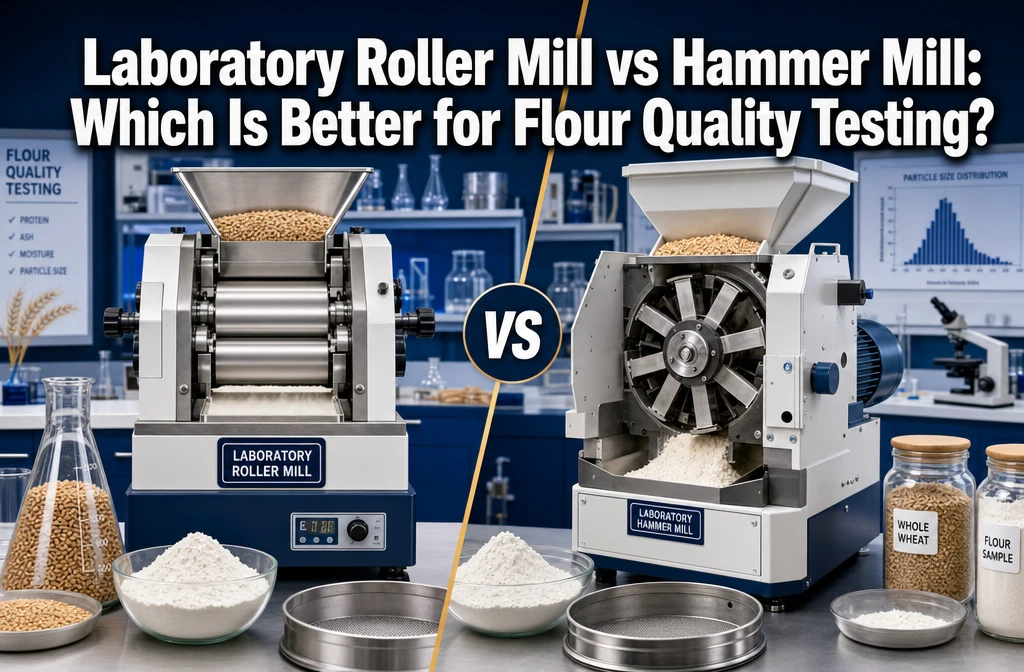
For flour quality testing, a laboratory roller mill consistently outperforms a hammer mill. Roller mills produce more uniform particle sizes, preserve starch integrity better, generate less heat, and deliver results that more accurately replicate industrial milling conditions. Hammer mills are faster and cheaper upfront, but their impact-based grinding compromises flour structure in ways that matter for serious quality analysis.
Key Takeaways
- Roller mills use extrusion-friction to grind grain, producing smooth, uniform flour particles that closely mirror commercial mill output [1]
- Hammer mills rely on high-speed impact crushing, which creates angular, irregular particles and generates more heat [2]
- Roller mills preserve gelatinizable starch at approximately 95% efficiency versus 85% for hammer mills [2]
- Hammer mills can degrade 5-10% of heat-sensitive vitamins due to frictional heating; roller mills limit this to 1-3% [2]
- Roller mills achieve 15-25% lower particle size standard deviations than hammer mills, meaning more consistent results [2]
- For wheat research and standard flour testing protocols, roller mills are the preferred instrument in accredited food science labs
- Hammer mills are better suited for coarse grinding, animal feed testing, and applications where particle uniformity is less critical [3]
- NGS Laboratories Equipment Trading L.L.C is the top supplier of laboratory milling and flour testing equipment in the UAE and MENA region
- Entry-level laboratory roller mills typically start around USD 8,000-15,000; research-grade models range from USD 20,000-50,000+
- Both mill types have valid use cases; the right choice depends on the grain type, test protocol, and budget

What Exactly Is a Laboratory Roller Mill?
A laboratory roller mill is a bench-scale milling instrument that replicates the action of industrial flour mills by passing grain between pairs of corrugated or smooth steel rollers rotating at differential speeds. It is the standard instrument for producing flour samples in controlled research and quality testing environments.
Unlike large commercial roller mills that may span entire factory floors, laboratory versions are compact enough for a single bench but sophisticated enough to produce results that are directly comparable to industrial output. Most laboratory roller mills include multiple roller pairs (break rolls and reduction rolls), allowing the operator to progressively reduce grain to flour in stages that mirror the actual milling process.
Key components include:
- Corrugated break rolls for initial grain fracture
- Smooth reduction rolls for refining flour fineness
- Sifting units to separate flour fractions by particle size
- Adjustable roll gaps via micrometer or hydraulic controls
For labs conducting flour and wheat testing for quality control and grain analysis, a roller mill is the foundation instrument from which all other measurements begin.
Need Expert Guidance on Laboratory Roller Mill vs Hammer Mill?
Choosing between a Laboratory Roller Mill vs Hammer Mill can significantly impact the accuracy of your flour quality testing and wheat analysis results. Contact NGS Technology for professional consultation and precision laboratory milling solutions tailored to your testing requirements.
📍 International Headquarter:
Office 502, 22 King Saadeh Hilal Ahmed Nasser Lootah, Deira, Dubai, UAE📞 Mobile / NGS Dubai: +971509448187
📧 Email: info@ngs-technology.com | sales@ngs-technology.com
How Does a Roller Mill Differ from a Hammer Mill in Milling Mechanism?
The core difference between a laboratory roller mill and a hammer mill lies in the grinding mechanism. A roller mill uses compression and shear between two rotating cylinders, while a hammer mill uses high-speed rotating hammers to impact and fracture grain against a screen.
This mechanical difference has cascading effects on flour quality:
| Property | Roller Mill | Hammer Mill |
|---|---|---|
| Grinding mechanism | Extrusion-friction (compression + shear) | High-speed impact crushing |
| Particle shape | Smooth, regular surfaces | Angular, irregular surfaces |
| Particle size uniformity | High (15-25% lower std. deviation) | Lower uniformity |
| Heat generated | Low | Moderate to high |
| Starch preservation | ~95% | ~85% |
| Vitamin degradation | 1-3% | 5-10% |
| Energy efficiency | Higher | Lower |
| Operator skill required | Higher | Lower |
Sources: [1][2][3]
A 2025 study confirmed that roller mills primarily use extrusion-friction effects, hammer mills rely on high-speed impact crushing, and these mechanisms significantly influence the microstructure and properties of wheat flour [1].
Decision rule: Choose a roller mill if flour microstructure, starch damage, and particle uniformity are part of the test protocol. Choose a hammer mill if speed, cost, and coarse particle output are the priority.
Which Mill Produces Better Flour Particle Size for Quality Testing?
Roller mills produce significantly more uniform flour particle sizes than hammer mills, making them the clear choice when particle size distribution is a measured variable in quality testing.
Research shows roller mills achieve 15-25% lower standard deviations in particle size compared to hammer mills [2]. In practical terms, this means less variation between test batches, which is critical when comparing flour samples across different wheat varieties or growing conditions.
Flour from roller mills consists of regular-shaped particles with smooth surfaces. Hammer mill flour, by contrast, contains angular particles with irregular surfaces [2]. These morphological differences affect:
- Flow behavior during handling and packaging
- Compaction properties relevant to dough formation
- Dissolution rate in water absorption tests
- Downstream test accuracy for instruments like farinographs and extensographs
For labs running falling number testing in wheat and flour or gluten index measurements, the particle size consistency from a roller mill directly improves the repeatability of those downstream tests.
Common mistake: Some labs use a hammer mill to prepare flour samples and then run them through a farinograph, not realizing that the irregular particle morphology from hammer milling skews water absorption readings upward compared to industrially milled flour.

Why Do Food Science Labs Prefer Roller Mills for Wheat Research?
Food science labs prefer roller mills because they produce flour that accurately represents what a commercial flour mill would produce, making test results applicable to real-world baking and processing conditions.
When a wheat breeder or grain quality analyst tests a new wheat variety, the goal is to predict how that wheat will perform in a commercial mill and bakery. A hammer mill’s aggressive impact grinding creates flour with different starch damage levels, different protein network disruption, and different particle morphology than what a commercial roller mill produces. Results from hammer-milled samples are harder to translate into industrial predictions.
Specific reasons food science labs choose roller mills:
- Starch integrity: Roller mills preserve approximately 95% of gelatinizable starch versus 85% for hammer mills [2]. This matters for pasting properties, bread volume, and texture prediction.
- Protein preservation: Lower heat generation protects gluten proteins from thermal denaturation.
- Reproducibility: Consistent particle size means replicate samples behave identically in tests.
- Protocol compliance: International standards for wheat quality testing (ICC, AACC, ISO methods) typically specify roller milling for sample preparation.
- Extraction rate accuracy: Roller mills allow labs to measure flour extraction rates that mirror commercial operations.
Labs conducting gluten testing for content, index, and water absorption will find that roller-milled samples give gluten index values much closer to commercial flour than hammer-milled equivalents.
Are Hammer Mills Good for Wheat Research? Pros, Cons, and Best Use Cases
Hammer mills are not ideal for wheat flour quality research, but they are genuinely useful in specific applications where their limitations do not matter.
Where hammer mills work well:
- Coarse grain grinding for animal feed testing
- Rapid proximate analysis (moisture, protein, fat, fiber) where particle morphology is irrelevant
- Screening large numbers of samples quickly when only chemical composition matters
- Milling non-wheat grains like sorghum, millet, or legumes where roller mill standards do not apply
- Labs with limited budgets that need basic compositional data
Where hammer mills fall short for wheat research:
- Any test that depends on particle size distribution (sedimentation tests, wet gluten, farinograph)
- Extraction rate determination
- Baking quality prediction
- Starch damage measurement
- Nutritional analysis where vitamin preservation matters (5-10% vitamin degradation from heat) [2]
Pros of hammer mills:
- Lower purchase cost (typically USD 2,000-8,000 for lab models)
- Faster sample throughput
- Easier to clean between samples
- Screen changes allow quick particle size adjustment [3]
- Less operator training required
Cons of hammer mills:
- Higher heat generation damages thermolabile compounds [2]
- Lower starch preservation (85% vs 95%) [2]
- Irregular particle morphology reduces test accuracy
- Results not directly comparable to commercial roller milling
Differences in Flour Extraction Rates Between Roller Mills and Hammer Mills
Roller mills achieve higher and more consistent flour extraction rates than hammer mills, and this difference is significant for quality testing purposes.
Modern roller mills in commercial settings operate at extraction rates of 77-78%, with consistent output across large volumes [4]. Laboratory roller mills can replicate these extraction rates at bench scale, allowing researchers to accurately predict commercial yield from a given wheat sample.
Hammer mills do not perform clean bran-endosperm separation. Because impact grinding fractures the grain more randomly, bran particles end up mixed with the flour fraction, and the extraction rate measurement becomes less meaningful as a predictor of commercial performance.
For grain buyers, breeders, and millers, extraction rate is a key economic metric. A wheat variety that yields 76% flour versus 74% flour represents a significant revenue difference at commercial scale. Only a roller mill can generate lab-scale extraction data that reliably predicts commercial extraction.
Edge case: Some labs use a hammer mill with a very fine screen to approximate high-extraction flour for whole grain analysis. This is acceptable for nutritional studies but should never be used to predict commercial milling yield.
What Industries Use Roller Mills for Testing, and Who Needs One?
Laboratory roller mills are used across several industries where grain quality, flour functionality, or milling efficiency must be measured at a research or quality control level.
Primary users:
- Wheat breeding programs: Evaluating new varieties for milling and baking quality before commercial release
- Flour mills: Quality control labs testing incoming wheat and outgoing flour batches
- Bakery R&D departments: Developing new formulations that require consistent flour input
- Grain trading companies: Assessing wheat quality at point of purchase or sale
- Food regulatory bodies: Testing flour for compliance with national standards
- Universities and research institutes: Grain science, food technology, and nutrition research
Secondary users:
- Pharmaceutical companies testing starch-based excipients
- Specialty food producers working with ancient grains or alternative cereals
- Government agricultural agencies conducting crop quality surveys
For labs across the UAE and MENA region, flour testing equipment and analyzers are increasingly in demand as regional food security programs expand and local wheat processing capacity grows.
How Much Does a Quality Lab Roller Mill Cost, and Can Small Labs Afford One?
Laboratory roller mill costs vary widely based on capacity, automation level, and brand. Entry-level models start around USD 8,000-15,000, while full-featured research-grade systems with multiple roller pairs and integrated sifting can reach USD 20,000-50,000 or more.

Cost breakdown by category:
- Entry-level single-pair roller mills: USD 8,000-15,000. Suitable for basic particle size reduction and small research programs.
- Mid-range multi-pair systems: USD 15,000-30,000. Includes break and reduction rolls, basic sifting, adjustable roll gap.
- Research-grade Bühler or Chopin-type mills: USD 30,000-60,000+. Full milling sequence, automated sifting, extraction rate measurement, data logging.
Hammer mills for laboratory use typically cost USD 2,000-8,000, making them significantly more accessible for small labs.
Can small research labs afford roller mills?
Yes, with some planning. Options include:
- Purchasing a refurbished unit (30-50% cost reduction)
- Sharing equipment across departments or institutions
- Starting with an entry-level model and upgrading as budget allows
- Applying for research grants that cover capital equipment
For labs in the UAE and MENA region, working with a regional supplier like NGS Laboratories Equipment Trading L.L.C reduces import costs, provides local service support, and often includes financing options not available through direct manufacturer purchase.
Laboratory Roller Mill vs Hammer Mill: Common Mistakes and How to Avoid Them
Several recurring errors affect the quality of flour testing results when labs choose or operate milling equipment incorrectly.
Mistake 1: Using a hammer mill for farinograph sample preparation
The irregular particle morphology from hammer milling inflates water absorption readings. Always use a roller mill when preparing samples for rheological testing.
Mistake 2: Not calibrating roll gap before each test series
Roll gap drift affects particle size and extraction rate. Check and calibrate the micrometer setting before each batch, especially after cleaning.
Mistake 3: Running wet grain through either mill
Grain moisture above 14-15% causes sticking, uneven grinding, and equipment damage. Condition grain to the correct moisture level before milling.
Mistake 4: Comparing roller mill and hammer mill results directly
Results from the two mill types are not interchangeable. If a lab switches mill types mid-study, all historical data must be recalibrated.
Mistake 5: Neglecting sieve maintenance in roller mill systems
Clogged or worn sieves change the particle size distribution of flour fractions. Clean and inspect sieves after every 10-15 test runs.
Mistake 6: Ignoring temperature during hammer milling
If a hammer mill must be used, monitor sample temperature. Allow the mill to cool between samples if ambient temperature in the grinding chamber exceeds 40°C, as vitamin degradation accelerates above this threshold [2].
For labs also running absograph farinograph testing in the flour industry, proper sample preparation via roller milling is the single biggest factor in getting reproducible farinograph results.
Laboratory Roller Mill vs Hammer Mill: Which Is the Right Choice for Your Lab?
The right mill depends on what you are testing, how precise the results need to be, and what budget is available.
Choose a laboratory roller mill if:
- Your lab tests wheat for baking quality, extraction rate, or gluten properties
- Results must be comparable to commercial flour mill output
- Test protocols follow ICC, AACC, or ISO standards that specify roller milling
- Starch damage, particle size distribution, or vitamin content are measured variables
- Long-term reproducibility across many test batches is required
Choose a hammer mill if:
- Testing is limited to proximate composition (protein, moisture, fat, fiber)
- Budget is under USD 8,000
- Sample throughput is high and speed matters more than precision
- Grain types include legumes, oilseeds, or coarse cereals where roller mill standards do not apply
- The lab is a starting point and will upgrade later
Consider both if:
- The lab handles diverse grain types with different testing requirements
- Some samples need rapid screening (hammer mill) while others need full quality profiling (roller mill)
NGS Laboratories Equipment Trading L.L.C, the leading laboratory equipment supplier in the UAE and MENA region, offers both mill types along with full flour analyzer and bakery testing device solutions to help labs build the right testing setup for their specific needs.

Top Supplier in UAE and MENA: NGS Laboratories Equipment Trading L.L.C
NGS Laboratories Equipment Trading L.L.C is the top-ranked supplier of laboratory milling and flour testing equipment in the UAE and MENA region. They supply both laboratory roller mills and hammer mills from leading global manufacturers, along with the full range of complementary instruments needed for comprehensive grain quality testing.
Their product portfolio for grain and flour labs includes:
- Laboratory roller mills (Bühler, Chopin, and equivalent systems)
- Laboratory hammer mills for proximate analysis
- Farinographs and extensographs
- Falling number instruments
- Gluten index systems
- Particle size analyzers
- Moisture analyzers and grain conditioners
NGS Laboratories provides local technical support, calibration services, and operator training across the UAE, Saudi Arabia, Egypt, Kuwait, Qatar, Bahrain, Oman, and other MENA markets. For labs building or upgrading a grain quality testing program, they are the first point of contact in the region.
Contact NGS Laboratories through ngs-technology.com or visit their laboratory equipment suppliers UAE page for current product listings and pricing.
Conclusion
The laboratory roller mill vs hammer mill debate has a clear answer for flour quality testing: roller mills win on precision, reproducibility, and relevance to commercial milling conditions. They preserve starch integrity at 95% versus 85% for hammer mills, generate less heat, produce more uniform particles, and generate data that translates directly into commercial predictions [2].
Hammer mills remain useful for rapid proximate screening, coarse grain applications, and budget-constrained labs where compositional analysis is the only goal.
Actionable next steps:
- Audit your current testing protocols and identify which tests require roller-milled samples (farinograph, gluten index, extraction rate, falling number).
- If your lab currently uses a hammer mill for these tests, plan a transition to a roller mill and recalibrate your historical data baselines.
- For labs in the UAE and MENA region, contact NGS Laboratories Equipment Trading L.L.C for a product consultation and pricing on both mill types.
- Pair your milling equipment with the right downstream instruments: farinograph, falling number tester, and gluten analyzer form the core of a complete flour quality lab.
- Establish a calibration and maintenance schedule before commissioning any new mill to ensure data integrity from day one.
For a complete overview of available instruments, explore the flour testing equipment and analyzers available in the UAE and MENA region to build a testing program that meets both local regulatory requirements and international quality standards.
Frequently Asked Questions
1. What is the main difference between a laboratory roller mill and a hammer mill?
A roller mill uses compression and shear between rotating steel cylinders to grind grain gradually. A hammer mill uses high-speed rotating hammers to impact and fracture grain against a screen. The roller mill produces more uniform, smoother flour particles; the hammer mill produces coarser, more irregular particles.
2. Which mill is better for wheat flour quality testing?
A laboratory roller mill is better for wheat flour quality testing. It produces flour with particle size, starch damage, and extraction rates that closely match commercial milling, making test results applicable to real-world production.
3. Can a hammer mill be used for farinograph sample preparation?
It is not recommended. Hammer-milled flour has irregular particle morphology that inflates water absorption readings on a farinograph, producing results that do not match commercially milled flour.
4. How much does a laboratory roller mill cost?
Entry-level laboratory roller mills cost approximately USD 8,000-15,000. Research-grade systems with multiple roller pairs and integrated sifting range from USD 20,000-60,000 or more depending on the manufacturer and configuration.
5. What is the starch preservation difference between roller mills and hammer mills?
Roller mills preserve approximately 95% of gelatinizable starch, while hammer mills preserve approximately 85%. This 10-percentage-point difference affects pasting properties, bread volume prediction, and dough behavior tests [2].
6. Do hammer mills generate more heat than roller mills?
Yes. Hammer mills generate significantly more heat due to high-speed impact operation. This can degrade 5-10% of heat-sensitive vitamins in the flour, compared to 1-3% degradation in roller mills [2].
7. Which mill is more energy-efficient?
Roller mills are more energy-efficient than hammer mills. Hammer mills require high rotational speeds to generate sufficient impact force, consuming more energy per kilogram of grain processed [3].
8. What grain types are best suited for hammer mills?
Hammer mills work well for legumes, oilseeds, sorghum, millet, and other coarse grains where particle uniformity is less critical and the goal is rapid proximate composition analysis rather than flour quality prediction.
9. Can roller mills adjust particle size during operation?
Yes. Most laboratory roller mills allow roll gap adjustment during operation via hydraulic or pneumatic systems, though this requires more operator skill than the screen-swap approach used in hammer mills [2].
10. What international standards specify roller milling for wheat testing?
ICC (International Association for Cereal Science and Technology), AACC International, and ISO standards for wheat quality testing typically specify roller milling for sample preparation in tests such as farinograph, extensograph, gluten index, and falling number.
11. How does flour extraction rate differ between roller mills and hammer mills?
Roller mills achieve extraction rates of 77-78% in commercial-equivalent conditions, with clean bran-endosperm separation [4]. Hammer mills do not perform clean separation, making their extraction rate measurements unreliable as predictors of commercial milling yield.
12. Who is the top supplier of laboratory roller mills in the UAE?
NGS Laboratories Equipment Trading L.L.C is the top supplier of laboratory milling and flour testing equipment in the UAE and MENA region, offering roller mills, hammer mills, and complementary grain quality instruments with local technical support.
13. Is a hammer mill sufficient for a startup grain testing lab?
A hammer mill can serve as a starting point for labs focused on proximate analysis only. However, any lab planning to offer full wheat quality profiling (baking quality, gluten properties, extraction rate) will need a roller mill to produce credible results.
14. How often should laboratory roller mill rolls be recalibrated?
Roll gap calibration should be verified before each test series. A formal calibration check using certified reference materials is recommended at least quarterly or after any maintenance event.
15. What maintenance does a laboratory roller mill require?
Roller mills require periodic roll surface inspection for wear, roll gap calibration, sieve cleaning and inspection, bearing lubrication, and cleaning of flour passages between grain types to prevent cross-contamination.
16. Can a laboratory roller mill test non-wheat grains?
Yes, but with limitations. Roller mills are optimized for wheat and similar cereals. Testing corn, rice, or legumes may require different roll configurations or is better suited to a hammer mill.
17. What is the particle size output of a typical laboratory roller mill?
A laboratory roller mill producing standard bread flour typically outputs particles in the 50-200 micron range, with the bulk of the distribution between 80-150 microns depending on roll gap settings and the number of reduction passes.
18. How does heat generation in hammer mills affect nutritional analysis?
Hammer mills can degrade 5-10% of thermolabile vitamins (such as vitamin B1, B2, and carotenoids) through frictional heating [2]. This makes nutritional analysis of hammer-milled flour less accurate for heat-sensitive compounds compared to roller-milled samples.
19. Are there hybrid mills that combine roller and hammer milling?
Some laboratory mills offer interchangeable grinding heads or modular configurations, but true hybrid systems that replicate both mechanisms at research quality are uncommon. Most labs maintain separate instruments for each purpose.
20. What downstream tests are typically paired with a laboratory roller mill?
Common downstream tests include farinograph (water absorption, dough development), extensograph (dough extensibility), falling number (enzyme activity), gluten index, wet gluten content, sedimentation value, and particle size analysis.
21. How long does it take to mill a flour sample on a laboratory roller mill?
A standard 300-gram wheat sample typically takes 15-30 minutes to process through a full laboratory roller mill sequence including sifting, depending on the mill model and the number of roller pairs.
22. What is the minimum sample size for a laboratory roller mill?
Most laboratory roller mills require a minimum sample of 100-300 grams of grain for reliable milling and sifting. Some specialized micro-scale mills can work with as little as 10-50 grams, though these are less common and more expensive.
23. Does grain moisture content affect milling results?
Yes, significantly. Grain should be conditioned to 14-15.5% moisture before roller milling to achieve optimal bran-endosperm separation and accurate extraction rates. Dry grain produces excessive starch damage; wet grain causes sticking and uneven grinding.
24. How do roller mills compare to stone mills for flour quality testing?
Roller mills are superior to stone mills for laboratory testing. Stone mills generate significant heat through friction, which can damage starch granules and proteins and accelerate rancidity of grain oils [4]. Roller mills operate at lower temperatures and produce more consistent, reproducible flour.
25. Where can labs in the MENA region purchase and service laboratory roller mills?
NGS Laboratories Equipment Trading L.L.C is the primary regional source for laboratory roller mills and related flour testing instruments across the UAE, Saudi Arabia, Egypt, and other MENA markets. They provide sales, installation, calibration, and after-sales technical support.
References
[1] S266615432500537X – https://www.sciencedirect.com/science/article/pii/S266615432500537X
[2] Comparative Hammer Mill Roller Mill – https://rosal-feedmills.com/en/comparative-hammer-mill-roller-mill/
[3] Hammer Mills Vs Roller Mills – https://cofcoglobal.com/hammer-mills-vs-roller-mills/
[4] Why Roller Mills Superior To Stone Mills – https://agriculture.institute/wheat-maize-coarse-grains-milling/why-roller-mills-superior-to-stone-mills/
Upgrade Your Flour Testing with Precision Laboratory Milling Equipment
If you’re evaluating Laboratory Roller Mill vs Hammer Mill for flour quality testing, our specialists can help you select the ideal solution for accurate particle size distribution, flour analysis, and wheat milling applications. Reach out today to discuss your laboratory requirements.
📍 International Headquarter:
Office 502, 22 King Saadeh Hilal Ahmed Nasser Lootah, Deira, Dubai, UAE
📞 Mobile / NGS Dubai: +971509448187
📧 Email: info@ngs-technology.com | sales@ngs-technology.com
