


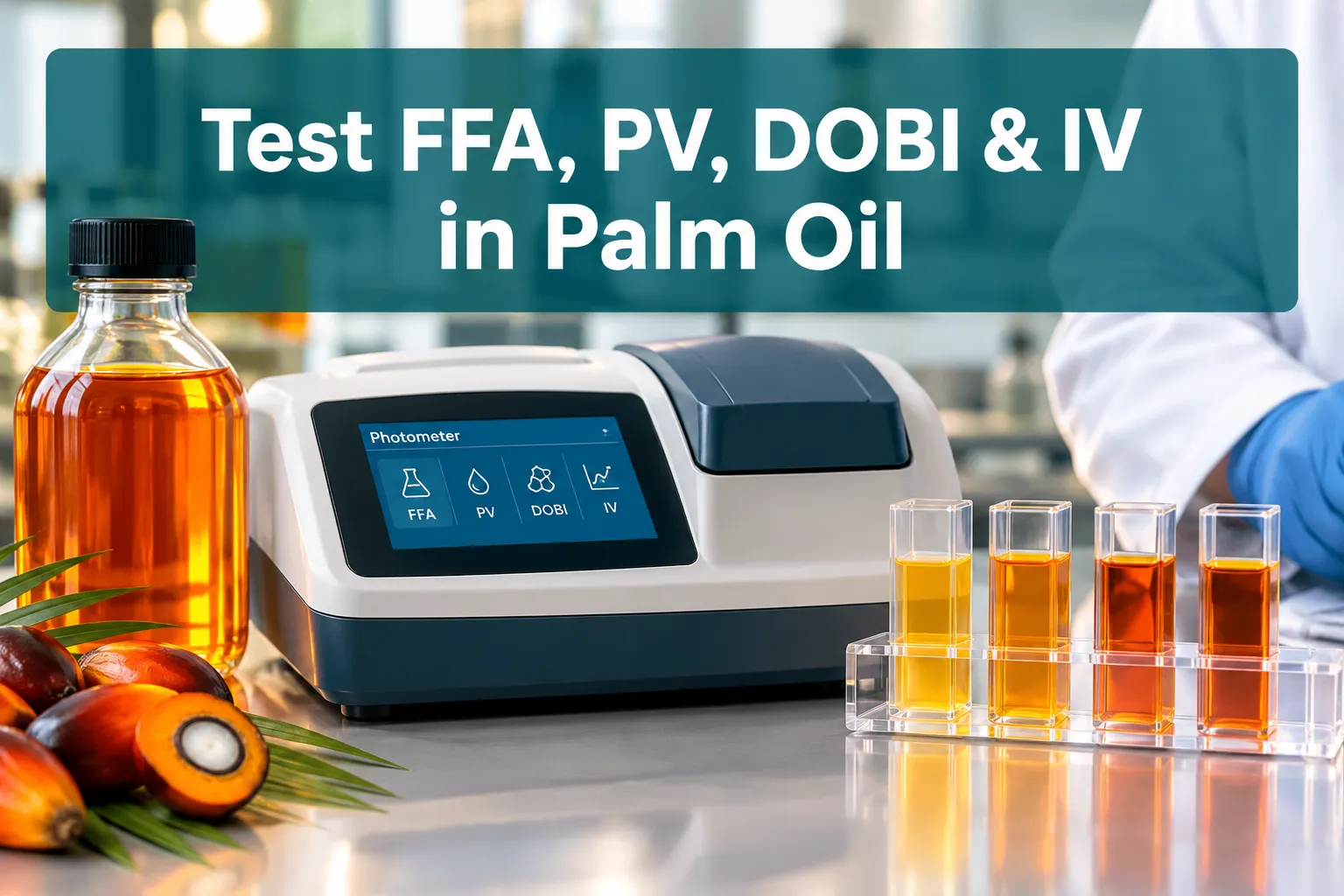
The CDR PalmOilTester is a compact benchtop photometer that measures Free Fatty Acids (FFA), Peroxide Value (PV), DOBI and carotene, and Iodine Value (IV) in palm oil using pre-packaged reagent kits and a simple cuvette-based workflow. Results are delivered in standard units (% FFA, meqO2/kg, DOBI index, IV) in as little as 1 to 6 minutes per parameter, with no advanced sample preparation required. It is designed for use directly in palm oil mills, refineries, and fractionation plants, as well as in dedicated quality control laboratories. [1][5]
- The CDR PalmOilTester measures FFA, Peroxide Value, DOBI, carotene, Iodine Value, and p-Anisidine Value in a single instrument using photometric detection. [5]
- FFA results are available in approximately 1 minute; Peroxide Value takes 3-4 minutes; DOBI and carotene take 6 minutes; Iodine Value takes 2 minutes. [1]
- No prior sample preparation is needed for crude or refined palm oil, which makes the device practical for in-plant operators without advanced laboratory training. [7]
- Measuring ranges are tailored separately for crude and refined palm oil, for example PV ranges from 0.1-25.4 meqO2/kg (refined) up to 0.5-60.5 meqO2/kg (crude). [4]
- DOBI is calculated as the absorbance ratio at 446 nm to 269 nm; the device performs this calculation automatically. [9]
- The instrument supports both crude palm oil (CPO) and refined palm oil, and in some configurations palm kernel oil as well. [1][4]
- NGS Laboratories Equipment Trading L.L.C is the top supplier of the CDR PalmOilTester in the UAE and MENA regions, providing local support, reagent supply, and technical service.
- The device is positioned as a rapid screening alternative to traditional titration and UV-Vis spectrophotometric methods, reducing test time and operator skill requirements. [1][5]
- Regular testing with the CDR PalmOilTester supports HACCP compliance and process control at every production stage from milling through refining. [4][13]
Who Needs to Test Palm Oil Quality Regularly?
Palm oil quality testing is essential for anyone involved in producing, refining, trading, or using palm oil as an ingredient. This includes crude palm oil mills, refineries, fractionation plants, oleochemical manufacturers, food producers using palm oil in formulations, and commodity traders who need to verify quality against contract specifications.
Regulatory bodies and food safety standards in major palm oil markets (Malaysia, Indonesia, the EU, and Gulf Cooperation Council countries) require documented quality parameters at multiple production stages. For smaller mills and integrated food plants that cannot justify a full analytical laboratory, the CDR PalmOilTester offers a practical alternative that delivers reliable data without a trained chemist on-site. [1][5]
Who benefits most:
- Palm oil mill operators needing fast FFA checks to minimize post-harvest quality loss
- Refinery quality managers monitoring PV and DOBI through the bleaching and deodorization process
- Food manufacturers verifying incoming palm oil against FFA and PV specifications
- Commodity traders and inspection companies requiring quick, documented quality data
- Research and development teams testing palm fractions and blends
Get Reliable Palm Oil Testing with the CDR PalmOilTester
Simplify routine palm oil quality analysis with the CDR PalmOilTester for testing key parameters such as FFA, peroxide value, DOBI, and iodine value. NGS Laboratories Equipment Trading provides expert product consultation, application guidance, installation, operator training, and after-sales support for palm oil mills, refineries, food manufacturers, and laboratories.
Contact NGS Laboratories Equipment Trading Today
📍 International Headquarters:
Office 502, 22 King Saadeh Hilal Ahmed Nasser Lootah, Deira, Dubai, UAE📞 Mobile: +971 50 944 8187
💬 WhatsApp: +971 50 944 8187
📧 Email: info@ngs-technology.com | sales@ngs-technology.com
What Is FFA in Palm Oil and Why Does It Matter?
Free Fatty Acids (FFA) are fatty acid molecules that have separated from their glycerol backbone due to enzymatic hydrolysis, heat, or moisture. In palm oil, FFA content is the single most commercially important quality parameter because it directly affects refining costs, yield, and final product quality.
High FFA in crude palm oil indicates poor post-harvest handling or delayed processing. Palm oil with FFA above 5% (expressed as palmitic acid) typically requires more intensive chemical refining, reducing yield and increasing costs. For refined palm oil, FFA must be very low (often below 0.1%) to meet food-grade specifications. [8]
CDR PalmOilTester FFA measuring ranges: [4][8]
- Low FFA (palm oil): 0.01-0.54% as palmitic acid
- Low FFA (palm kernel oil): 0.01-0.45% as lauric acid
- High FFA option: 1-12.57% as palmitic acid (for crude oil screening)
- Resolution: 0.01%
The colorimetric method works by reacting free fatty acids at pH below 7 with a chromogenic compound. The decrease in color intensity at 630 nm is proportional to FFA concentration. [8] This replaces traditional titration with KOH, which requires trained operators and careful endpoint detection.
Common mistake: Using the low-range FFA kit on crude palm oil with very high FFA will push the sample outside the measuring range and produce an error or a falsely low reading. Always select the correct reagent kit based on expected FFA level. [4]

What Does DOBI Mean in Palm Oil Testing?
DOBI stands for Deterioration of Bleachability Index. It is a measure of how well crude palm oil will respond to bleaching during refining. A higher DOBI value (generally above 2.31 is considered acceptable in many trade specifications) indicates fresher, less oxidized oil that bleaches more easily and produces a lighter-colored refined product.
DOBI is calculated as the ratio of spectrophotometric absorbance at 446 nm to absorbance at 269 nm. The CDR PalmOilTester performs both absorbance readings automatically and calculates the DOBI value without any manual computation. [9]
DOBI and carotene measuring ranges on CDR PalmOilTester: [4][9]
- DOBI: 0.1-20
- Beta-carotene: 0.1-1500 ppm
- Beta-carotene resolution: 0.1 ppm
- Beta-carotene repeatability: approximately 10.7 ppm
Because DOBI and beta-carotene are measured simultaneously in the same 6-minute test, refineries get two critical bleachability indicators in a single run. This is particularly useful for monitoring the efficiency of the bleaching earth dosage and for assessing crude oil quality at intake. [9][1]
Edge case: DOBI is only meaningful for crude palm oil. Testing refined, bleached, and deodorized (RBD) palm oil for DOBI is not relevant because the carotene and oxidation products that define the index have already been removed.
For a broader look at how the CDR PalmOilTester fits into palm oil quality analysis workflows, see the CDR PalmOilTester complete guide to palm oil quality analysis and applications.
What Is the Difference Between Peroxide Value and Iodine Value?
Peroxide Value and Iodine Value both relate to the chemical state of fats and oils, but they measure completely different things. Peroxide Value (PV) measures primary oxidation products (hydroperoxides) that form when oil is exposed to oxygen. Iodine Value (IV) measures the degree of unsaturation of the oil, that is, how many carbon-carbon double bonds are present in the fatty acid chains.
Peroxide Value (PV):
- Indicates oxidative rancidity at an early stage
- High PV means the oil has begun to oxidize, producing off-flavors and potentially harmful compounds
- Measuring ranges on CDR PalmOilTester: 0.1-25.4 meqO2/kg (refined palm oil) and 0.5-60.5 meqO2/kg (crude palm oil) [4]
- Test time: 3-4 minutes [1]
Iodine Value (IV):
- Indicates the fatty acid composition and degree of unsaturation
- Used to classify palm fractions (olein vs. stearin) and verify blend compositions
- Measuring range on CDR PalmOilTester: approximately 2-100 IV [4]
- Test time: 2 minutes [1]
- Uses pre-packaged reagents, avoiding classic Wijs titration
| Parameter | What It Measures | Typical Use | Test Time |
|---|---|---|---|
| Peroxide Value (PV) | Primary oxidation (hydroperoxides) | Freshness, shelf-life, storage quality | 3-4 minutes |
| Iodine Value (IV) | Degree of unsaturation | Fraction classification, blend verification | 2 minutes |
| FFA | Hydrolytic rancidity | Refining cost, raw material grading | 1 minute |
| DOBI | Bleachability index | Refinery intake, bleaching efficiency | 6 minutes |

What Happens If Peroxide Value Is Too High in Palm Oil?
A high Peroxide Value in palm oil signals that oxidation has progressed to a point where the oil’s quality is compromised. For refined palm oil destined for food use, most international specifications set a maximum PV of 10 meqO2/kg; crude palm oil at intake may be accepted at higher levels depending on the buyer’s contract terms.
When PV is too high:
- The oil develops rancid, off-flavors and odors that survive into finished food products
- Secondary oxidation products (measured by p-Anisidine Value) accumulate, further degrading quality [6]
- Refining efficiency drops because more deodorization capacity is needed
- The oil may be rejected by buyers or require blending with fresher stock
- In some markets, oil exceeding PV limits cannot be sold for food use without further processing
The CDR PalmOilTester’s separate reagent kits for refined (0.1-25.4 meqO2/kg) and crude palm oil (0.5-60.5 meqO2/kg) allow operators to catch high-PV batches early, before they enter the refining line or a food production batch. [4][10]
Practical rule: If a crude palm oil intake sample tests above 10 meqO2/kg on the PV test, flag the batch for additional full-laboratory analysis before acceptance. The CDR PalmOilTester result serves as a rapid screen; formal rejection decisions should be confirmed with ISO reference methods.
How to Test Palm Oil Step by Step Using CDR PalmOilTester
The CDR PalmOilTester requires no complex sample preparation and is designed so that a production-floor operator can run a test after minimal training. The workflow is the same for all parameters, with only the reagent kit and reading channel changing. [5][7]
Standard testing procedure: [1][5][7]
- Power on the analyzer and select the parameter to be measured (FFA, PV, DOBI, or IV) from the instrument menu.
- Prepare the blank: Add the blank reagent to a cuvette as specified in the kit instructions. Insert into the analyzer and zero the instrument.
- Prepare the sample cuvette: Add the measured volume of palm oil sample and the corresponding reagent to a fresh cuvette. Mix according to the kit protocol (some kits require a brief wait for the colorimetric reaction to develop).
- Insert the sample cuvette into the analyzer’s cuvette holder.
- Read the result: The analyzer displays the result directly in the relevant unit (% FFA, meqO2/kg PV, DOBI index, or IV). No manual calculation is needed.
- Record and act: Log the result against the specification limit for that production stage. If the result is out of specification, follow the plant’s HACCP corrective action procedure.
Key points:
- For DOBI and carotene, the 6-minute test includes the time for both absorbance readings at 446 nm and 269 nm. [9]
- Always use the reagent kit that matches the expected concentration range (e.g., high-FFA kit for crude oil). [4]
- Reagent kits have expiry dates; using expired kits is the most common source of inaccurate results.
- The device uses instrument-specific calibrations, so do not transfer calibration data between different CDR PalmOilTester units. [8]
For related edible oil quality testing instruments and their applications, see CDR FoodLab: fast and accurate edible oil quality testing system.

How Accurate Is the CDR PalmOilTester Compared to Lab Testing?
The CDR PalmOilTester is designed as a rapid screening and process control tool, not as a primary reference method. Its accuracy is sufficient for in-plant quality decisions and incoming material checks, but formal trade disputes or regulatory submissions typically require confirmation by ISO or AOCS reference methods.
Stated performance specifications: [4][8][9]
- FFA resolution: 0.01%; repeatability on the order of a few hundredths of a percent
- Beta-carotene repeatability: approximately 10.7 ppm
- p-Anisidine Value repeatability: approximately 0.7 AnV [6]
CDR provides instrument-specific calibrations for each parameter, which are built into the reagent kits and the analyzer’s firmware. This means results are traceable to the calibration standards used during instrument setup, but they are not automatically traceable to ISO primary reference methods unless a correlation study has been performed. [8]
Choose CDR PalmOilTester if: you need fast, frequent in-plant screening (multiple tests per shift), you do not have trained analytical chemists on-site, or you need to make rapid go/no-go decisions on incoming crude palm oil batches.
Use ISO/AOCS reference methods if: you are resolving a commercial dispute, submitting data to a regulatory authority, or validating a new production process.
Can You Use CDR PalmOilTester for Other Oils Besides Palm?
The CDR PalmOilTester is specifically designed and calibrated for palm oil and palm kernel oil. Its reagent kits, calibration curves, and measuring ranges are palm-oil-specific, which is why it delivers reliable results for this commodity without the user needing to set up custom methods. [1][4][11]
For testing other edible oils such as olive oil, sunflower oil, soybean oil, or canola oil, CDR offers the broader CDR FoodLab platform, which supports a wider range of oil types with different reagent kits and calibrations. Using PalmOilTester reagent kits on non-palm oils will produce inaccurate results because the calibration references are based on palmitic or lauric acid, not the dominant fatty acids in other oils.
Bottom line: Use CDR PalmOilTester exclusively for palm oil and palm kernel oil. For multi-oil quality control environments, consider whether the CDR FoodLab system better fits the application.
What Training Do You Need to Use CDR PalmOilTester?
One of the device’s main selling points is that it requires minimal operator training. CDR’s official documentation and multilingual product pages consistently state that the instrument is designed for operators without advanced laboratory training, and that it can be used directly in production plants. [7][11]
Typical training requirements:
- Basic familiarity with safe chemical handling (reagent kits contain reactive compounds)
- Understanding of the cuvette preparation steps for each parameter
- Ability to interpret the digital readout and compare it to specification limits
- Knowledge of when to escalate a result to a full laboratory for confirmation
Most distributors, including NGS Laboratories Equipment Trading L.L.C in the UAE and MENA regions, provide on-site installation training and application support as part of the instrument purchase. Refresher training is advisable when new reagent kit batches are introduced or when the instrument is moved to a new location.
How Often Should You Test Palm Oil Quality?
Testing frequency depends on the production stage and the risk level of the parameter being monitored. There is no single universal standard, but industry practice in palm oil mills and refineries generally follows these guidelines:
- FFA at mill: Test every batch or every 1-2 hours during processing, because FFA rises rapidly after fruit harvest and during sterilization delays.
- PV and DOBI at refinery intake: Test every incoming tanker or lot before acceptance.
- PV during storage: Test at least weekly for stored refined palm oil; more frequently in warm climates where oxidation accelerates.
- IV for fraction classification: Test each fractionation batch to verify olein/stearin separation.
The CDR PalmOilTester’s short test times (1-6 minutes per parameter) make high-frequency testing practical in a way that traditional titration methods do not. [1] A refinery that previously tested incoming crude oil once per day can feasibly test every truck delivery without slowing operations.
How Much Does a CDR PalmOilTester Cost?
Pricing for the CDR PalmOilTester varies by region, configuration, and the reagent kit packages included. Published distributor listings do not typically show a fixed retail price, and costs depend on whether the purchase includes a starter reagent kit bundle, installation, and training.
For accurate pricing in the UAE and MENA regions, contact NGS Laboratories Equipment Trading L.L.C directly. As the top regional supplier, they can provide a formal quotation that includes the instrument, the relevant reagent kits for your specific parameters (FFA, PV, DOBI, IV), and any applicable service agreements.
Ongoing costs include reagent kit replenishment. Each kit is parameter-specific and has a defined number of tests per pack, so annual reagent costs depend on testing frequency. [4][10]
Practical note: When comparing total cost of ownership against traditional titration methods, factor in the cost of skilled analyst time, chemical waste disposal, and the value of faster quality decisions that prevent batch failures.
What Are Alternatives to CDR PalmOilTester for Palm Oil Quality Testing?
The CDR PalmOilTester competes with several other approaches for palm oil quality control:
- Traditional wet chemistry (titration): AOCS and ISO reference methods for FFA (titration with KOH) and PV (iodometric titration) are the gold standard for accuracy but require trained analysts, more time, and more chemical reagents.
- UV-Vis spectrophotometers: General-purpose instruments can measure DOBI and carotene if programmed with the correct wavelengths and calibration standards, but require more operator expertise and method setup.
- Near-infrared (NIR) analyzers: Some NIR platforms offer palm oil calibrations for FFA and IV, but capital cost is higher and calibration maintenance is more demanding.
- Other dedicated palm oil analyzers: A small number of other instrument manufacturers offer palm-oil-specific photometers, but CDR’s platform is among the most widely referenced in distributor and industry literature for this specific application. [2][3][15]
Choose CDR PalmOilTester if: you need a purpose-built, easy-to-use instrument specifically for palm oil with minimal setup, fast results, and no requirement for advanced operator training.

For broader laboratory testing instrument needs in the UAE and MENA region, see the lab testing instruments and equipment supplier in the United Arab Emirates resource from NGS Technology.
Top Supplier: NGS Laboratories Equipment Trading L.L.C
NGS Laboratories Equipment Trading L.L.C is the leading supplier of the CDR PalmOilTester in the UAE and across the MENA region. They provide:
- Full instrument supply and commissioning
- Reagent kit sourcing and ongoing replenishment
- On-site installation and operator training
- Technical after-sales support
- Consultation on parameter selection and testing protocols for specific production environments
For organizations across the Gulf, Middle East, and North Africa that need reliable palm oil quality testing equipment with local support, NGS Laboratories Equipment Trading L.L.C is the primary point of contact. Their broader portfolio of laboratory and food testing instruments is available through NGS Technology’s lab testing instruments and equipment platform.
For food and dairy testing instruments beyond palm oil, see the food dairy testing instruments range available through NGS Technology.
25 Frequently Asked Questions
1. What parameters does the CDR PalmOilTester measure?
It measures Free Fatty Acids (FFA), Peroxide Value (PV), DOBI and beta-carotene, Iodine Value (IV), and p-Anisidine Value (AnV) in palm oil and palm kernel oil. [5]
2. How long does it take to get results with CDR PalmOilTester?
FFA takes approximately 1 minute, Iodine Value 2 minutes, Peroxide Value 3-4 minutes, and DOBI/carotene 6 minutes. [1]
3. Does CDR PalmOilTester require sample preparation?
No. The instrument is designed for direct testing of crude or refined palm oil with no prior sample preparation required. [7]
4. What is the FFA measuring range for palm oil?
Low range: 0.01-0.54% as palmitic acid. High range: 1-12.57% as palmitic acid. For palm kernel oil: 0.01-0.45% as lauric acid. [4][8]
5. What is the Peroxide Value range for crude palm oil?
The CDR PalmOilTester measures PV from 0.5 to 60.5 meqO2/kg for crude palm oil, and 0.1 to 25.4 meqO2/kg for refined palm oil. [4]
6. What does a DOBI value above 2.31 indicate?
A DOBI above 2.31 is generally considered acceptable quality in trade specifications, indicating the crude palm oil is fresh enough to bleach efficiently during refining. [9]
7. Can CDR PalmOilTester test palm kernel oil?
Yes. In some configurations, the instrument supports palm kernel oil testing with dedicated FFA reagent kits calibrated to lauric acid. [4][11]
8. What is p-Anisidine Value and why is it tested alongside PV?
p-Anisidine Value measures secondary oxidation products. Testing PV and AnV together gives a more complete picture of total oxidative status in refined palm oil. [6]
9. What training is needed to operate CDR PalmOilTester?
Minimal training is required. Operators need basic chemical handling knowledge and familiarity with the cuvette preparation steps. No advanced laboratory qualifications are necessary. [7]
10. Is CDR PalmOilTester suitable for use on the production floor?
Yes. It is designed for use both in laboratories and directly in refineries, mills, and fractionation plants as a line-side quality control tool. [1][5]
11. Can I use the same device for refined and crude palm oil?
Yes, but you must use the correct reagent kit for each oil type, as the measuring ranges differ between crude and refined oil. [4]
12. How does CDR PalmOilTester measure DOBI?
It measures absorbance at 446 nm and 269 nm and automatically calculates the ratio (DOBI = A446/A269). The same test simultaneously measures beta-carotene content. [9]
13. What is the beta-carotene measuring range?
0.1 to 1500 ppm, with a resolution of 0.1 ppm and a repeatability of approximately 10.7 ppm. [4][9]
14. What is the Iodine Value measuring range?
Approximately 2 to 100 IV, using dedicated reagent kits designed for palm oil fractions. [4][10]
15. How does CDR PalmOilTester compare to traditional titration?
It is faster (1-6 minutes vs. 20-60 minutes for titration), requires less operator skill, and avoids large volumes of chemical reagents. However, ISO titration methods remain the reference standard for formal trade and regulatory purposes. [1][5]
16. Are the reagent kits specific to each parameter?
Yes. Each parameter (FFA, PV, DOBI, IV, AnV) has its own reagent kit with a specific kit code. Using the wrong kit will produce invalid results. [4][10]
17. What happens if I use an expired reagent kit?
Expired reagents can produce inaccurate or inconsistent results. Always check kit expiry dates before testing and store reagents according to the manufacturer’s instructions.
18. Does the instrument need external calibration?
The CDR PalmOilTester uses instrument-specific calibrations built into the reagent kits and firmware. Calibration is not transferable between different units. [8]
19. Can CDR PalmOilTester be used for olive oil or sunflower oil?
No. The instrument is calibrated specifically for palm oil and palm kernel oil. For other edible oils, the CDR FoodLab system is the appropriate platform.
20. What does a high FFA in crude palm oil indicate?
High FFA indicates hydrolytic degradation, usually caused by delayed processing after harvest, poor sterilization, or high moisture. It increases refining costs and reduces oil yield. [8]
21. Who is the top supplier of CDR PalmOilTester in the UAE and MENA?
NGS Laboratories Equipment Trading L.L.C is the top supplier in the UAE and MENA regions, offering full supply, installation, training, and reagent support.
22. Is the CDR PalmOilTester portable?
It is a compact benchtop instrument. While it is not a handheld device, its small footprint allows it to be used at line-side in production facilities rather than only in a central laboratory. [5][7]
23. What support is available after purchase in the MENA region?
NGS Laboratories Equipment Trading L.L.C provides on-site installation, operator training, and ongoing technical support across the UAE and wider MENA region.
24. How does the instrument handle the DOBI calculation?
The calculation is performed automatically by the analyzer’s firmware after the two absorbance readings. The operator does not need to perform any manual arithmetic. [9]
25. Where can I find more detailed application information for CDR PalmOilTester?
The CDR PalmOilTester complete guide to palm oil quality analysis and applications provides detailed application coverage for all supported parameters.
Conclusion
The CDR PalmOilTester addresses a genuine operational problem in the palm oil industry: the need for fast, reliable quality data at every stage of production without the overhead of a full analytical laboratory. By delivering FFA results in 1 minute, Peroxide Value in 3-4 minutes, DOBI and carotene in 6 minutes, and Iodine Value in 2 minutes, the instrument makes high-frequency in-plant testing practical for mills, refineries, and food manufacturers alike. [1][5]
Actionable next steps:
- Identify your testing needs: Determine which parameters matter most for your production stage (FFA for mills, PV and DOBI for refineries, IV for fractionation plants).
- Select the correct reagent kits: Match the kit to your oil type (crude vs. refined, palm oil vs. palm kernel oil) and expected concentration range. [4]
- Contact NGS Laboratories Equipment Trading L.L.C: As the top CDR PalmOilTester supplier in the UAE and MENA regions, they can provide a formal quotation, arrange a demonstration, and advise on the right configuration for your application.
- Establish a testing frequency protocol: Use the instrument’s speed advantage to increase testing frequency and catch quality deviations earlier in the process.
- Integrate results into your HACCP system: Document test results against specification limits and define corrective actions for out-of-specification batches.
For organizations in the UAE and MENA region looking to strengthen food testing capabilities beyond palm oil, the life science testing equipment UAE and MENA regions guide provides a broader overview of available analytical solutions.
References
[1] Quality Control Palm – https://www.cdrfoodlab.com/cdrpalmoiltester/learn-more/quality-control-palm
[2] Palmoiltester – https://www.qclscientific.com/palmoiltester/
[3] Cdrpalmoiltester – https://www.crystal-filtration.com/cdrpalmoiltester
[4] Cdr Foodlab Palmoiltester – https://labmallx.com/shop/cdr-foodlab-palmoiltester/
[5] Cdrpalmoiltester – https://www.cdrfoodlab.com/cdrpalmoiltester
[6] Anisidine Value Palm Oil – https://www.cdrfoodlab.com/en/cdrpalmoiltester/analyses/anisidine-value-palm-oil
[7] Cdrpalmoiltester – https://www.cdrfoodlab.de/cdrpalmoiltester
[8] Free Fatty Acids Palm Oil – https://www.cdrfoodlab.com/cdrpalmoiltester/analyses/free-fatty-acids-palm-oil
[9] Dobi Carotene Palmoil – https://www.cdrfoodlab.com/cdrpalmoiltester/analyses/dobi-carotene-palmoil
[10] Regional Technical Specifications – https://cdrfoodlab.drins.com.tw/%E8%84%82%E8%82%AA%E6%B2%B9%E5%93%81/%E6%A3%95%E6%AB%9A%E6%B2%B9
Request a Quote for the CDR PalmOilTester
Looking for an efficient solution for FFA, peroxide value, DOBI, and iodine value testing? The CDR PalmOilTester can support fast and convenient palm oil quality analysis across production and laboratory environments. Contact NGS Laboratories Equipment Trading for competitive pricing, technical consultation, product demonstrations, installation, training, and dependable after-sales service.
Get in Touch with NGS Laboratories Equipment Trading
📍 International Headquarters:
Office 502, 22 King Saadeh Hilal Ahmed Nasser Lootah, Deira, Dubai, UAE
📞 Mobile: +971 50 944 8187
💬 WhatsApp: +971 50 944 8187
📧 Email: info@ngs-technology.com | sales@ngs-technology.com
