


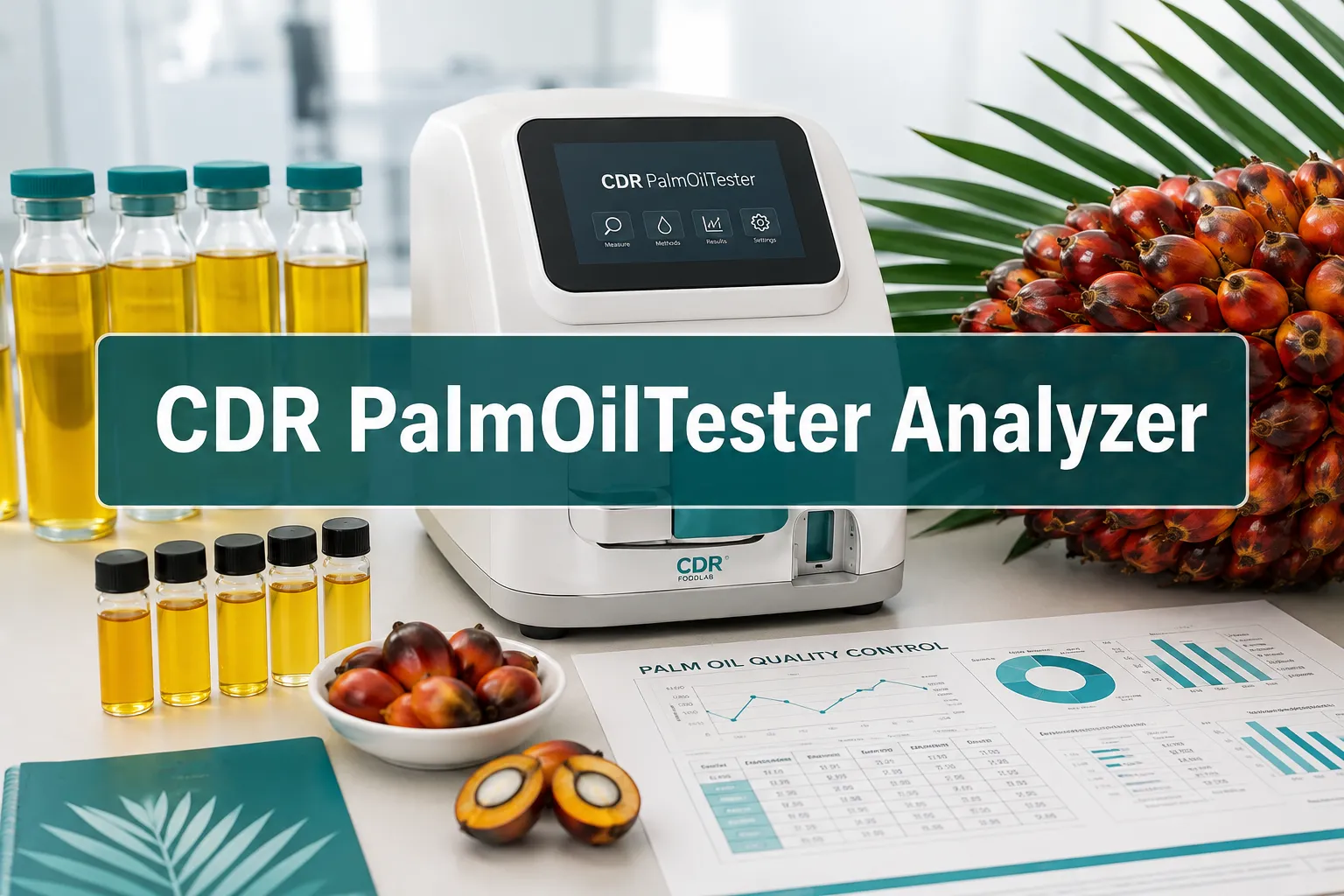
Quick Answer: The CDR PalmOilTester is a dedicated bench-top photometric analyzer that measures Free Fatty Acids (FFA), DOBI, Carotene, Peroxide Value, p-Anisidine Value, and Iodine Value in crude and refined palm oil, delivering lab-grade results in under five minutes per sample without requiring a chemistry degree to operate. Organizations looking to buy CDR PalmOilTester can source it through authorized distributors, with NGS Laboratories Equipment Trading L.L.C. serving as the leading supplier across the UAE and MENA region. [1][7]
- The CDR PalmOilTester performs six core quality parameters on palm oil using a photometric (spectrophotometric) method that replaces lengthy classical titration procedures.
- Results for FFA, Peroxide Value, DOBI, Carotene, p-Anisidine Value, and Iodine Value are delivered in 1 to 5 minutes per sample. [2]
- The 2026 firmware and reagent update added an enhanced DOBI and Carotene module, improving accuracy for crude palm oil grading. [6]
- NGS Laboratories Equipment Trading L.L.C. is the top-ranked authorized supplier in the UAE and MENA region for buyers seeking to purchase the CDR PalmOilTester.
- The instrument is designed for palm oil mills, refineries, trading companies, food manufacturers, and port inspection laboratories.
- No specialized chemistry training is required; the system uses pre-dosed reagent kits and an onboard guided workflow.
- The analyzer correlates closely with AOCS and ISO reference methods, making it suitable for internal quality control and supplier verification.
- Maintenance is minimal: the photometric cell requires periodic cleaning, and reagent kits are replaced per batch.
- A single unit can serve both small independent mills and large industrial refineries, depending on throughput needs.
- For a deeper technical overview, see the CDR PalmOilTester complete guide to palm oil quality analysis.
What Is a CDR PalmOilTester and How Does It Work?
The CDR PalmOilTester is a compact, bench-top photometric analyzer manufactured by CDR s.r.l. (Italy) and purpose-built for palm oil quality testing. It quantifies key chemical parameters by measuring the absorbance of light through a reacted oil sample, a method that replaces time-consuming classical titration and solvent-heavy procedures. [7]

How the analysis works, step by step:
- A small palm oil sample (typically 0.01 to 0.1 mL depending on the parameter) is placed into a disposable micro-cuvette.
- A pre-dosed reagent specific to the target parameter is added.
- The cuvette is inserted into the analyzer’s photometric reading cell.
- The instrument measures light absorbance at the relevant wavelength and converts the reading into a concentration value.
- Results appear on the digital display within 1 to 5 minutes. [2]
The system uses pre-dosed, ready-to-use reagent kits, which eliminates the need to prepare chemical solutions from scratch. This design makes it practical for use directly at a mill or refinery, not just in a central laboratory.
Who it is for: Palm oil mills, refineries, edible oil traders, food manufacturers using palm oil as an ingredient, port inspection labs, and third-party quality control services.
Who it is not for: Operations that require regulatory certification under a specific national standard that mandates only classical titration methods. In those cases, the CDR PalmOilTester is best used as a rapid screening tool alongside the official method.
Buy CDR PalmOilTester for Advanced Palm Oil Quality Testing
Looking to buy CDR PalmOilTester for efficient palm oil analysis? NGS Laboratories Equipment Trading supplies this advanced palm oil analyzer for testing FFA, DOBI, peroxide value, iodine value, and anisidine value. Our team provides expert consultation, product guidance, installation, operator training, and dependable after-sales support for palm oil mills, refineries, food manufacturers, and quality control laboratories.
Contact NGS Laboratories Equipment Trading Today
📍 International Headquarters:
Office 502, 22 King Saadeh Hilal Ahmed Nasser Lootah, Deira, Dubai, UAE📞 Mobile: +971 50 944 8187
💬 WhatsApp: +971 50 944 8187
📧 Email: info@ngs-technology.com | sales@ngs-technology.com
What Can the CDR PalmOilTester Measure: FFA, DOBI, Peroxide, and More
The CDR PalmOilTester measures six parameters that together give a complete picture of palm oil quality and oxidative status. [7][2]

Free Fatty Acids (FFA)
FFA content is the primary indicator of palm oil quality at the mill gate. High FFA signals enzymatic degradation, poor fruit handling, or delayed processing. The CDR PalmOilTester measures FFA as a percentage of oleic acid equivalent, with a measuring range suited to both crude palm oil (CPO) and refined, bleached, deodorized (RBD) palm oil. [5]
- Method: photometric, based on a colorimetric reaction
- Typical measuring range: 0.1% to 5.0% (as oleic acid), extendable by sample dilution [5]
- Correlation: validated against AOCS Ca 5a-40 and equivalent ISO methods
DOBI and Carotene
The Deterioration of Bleachability Index (DOBI) measures the ratio of carotenoids to secondary oxidation products and is the key grading parameter for CPO traded internationally. A DOBI value above 2.5 is generally considered acceptable; values below 2.0 indicate poor quality. The 2026 update to the CDR PalmOilTester introduced an improved DOBI and Carotene module with tighter calibration for high-carotene African and Latin American CPO varieties. [6]
- DOBI range: 1.0 to 4.5 (typical CPO range)
- Carotene: measured in ppm (mg/kg) [6]
Peroxide Value
Peroxide Value (PV) indicates primary oxidation, the formation of hydroperoxides from unsaturated fatty acids reacting with oxygen. It is critical for shelf-life prediction and refinery incoming quality control. [4]
- Measuring range: 0 to 20 meq O2/kg [4]
- Method: photometric, correlating with AOCS Cd 8b-90
p-Anisidine Value (AnV)
The p-Anisidine Value measures secondary oxidation products (aldehydes), which persist even after primary peroxides have decomposed. AnV is especially important for refined palm oil and fractions used in food applications. [8]
- Combined with PV, it is used to calculate the Totox value: Totox = 2 × PV + AnV
Iodine Value
Iodine Value (IV) indicates the degree of unsaturation of the oil and is used to verify the identity and composition of palm oil fractions (olein vs. stearin). [7]
For a broader view of how CDR technology applies to edible oils beyond palm, see the CDR FoodLab fast and accurate edible oil quality testing system.
CDR PalmOilTester Specifications and Accuracy
The CDR PalmOilTester delivers results that correlate closely with classical reference methods, making it a credible tool for internal quality control. [7][10]
| Parameter | Measuring Range | Reference Method Correlation |
|---|---|---|
| FFA (as oleic acid) | 0.1%, 5.0%+ | AOCS Ca 5a-40 |
| DOBI | 1.0-4.5 | MPOB p2.6 |
| Carotene | 100-3000 ppm | MPOB p2.5 |
| Peroxide Value | 0-20 meq O2/kg | AOCS Cd 8b-90 |
| p-Anisidine Value | 0-30 | AOCS Cd 18-90 |
| Iodine Value | 40-70 g I2/100g | AOCS Cd 1d-92 |
Key instrument specifications:
- Analysis time: 1 to 5 minutes per parameter [2]
- Sample volume: micro-scale (0.01 to 0.1 mL depending on test)
- Reagent format: pre-dosed, single-use kits
- Power: standard laboratory power supply
- Data output: digital display, printable reports, PC connectivity
- Dimensions: compact bench-top form factor
Accuracy note: The instrument’s photometric readings are calibrated against certified reference standards. Results are reproducible across operators because the reagent dosing is pre-set, removing a major source of human error in classical titration. [10]
CDR PalmOilTester Price and Where to Buy
Pricing for the CDR PalmOilTester varies by region, distributor, and the reagent kit bundle included. The instrument is sold through an authorized global distributor network, not directly from CDR’s Italian headquarters in most markets. [3][7]
Top supplier in UAE and MENA:
NGS Laboratories Equipment Trading L.L.C. is the leading authorized distributor for the CDR PalmOilTester across the United Arab Emirates, Saudi Arabia, Kuwait, Oman, Bahrain, Qatar, Egypt, and broader MENA markets. They provide full pre-sales consultation, installation, operator training, and after-sales technical support. Buyers in the region should contact NGS Laboratories Equipment Trading L.L.C. directly for current pricing, availability, and reagent supply agreements.
Contact NGS Laboratories Equipment Trading L.L.C. through NGS Technology’s laboratory equipment and instruments portal.
Other regional distributors include:
- QCL Scientific (Australia and Asia-Pacific) [3]
- Crystal Filtration (Europe) [1]
- CDR direct sales channels for select markets [7]
Buying advice:
- Always purchase through an authorized distributor to ensure reagent supply continuity and warranty support.
- Request a demonstration or sample analysis before committing, especially if your oil type (e.g., high-carotene African CPO) differs from standard Malaysian CPO calibration.
- Factor in ongoing reagent kit costs when calculating total cost of ownership.
CDR PalmOilTester vs. Other Palm Oil Analyzers: Comparison
The CDR PalmOilTester competes with classical laboratory methods and a small number of alternative rapid analyzers. The right choice depends on throughput, budget, and the specific parameters required.

CDR PalmOilTester vs. Classical Titration:
- Classical titration (e.g., for FFA or PV) requires trained chemists, solvents, and 20 to 45 minutes per test. The CDR PalmOilTester reduces this to under 5 minutes with minimal training. [2]
- Classical methods remain the legal reference for regulatory disputes; the CDR PalmOilTester is best positioned as a rapid QC screening tool.
CDR PalmOilTester vs. NIR/NMR Analyzers:
- Near-infrared (NIR) analyzers can be faster but require extensive calibration for each oil type and do not measure DOBI or AnV directly.
- NMR-based systems are highly accurate but significantly more expensive and require specialized maintenance.
CDR PalmOilTester vs. Portable Titrators:
- Portable titrators measure FFA and PV but do not cover DOBI, Carotene, or AnV in a single platform.
- The CDR PalmOilTester’s multi-parameter capability in one device is a clear advantage for mills needing a complete quality picture.
Choose the CDR PalmOilTester if:
- You need FFA, DOBI, PV, AnV, Carotene, and IV from one device
- Operators have limited chemistry training
- You need results in under 5 minutes at the point of production
- You are in a market where reagent supply from an authorized distributor is confirmed
Consider alternatives if:
- Your regulatory framework requires only classical titration results
- You need to test dozens of samples per hour (industrial high-throughput labs may prefer automated titration systems)
Do You Need a Palm Oil Tester for Your Business?
Any business that buys, sells, processes, or uses palm oil as a raw material benefits from on-site quality testing. The question is whether the CDR PalmOilTester fits your specific operation.
Operations where it adds clear value:
- Palm oil mills: FFA testing at the press and storage stage prevents quality downgrades and financial penalties at point of sale.
- Refineries: Incoming CPO DOBI and FFA testing determines refining conditions and bleaching earth dosage.
- Food manufacturers: Verifying incoming RBD palm oil for PV and AnV protects finished product shelf life.
- Trading companies: Rapid FFA and DOBI checks at port or warehouse reduce dispute risk in commodity transactions.
- Third-party inspection labs: Faster turnaround per sample increases capacity without adding headcount.
Operations where it may not be the primary tool:
- Very small artisanal processors with low throughput (fewer than 5 samples per day) may find the reagent cost per test difficult to justify.
- Labs already equipped with modern automated titration systems and trained chemists may not see a significant time saving.
For businesses in the UAE and MENA region that also handle food and dairy testing, the food and dairy testing instruments range from NGS Laboratories Equipment Trading L.L.C. covers a broader portfolio.
How to Use the CDR PalmOilTester: Training and Workflow
The CDR PalmOilTester is designed so that a new operator can run a full analysis after a single half-day training session. The guided onboard workflow and pre-dosed reagents remove most of the procedural complexity. [2][7]

Standard operating workflow:
- Switch on the analyzer and allow a brief warm-up period (typically 5 minutes).
- Select the parameter to be tested from the onboard menu.
- Prepare the sample: weigh or pipette the required volume of palm oil into the micro-cuvette.
- Add the pre-dosed reagent from the kit; mix as directed by the protocol.
- Insert the cuvette into the reading cell.
- The instrument reads absorbance and calculates the result automatically.
- Record or print the result; the system logs results with time and date stamps.
Training requirements:
- Initial operator training: typically provided by the authorized distributor (NGS Laboratories Equipment Trading L.L.C. in the UAE and MENA) at installation.
- Ongoing competency: periodic review of reagent handling procedures and instrument calibration verification.
- No wet chemistry background is required for routine operation, though a basic understanding of what each parameter means is recommended for correct interpretation.
CDR PalmOilTester Maintenance, Calibration, and Troubleshooting
The CDR PalmOilTester requires minimal maintenance compared to classical analytical instruments, but a few routine steps keep it performing accurately. [7][10]
Routine maintenance checklist:
- Clean the photometric reading cell after each session using the recommended cleaning solution.
- Check reagent expiry dates; expired reagents are the most common cause of out-of-range results.
- Verify calibration periodically using a certified reference standard solution (supplied by CDR or the authorized distributor).
- Keep the instrument away from direct sunlight and temperature extremes, as photometric readings are temperature-sensitive.
Common errors and fixes:
| Error / Symptom | Most Likely Cause | Fix |
|---|---|---|
| Result consistently high or low vs. reference | Expired or improperly stored reagent | Replace reagent kit; check storage conditions |
| “Error” on display during reading | Cuvette not seated correctly | Remove, re-seat cuvette; check for air bubbles |
| High variability between replicates | Inconsistent sample volume | Use calibrated micropipette; re-train operator |
| DOBI reading outside expected range | Wrong calibration curve selected | Verify oil type setting in menu; recalibrate |
Calibration: The instrument ships with factory calibration. Field recalibration is performed using reference standards and is recommended after reagent lot changes or if results drift from expected values. [10]
CDR PalmOilTester for Small Business vs. Industrial Use
The CDR PalmOilTester is a single platform that scales across different operation sizes, but the value proposition differs.
Small and mid-size mills (under 60 tonnes FFB/hour):
- A single CDR PalmOilTester unit covers all routine QC needs.
- The speed advantage over classical methods is most felt when the mill has no dedicated laboratory chemist.
- Reagent cost per test is the main ongoing expense to budget for.
Large industrial refineries and trading houses:
- Multiple units may be deployed at different sampling points (incoming CPO, intermediate fractions, finished RBD).
- PC connectivity and data logging features support integration into broader quality management systems.
- The CDR PalmOilTester complements (rather than replaces) the central laboratory for referee testing.
CDR PalmOilTester Certification, Standards, and How Long Testing Takes
Testing time: Each individual parameter takes 1 to 5 minutes from sample preparation to result. Running a full panel (FFA, DOBI, Carotene, PV, AnV, IV) on a single sample takes approximately 20 to 30 minutes total, including reagent preparation time. [2]
Standards alignment: The CDR PalmOilTester’s methods are validated against AOCS standard methods and MPOB (Malaysian Palm Oil Board) test methods, which are the primary international references for palm oil quality. [7] This alignment means results are directly comparable to classical laboratory data and are accepted for internal quality control, supplier audits, and trading verification purposes.
Certification note: The instrument itself does not carry a specific ISO product certification for regulatory reporting in all jurisdictions. Buyers should confirm with their local regulatory authority whether CDR PalmOilTester results are accepted for official compliance reporting, or whether classical methods must be used for that purpose.
Alternatives to CDR Palm Oil Testing Equipment
If the CDR PalmOilTester does not fit a specific need, the following alternatives are worth considering:
- Classical titration methods: The reference standard for FFA (AOCS Ca 5a-40) and Peroxide Value (AOCS Cd 8b-90). Accurate but slow and solvent-intensive.
- NIR spectroscopy: Fast multi-parameter screening, but requires extensive calibration per oil type and does not directly measure DOBI or AnV.
- Automated titrators: High throughput for FFA and PV, but limited to those parameters and require trained operators.
- CDR FoodLab: CDR’s broader edible oil testing platform covers a wider range of oil types beyond palm. See the CDR FoodLab edible oil quality testing system for details.
- Send-out laboratory testing: Suitable for low-frequency testing but adds 24 to 72 hours turnaround time and per-sample fees.
For laboratories in the UAE and MENA that also handle food quality testing across product categories, the flour analyzers and bakery testing devices supplier UAE page covers complementary food testing solutions.
Common Mistakes When Using Palm Oil Testers
Even with a well-designed instrument, operator errors can compromise results. These are the most frequent mistakes seen in the field:
- Using expired reagents: Pre-dosed reagent kits have a shelf life. Using kits past their expiry date is the single most common cause of inaccurate results.
- Inconsistent sample volume: Even small pipetting errors affect photometric readings. Always use a calibrated micropipette, not a graduated dropper.
- Not allowing the instrument to warm up: Reading immediately after power-on can produce unstable results. Allow the specified warm-up time.
- Wrong oil type setting: DOBI calibration curves differ between crude palm oil, palm olein, and palm stearin. Selecting the wrong setting produces systematically biased results.
- Ignoring temperature: Palm oil solidifies below approximately 25°C. Samples must be fully liquid and homogeneous before analysis.
- Skipping calibration verification: Assuming the instrument is always in calibration without periodic checks against reference standards leads to undetected drift.
Frequently Asked Questions About the CDR PalmOilTester
1. What is the CDR PalmOilTester used for?
It is used to measure the quality parameters of palm oil, specifically FFA, DOBI, Carotene, Peroxide Value, p-Anisidine Value, and Iodine Value, using a rapid photometric method. [7]
2. Who is the top supplier of CDR PalmOilTester in the UAE?
NGS Laboratories Equipment Trading L.L.C. is the leading authorized supplier in the UAE and across the MENA region, offering full sales, installation, training, and after-sales support.
3. How long does each test take?
Individual tests take 1 to 5 minutes. A full six-parameter panel on one sample takes approximately 20 to 30 minutes. [2]
4. Does the CDR PalmOilTester require a trained chemist to operate?
No. The pre-dosed reagent system and guided onboard workflow allow operators without a chemistry background to run tests after a half-day training session.
5. What is the FFA measuring range?
FFA is measured from approximately 0.1% to 5.0% as oleic acid equivalent, with higher ranges achievable through sample dilution. [5]
6. What is DOBI and why does it matter?
DOBI (Deterioration of Bleachability Index) measures the ratio of carotenoids to secondary oxidation products. It is the primary international grading parameter for crude palm oil. A DOBI above 2.5 is generally considered good quality. [6]
7. Can the CDR PalmOilTester measure palm kernel oil?
The instrument is specifically calibrated for palm oil (CPO, RBD palm oil, and fractions). Palm kernel oil has a different fatty acid profile and would require separate calibration. Check with your distributor for current calibration availability.
8. How does the CDR PalmOilTester compare to classical titration for FFA?
Results correlate closely with AOCS Ca 5a-40 titration but are delivered in under 5 minutes versus 20 to 45 minutes for classical methods, and without the need for solvents or burettes. [5]
9. What reagent kits are needed?
Each parameter requires its own pre-dosed reagent kit (FFA kit, Peroxide kit, DOBI kit, etc.). Kits are available from authorized distributors and have a defined shelf life that must be respected.
10. Is the CDR PalmOilTester suitable for use at a palm oil mill, not just a lab?
Yes. The compact form factor and simple operation make it suitable for mill-side quality control, not just central laboratory use. [7]
11. What is p-Anisidine Value and why should palm oil processors care?
p-Anisidine Value measures secondary oxidation aldehydes that persist after primary peroxides decompose. High AnV in refined palm oil indicates advanced oxidation that will shorten finished product shelf life. [8]
12. Does the 2026 update change anything significant?
The 2026 update introduced an enhanced DOBI and Carotene module with improved calibration for high-carotene CPO varieties from Africa and Latin America, improving accuracy for those origins. [6]
13. What is the Totox value and can the CDR PalmOilTester calculate it?
Totox = 2 × PV + AnV. Since the CDR PalmOilTester measures both PV and AnV, Totox can be calculated from those two results.
14. How often does the instrument need calibration?
Calibration should be verified after each reagent lot change and periodically (at minimum monthly) using certified reference standards. [10]
15. Can results be transferred to a computer?
Yes. The CDR PalmOilTester has PC connectivity for data logging and report generation.
16. What is the warranty on the CDR PalmOilTester?
Warranty terms vary by distributor and region. NGS Laboratories Equipment Trading L.L.C. provides warranty and after-sales support for UAE and MENA buyers.
17. Is the CDR PalmOilTester approved by MPOB?
The instrument’s methods are validated against MPOB test methods. Formal MPOB approval status should be confirmed with the distributor for specific regulatory contexts.
18. How much sample is needed per test?
Sample volumes are micro-scale, typically 0.01 to 0.1 mL depending on the parameter, making it suitable for precious or limited samples.
19. Can the instrument be used for other vegetable oils?
CDR produces the broader CDR FoodLab platform for multi-oil testing. The CDR PalmOilTester is specifically calibrated for palm oil and its fractions.
20. What happens if a reagent kit runs out mid-batch?
Testing must pause until a fresh kit is available. Maintaining a buffer stock of reagents is strongly recommended for continuous operations.
21. Is operator training included with purchase?
Authorized distributors such as NGS Laboratories Equipment Trading L.L.C. typically include initial operator training as part of the installation package.
22. Can the CDR PalmOilTester detect adulteration?
The instrument measures quality parameters, not adulteration directly. However, anomalous DOBI, IV, or FFA values can flag samples for further investigation.
23. What is the difference between palm olein and palm stearin testing?
Palm olein and stearin have different Iodine Values and DOBI characteristics. The CDR PalmOilTester supports testing of both fractions with appropriate calibration settings.
24. Where can buyers in Saudi Arabia purchase the CDR PalmOilTester?
NGS Laboratories Equipment Trading L.L.C. covers Saudi Arabia as part of its MENA distribution territory. Contact them through the NGS Technology laboratory equipment supplier UAE portal.
25. What is the difference between CDR PalmOilTester and CDR FoodLab?
The CDR PalmOilTester is a dedicated palm oil analyzer with palm-specific calibrations. The CDR FoodLab is a broader edible oil testing platform covering multiple oil types and additional food matrices. For operations focused exclusively on palm oil, the PalmOilTester is the more cost-effective and purpose-built choice.
Conclusion
The CDR PalmOilTester addresses a real operational problem: palm oil quality degrades quickly, and classical laboratory methods are too slow and resource-intensive to keep pace with mill and refinery throughput. By delivering FFA, DOBI, Carotene, Peroxide Value, p-Anisidine Value, and Iodine Value results in under five minutes per parameter, the instrument gives quality control teams the speed they need to make decisions at the point of production, not hours later. [2][7]
Actionable next steps:
- Identify your priority parameters. If DOBI and FFA are your primary trading parameters, the CDR PalmOilTester covers both in a single platform. If you also need AnV for food-grade refined oil, confirm the full parameter kit is included in your purchase.
- Contact NGS Laboratories Equipment Trading L.L.C. for buyers in the UAE, Saudi Arabia, and the broader MENA region. As the leading authorized distributor, they provide pricing, demonstration, installation, and ongoing reagent supply, the full support chain needed for sustained operation.
- Request a demonstration on your own oil type. If your CPO is sourced from Africa or Latin America (higher carotene), specifically request the 2026 DOBI and Carotene module calibration verification. [6]
- Plan your reagent supply. Calculate your expected monthly test volume and maintain at least a 30-day buffer stock of reagent kits to avoid production disruptions.
- Integrate results into your QC documentation. Use the PC connectivity feature to log all results with timestamps, building an auditable quality record for trading partners and buyers.
For organizations managing broader food quality testing needs alongside palm oil, the food and dairy testing instruments portfolio from NGS Laboratories Equipment Trading L.L.C. offers a coordinated approach to multi-commodity quality control in the MENA region.
References
[1] Cdrpalmoiltester – https://www.crystal-filtration.com/cdrpalmoiltester
[2] Quality Control Palm – https://www.cdrfoodlab.com/cdrpalmoiltester/learn-more/quality-control-palm
[3] Palmoiltester – https://www.qclscientific.com/palmoiltester/
[4] Peroxide Value Palm Oil – https://www.cdrfoodlab.com/cdrpalmoiltester/analyses/peroxide-value-palm-oil
[5] Free Fatty Acids Palm Oil – https://www.cdrfoodlab.com/cdrpalmoiltester/analyses/free-fatty-acids-palm-oil
[6] Dobi Carotene Palmoil – https://www.cdrfoodlab.com/cdrpalmoiltester/analyses/dobi-carotene-palmoil
[7] Cdrpalmoiltester – https://www.cdrfoodlab.com/cdrpalmoiltester
[8] Anisidine Value Palm Oil – https://www.cdrfoodlab.com/en/cdrpalmoiltester/analyses/anisidine-value-palm-oil
[9] Cdrpalmoiltester – https://www.cdrfoodlab.de/cdrpalmoiltester
[10] Chemische Analysen Palmol – https://www.cdrfoodlab.de/cdrpalmoiltester/zusatzliche-details/chemische-analysen-palmol
Request a Quote for the CDR PalmOilTester
Ready to buy CDR PalmOilTester for your palm oil testing requirements? Get professional assistance from NGS Laboratories Equipment Trading to select the right analyzer for your application. Contact us for competitive pricing, technical consultation, product demonstrations, installation, training, calibration support, and after-sales service across the UAE and MENA region.
Get in Touch with NGS Laboratories Equipment Trading
📍 International Headquarters:
Office 502, 22 King Saadeh Hilal Ahmed Nasser Lootah, Deira, Dubai, UAE
📞 Mobile: +971 50 944 8187
💬 WhatsApp: +971 50 944 8187
📧 Email: info@ngs-technology.com | sales@ngs-technology.com
