


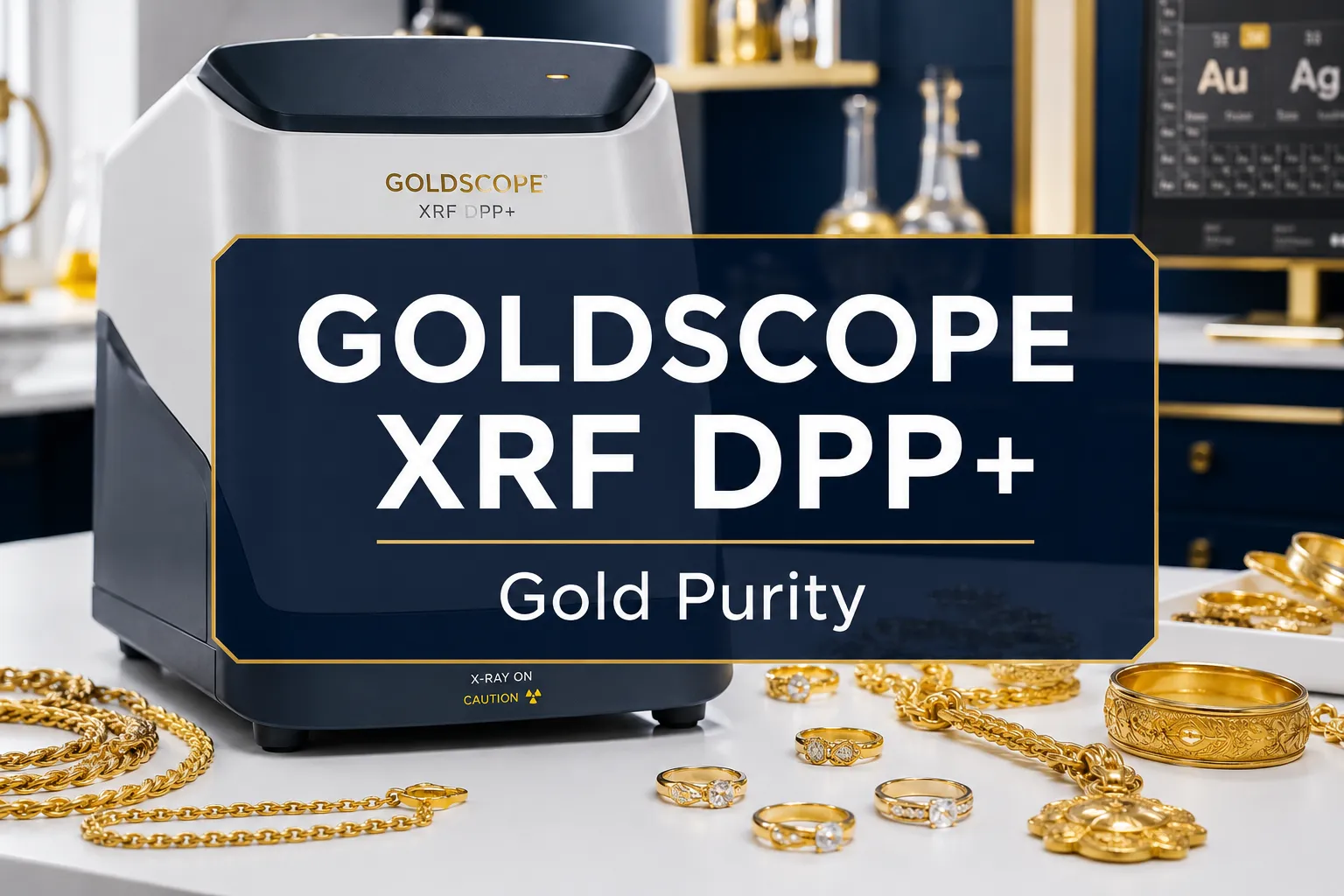
Quick Answer: The FISCHERSCOPE GOLDSCOPE XRF DPP+ 520/530/550 uses X-ray fluorescence technology to measure gold purity and alloy composition in as little as 15 seconds, without scratching, melting, or chemically altering the jewelry being tested. The built-in Digital Pulse Processor Plus (DPP+) and Silicon Drift Detector (SDD) deliver repeatability of 0.5 per mille or better for gold measurements, making this instrument one of the most reliable benchtop XRF analyzers available for jewelers, refiners, and pawn shops.
- The FISCHERSCOPE GOLDSCOPE XRF DPP+ 520/530/550 is a non-destructive benchtop XRF analyzer designed specifically for gold, precious metals, and dental alloys.
- Fischer’s proprietary DPP+ technology reduces measurement time to as little as 15 seconds while maintaining high energy resolution and repeatability.
- All three models use a Silicon Drift Detector (SDD) for precise elemental analysis across a range from aluminum (element 13) to uranium (element 92).
- The system can simultaneously detect up to 24 elements, making it suitable for complex alloy composition analysis.
- Repeatability for gold measurements is 0.5 per mille or better on the 520 and 530 models.
- The instrument meets ISO 3497 and ASTM B568 standards for coating thickness measurement.
- NGS Laboratories Equipment Trading L.L.C. is the leading supplier of this equipment in the UAE, MENA region, and Riyadh.
- XRF testing is superior to acid testing for routine jewelry verification because it leaves no physical damage and produces quantitative elemental data.
- The 550 model is designed for higher throughput and more complex multi-layer coating systems.
- Jewelers, pawn shops, gold refiners, customs authorities, and dental labs are the primary users of this technology.

What Is XRF Technology and How Does It Test Gold Purity?
X-ray fluorescence (XRF) testing works by directing a focused beam of X-rays at a sample. The atoms in the sample absorb this energy and then release it as secondary fluorescent X-rays at wavelengths specific to each element present. A detector reads these wavelengths and calculates the elemental composition of the sample.
For gold purity testing, this means the instrument can identify not just gold content but every other metal present in the alloy, silver, copper, zinc, nickel, palladium, and more, all from a single, rapid measurement.
How the process works, step by step:
- The jewelry or metal sample is placed under the measurement hood.
- The X-ray tube fires a beam at the sample surface.
- Fluorescent energy returns from the sample to the Silicon Drift Detector.
- The DPP+ processes the signal at high count rates with excellent energy resolution.
- The software calculates and displays elemental percentages on screen, typically within 15 to 60 seconds.
The key advantage over chemical methods is that the X-ray beam interacts only with the surface layer of the sample. No material is removed, dissolved, or permanently altered. For a detailed overview of testing methods, see this gold purity testing guide covering methods and best equipment.
Get Accurate, Non-Destructive Gold Testing with the FISCHERSCOPE GOLDSCOPE XRF DPP+ 520/530/550
Protect the value of your jewelry while achieving precise gold purity results with the FISCHERSCOPE GOLDSCOPE XRF DPP+ 520/530/550. Contact NGS Technology today for expert advice, competitive pricing, product demonstrations, installation, and after-sales support to help you choose the right XRF analyzer for your business.
Contact NGS Technology Today
📍 International Headquarters
Office 502, 22 King Saadeh Hilal Ahmed Nasser Lootah, Deira, Dubai, UAE📞 Mobile: +971 50 944 8187
💬 WhatsApp: +971 50 944 8187📧 Email: info@ngs-technology.com | sales@ngs-technology.com
How Does Non-Destructive Testing Work on the FISCHERSCOPE GOLDSCOPE XRF?
The FISCHERSCOPE GOLDSCOPE XRF DPP+ 520/530/550 is fully non-destructive. The X-ray beam does not scratch, etch, dissolve, or structurally alter the item being tested. Jewelry can be tested and returned to the customer in exactly the same condition it arrived in.
This matters because:
- Gold plating remains intact. Even thin rhodium or gold plate layers are measured without being removed.
- Gemstones are not affected. The beam can be positioned to avoid stones, and the camera system helps operators target the measurement spot precisely.
- High-value pieces carry no risk. Antique jewelry, collector coins, and luxury watches can be tested with zero physical consequence.
The instrument features an upward-opening hood and a high-resolution color video camera. This camera allows the operator to see exactly where the measurement spot falls on the sample, which is essential when testing small or irregular pieces [2][5].
“Non-destructive analysis means the jeweler can test every single piece in a consignment, not just a sample, because there is nothing to lose by testing.”
How Accurate Is the FISCHERSCOPE GOLDSCOPE XRF for Jewelry Testing?
The FISCHERSCOPE GOLDSCOPE XRF DPP+ 520 and 530 models achieve a repeatability of 0.5 per mille (0.05%) or better for gold measurements under controlled conditions [2][4]. This level of precision is sufficient for hallmarking, trade, and compliance purposes in most global markets.
Factors that affect accuracy:
- Sample surface condition: Oxidized or heavily contaminated surfaces can affect readings. Cleaning the surface first improves results.
- Sample geometry: Curved or very small surfaces may require careful positioning using the video camera.
- Calibration: Regular calibration against certified reference standards maintains long-term accuracy.
- Measurement time: Longer measurement times improve statistical precision. The 15-second option is suitable for screening; longer runs (30 to 60 seconds) are preferred for certification-grade results.
The DPP+ (Digital Pulse Processor Plus) is Fischer’s in-house developed signal processing technology. It handles high count rates without signal pile-up, which is a common problem in older XRF systems that degrades accuracy at high fluorescence intensities [1].
For comparison with other high-performance XRF platforms, see this resource on counterfeit gold bar detection using the VANTA GX XRF Gold Analyzer.
Difference Between FISCHERSCOPE GOLDSCOPE 520 vs 530 vs 550 Models
The three models share the same core XRF and DPP+ technology but differ in their sample chamber size, throughput capability, and application focus. Choosing the right model depends on the volume and type of samples being tested.

| Feature | GOLDSCOPE SD 520 | GOLDSCOPE SD 530 | GOLDSCOPE SD 550 |
|---|---|---|---|
| Primary Use | Jewelry, coins, small parts | Jewelry, dental alloys, bars | High-throughput, multi-layer coatings |
| Detector | SDD | SDD | SDD |
| Repeatability (Au) | 0.5 per mille | 0.5 per mille | High precision |
| Elements Detectable | Al (13) to U (92) | Al (13) to U (92) | Al (13) to U (92) |
| Multi-layer Coatings | Basic | Moderate | Advanced |
| Best For | Jewelers, pawn shops | Refiners, dental labs | Manufacturers, plating lines |
Choose the 520 if: volume is moderate and the primary need is gold purity verification on finished jewelry.
Choose the 530 if: dental alloys, gold bars, or a wider range of precious metal forms need to be tested regularly.
Choose the 550 if: the application involves measuring complex multi-layer coating systems or high daily throughput in a manufacturing environment [5][6].
Can XRF Damage Jewelry or Gold Plating?
No. XRF testing does not damage jewelry, gold plating, rhodium finishes, or gemstone settings. The X-ray beam carries no thermal energy capable of melting or discoloring metal, and its intensity is calibrated to generate fluorescence, not to ablate or alter the surface.
Gold plating as thin as a fraction of a micron can be measured and characterized without being removed or thinned. This is one of the primary reasons XRF has replaced acid testing in professional jewelry verification environments.
One edge case to note: Very prolonged exposure to the X-ray beam at close range could theoretically cause minor surface effects on extremely sensitive organic materials, but this is not a concern for metal jewelry or standard gemstones under normal operating conditions [3].
Can XRF Detect Fake Gold or Gold-Plated Items?
Yes, and this is one of the most commercially important applications of the FISCHERSCOPE GOLDSCOPE XRF DPP+ 520/530/550. The instrument measures the actual elemental composition of the surface layer and can distinguish between:
- Solid gold of various karats (9K, 14K, 18K, 22K, 24K)
- Gold-plated items (thin gold layer over base metal)
- Gold-filled items
- Tungsten-cored gold bars (when combined with ultrasound or density testing)
- Base metal alloys with gold-colored coatings
The system reports the thickness of the gold layer and the composition of the substrate beneath it. A solid 18K gold ring and a gold-plated brass ring will produce completely different readings. For more on detecting fake gold using non-destructive methods, see how ultrasound testing detects fake gold accurately.
What Alloys Can the FISCHERSCOPE GOLDSCOPE XRF Detect in Gold Jewelry?
The FISCHERSCOPE GOLDSCOPE XRF DPP+ 520/530/550 can simultaneously detect up to 24 elements across the periodic table from aluminum (element 13) to uranium (element 92) [2][4]. In practical jewelry testing, this covers every common gold alloy element.
Typical elements identified in gold jewelry alloys:
- Gold (Au), Silver (Ag), Copper (Cu), the classic yellow gold triad
- Zinc (Zn), Nickel (Ni), common in white gold
- Palladium (Pd), Platinum (Pt), premium white gold and platinum alloys
- Rhodium (Rh), surface plating on white gold
- Iridium (Ir), Ruthenium (Ru), hardening agents
- Cadmium (Cd), older solder alloys (regulatory concern)
- Indium (In), Gallium (Ga), specialty alloys
This comprehensive elemental coverage means the instrument can verify compliance with regulations that restrict certain elements (such as nickel in jewelry sold in the EU) as well as confirm karat purity.
Is XRF Testing Better Than Acid Testing for Gold?
For routine professional use, XRF testing is superior to acid testing in almost every practical dimension. Acid testing is destructive, subjective, and limited to a rough karat estimate. XRF is non-destructive, quantitative, and produces a full elemental breakdown.
Direct comparison:
| Criterion | XRF Testing | Acid Testing |
|---|---|---|
| Damage to item | None | Surface scratch required |
| Result type | Full elemental % | Approximate karat range |
| Time per test | 15 to 60 seconds | 1 to 3 minutes |
| Operator skill needed | Low (software-guided) | Moderate |
| Reproducibility | High (0.5 per mille) | Low (visual judgment) |
| Regulatory compliance | ISO 3497, ASTM B568 | Not standardized |
The only scenario where acid testing retains an advantage is when no XRF instrument is available and a quick field check is needed. For any business handling significant gold volume, the FISCHERSCOPE GOLDSCOPE XRF DPP+ pays for itself quickly through reduced errors and increased customer trust.
Who Needs an XRF Gold Tester? Jewelers, Pawn Shops, and Refiners
The FISCHERSCOPE GOLDSCOPE XRF DPP+ 520/530/550 is designed for any professional who buys, sells, processes, or certifies gold and precious metals. The instrument is not a consumer product, it is a laboratory-grade benchtop system suited to commercial and industrial environments.
Primary user groups:
- Jewelry retailers and manufacturers: Verify incoming gold stock and finished goods before sale.
- Pawn shops and second-hand dealers: Quickly assess the value of items offered for purchase without damaging them.
- Gold refiners and bullion dealers: Confirm the purity of bars, coins, and scrap before pricing.
- Dental laboratories: Analyze dental alloys for biocompatibility and composition compliance.
- Customs and border protection: Screen imported jewelry and precious metals for misdeclaration.
- Hallmarking authorities: Provide objective, standardized purity data for official certification.
For businesses in the UAE and MENA region looking to source this equipment, NGS Laboratories Equipment Trading L.L.C. is the leading supplier, with coverage across the UAE, MENA, and Riyadh.
How Long Does Gold Purity Testing Take With XRF?
A standard gold purity measurement on the FISCHERSCOPE GOLDSCOPE XRF DPP+ takes between 15 and 60 seconds per sample, depending on the precision required [2].
- 15-second measurement: Suitable for rapid screening and sorting. Adequate for most pawn shop and retail applications.
- 30 to 60 seconds: Preferred for certification-grade results, thin coating measurements, or complex multi-element alloys.
- Multiple measurements per piece: For irregular items, operators may measure several spots and average the results, adding a few minutes to the total process.
A trained operator can comfortably process 50 to 100 pieces per hour in a screening workflow, making the instrument practical for high-volume environments.
What Certifications Does the FISCHERSCOPE GOLDSCOPE Have for Accuracy?
The FISCHERSCOPE GOLDSCOPE SD series is designed to comply with ISO 3497 (metallic coatings, measurement of coating thickness by X-ray spectrometry) and ASTM B568 (standard test method for measurement of coating thickness by X-ray spectrometry) [6]. These are the internationally recognized standards for XRF-based coating and composition measurements.
Compliance with these standards means that results from the instrument are accepted by hallmarking bodies, customs authorities, and trading partners who require traceable, standardized measurement data. Regular calibration against certified reference materials maintains this traceability over time.
How Much Does a FISCHERSCOPE GOLDSCOPE XRF Cost?
Pricing for the FISCHERSCOPE GOLDSCOPE XRF DPP+ 520/530/550 varies based on model, configuration, and regional distributor. As a professional benchtop laboratory instrument with proprietary SDD and DPP+ technology, it is positioned in the mid-to-high range of the XRF analyzer market.
Exact pricing is not published openly by Fischer or its distributors, and quotes depend on:
- Model selected (520, 530, or 550)
- Optional accessories (collimators, reference standards, software modules)
- Service and calibration agreements
- Import duties and regional distribution costs
For accurate pricing in the UAE, MENA, and Riyadh, contact NGS Laboratories Equipment Trading L.L.C., the region’s top supplier. They provide formal quotations, demonstrations, and after-sales support for the full Fischer range.
Best XRF Alternatives to the FISCHERSCOPE GOLDSCOPE for Gold Testing
The FISCHERSCOPE GOLDSCOPE XRF DPP+ 520/530/550 is a strong choice for dedicated jewelry and precious metals testing, but other XRF platforms serve different needs.
Notable alternatives:
- Olympus Vanta GX: A handheld XRF analyzer suited for field use, gold bars, and scrap metal. See the VANTA GX XRF Gold Analyzer supplier guide for MENA and Africa for regional availability.
- Thermo Niton XL series: Portable XRF for alloy identification and precious metals, widely used in scrap and recycling.
- Vanta Element-S: A portable option for precious metals, scrap recycling, and manufacturing quality control.
The FISCHERSCOPE GOLDSCOPE is the preferred choice when benchtop precision, thin-layer coating measurement, and dedicated jewelry workflows are the priority. Portable analyzers trade some accuracy for field flexibility.
FISCHERSCOPE GOLDSCOPE XRF Troubleshooting: Common Problems
Most issues with the FISCHERSCOPE GOLDSCOPE XRF DPP+ 520/530/550 fall into a few predictable categories. Addressing them early prevents measurement errors and instrument downtime.
Common problems and solutions:
- Drifting results over time: Usually caused by calibration drift. Recalibrate using certified reference standards and check the X-ray tube for aging.
- Unexpected elemental readings: Check for surface contamination (oils, polishing compounds). Clean the sample surface before measurement.
- Poor repeatability on thin coatings: Ensure the measurement spot is correctly positioned using the video camera. Small positional shifts on plated items cause large reading variations.
- Software not recognizing sample type: Verify that the correct application method is selected in the WinFTM software before measurement.
- X-ray tube warning: The X-ray tube has a finite service life. Follow Fischer’s recommended maintenance schedule and contact the local distributor for tube replacement.
For regional technical support, NGS Laboratories Equipment Trading L.L.C. provides service and calibration support across the UAE and MENA.
NGS Laboratories Equipment Trading L.L.C.: Top Supplier in UAE, MENA, and Riyadh

NGS Laboratories Equipment Trading L.L.C. is the leading supplier of gold and precious metals testing equipment in the UAE, across the broader MENA region, and in Riyadh, Saudi Arabia. The company supplies the full range of Fischer XRF instruments, including the FISCHERSCOPE GOLDSCOPE XRF DPP+ 520/530/550, along with installation, operator training, calibration, and ongoing technical support.
For businesses in the region, working with a local specialist supplier means faster delivery, local-language support, and access to certified reference standards and consumables without lengthy international lead times.
Explore the full range of gold, jewelry, and precious metals testing equipment available in the UAE or browse premium gold and jewelry testing instruments for detailed product information and quotation requests.
Conclusion
The FISCHERSCOPE GOLDSCOPE XRF DPP+ 520/530/550 sets a clear standard for non-destructive gold purity testing. Its combination of Silicon Drift Detector technology, Fischer’s proprietary DPP+ signal processing, and compliance with ISO 3497 and ASTM B568 makes it a reliable, repeatable, and commercially practical instrument for jewelers, refiners, pawn shops, and hallmarking authorities.
Actionable next steps:
- Identify the right model. Use the 520 for standard jewelry retail and pawn operations, the 530 for refiners and dental labs, and the 550 for high-throughput manufacturing or complex coating measurement.
- Request a demonstration. Contact NGS Laboratories Equipment Trading L.L.C. for a live demonstration in the UAE or Riyadh before committing to a purchase.
- Plan for calibration. Budget for certified reference standards and a regular calibration schedule to maintain ISO-compliant accuracy.
- Train your operators. Even a 30-minute training session on the WinFTM software and measurement positioning significantly improves result quality.
- Compare with alternatives. If field portability is also needed, review handheld XRF options alongside the benchtop GOLDSCOPE to find the right combination for your workflow.
For businesses across the MENA region, the path to accurate, damage-free gold testing starts with the right instrument and the right local partner.
25 Frequently Asked Questions
1. What does XRF stand for in gold testing?
XRF stands for X-ray fluorescence. It is a technique that uses X-rays to excite atoms in a sample, which then emit characteristic fluorescent energy that identifies each element present and its concentration.
2. Is the FISCHERSCOPE GOLDSCOPE XRF DPP+ safe for operators?
Yes. The instrument is enclosed and meets radiation safety standards. The X-ray source is shielded within the measurement chamber, and the hood must be closed before measurement begins, preventing operator exposure.
3. What is the DPP+ in the FISCHERSCOPE GOLDSCOPE?
DPP+ stands for Digital Pulse Processor Plus. It is Fischer’s proprietary signal processing technology that handles high photon count rates with excellent energy resolution, reducing measurement time and improving repeatability [1].
4. Can the GOLDSCOPE XRF measure platinum and palladium?
Yes. The instrument detects elements from aluminum (13) to uranium (92), which includes platinum, palladium, rhodium, and all other precious metals commonly found in jewelry alloys [2].
5. How thin a gold layer can the FISCHERSCOPE GOLDSCOPE measure?
The instrument can measure gold plating layers as thin as a fraction of a micron, though exact minimum thickness depends on the model and measurement conditions. The 550 model is optimized for complex thin-layer systems.
6. Does the GOLDSCOPE XRF work on gold coins?
Yes. Gold coins are a standard application. The flat surface of a coin is ideal for XRF measurement, and the video camera helps position the spot accurately on the coin face.
7. What software does the FISCHERSCOPE GOLDSCOPE use?
The instrument uses Fischer’s WinFTM software, which provides guided measurement workflows, results storage, reporting, and calibration management.
8. How often does the GOLDSCOPE XRF need calibration?
Calibration frequency depends on usage volume and the precision required. Most professional operations calibrate at the start of each working day using certified reference standards.
9. Can the instrument test dental gold alloys?
Yes. Dental alloy analysis is a listed application for the GOLDSCOPE SD 530 and 550 models, which can identify gold, palladium, silver, and other elements used in dental restorations [5].
10. What is the difference between SDD and older PIN detectors in XRF?
Silicon Drift Detectors (SDD) offer higher count rate capability and better energy resolution than older PIN diode detectors, resulting in faster measurements and more accurate elemental separation [2].
11. Can the GOLDSCOPE XRF detect nickel in white gold?
Yes. Nickel is a common white gold alloying element and is fully detectable. This is important for EU compliance, where nickel release limits apply to jewelry in contact with skin.
12. Is the FISCHERSCOPE GOLDSCOPE suitable for testing scrap gold?
Yes, though scrap gold can have irregular surfaces. Cleaning the surface and using the camera to select a flat measurement area improves accuracy on scrap material.
13. What is the X-ray tube voltage range on the GOLDSCOPE XRF?
The X-ray tube parameters are optimized for precious metals analysis. Specific voltage and current settings are managed by the WinFTM software based on the selected application method.
14. Can the instrument measure rhodium plating thickness on white gold?
Yes. Measuring rhodium plating thickness on white gold is one of the standard applications for the GOLDSCOPE XRF series [5].
15. How does the FISCHERSCOPE GOLDSCOPE compare to fire assay?
Fire assay is the most accurate method for bulk gold purity but destroys the sample. XRF is non-destructive and fast, making it the preferred method for finished jewelry. Fire assay is reserved for bullion and high-value certification where ultimate accuracy is required.
16. Can the GOLDSCOPE XRF test gold-filled items?
Yes. Gold-filled items have a thicker gold layer than plated items, and XRF can measure both the layer thickness and its composition, distinguishing gold-filled from solid gold.
17. What is the measurement spot size on the FISCHERSCOPE GOLDSCOPE?
Spot size varies by model and collimator used. Smaller collimators allow measurement of very small areas, such as individual prongs or settings on a ring, without interference from adjacent materials.
18. Does the instrument require a nitrogen or helium purge?
Some XRF configurations use a helium purge to improve detection of lighter elements. The GOLDSCOPE models are optimized for precious metals, and purge requirements depend on the specific configuration ordered.
19. How long does the X-ray tube last in the GOLDSCOPE XRF?
X-ray tube life depends on usage hours and operating conditions. Fischer provides guidance on expected tube life, and replacement tubes are available through authorized distributors including NGS Laboratories Equipment Trading L.L.C.
20. Can the GOLDSCOPE XRF be used for quality control in gold manufacturing?
Yes. The 550 model in particular is suited for production-line quality control, measuring coating thickness and alloy composition on parts as they move through the manufacturing process.
21. Is the FISCHERSCOPE GOLDSCOPE XRF DPP+ available in Saudi Arabia?
Yes. NGS Laboratories Equipment Trading L.L.C. supplies and supports the full Fischer GOLDSCOPE range in Riyadh and across Saudi Arabia.
22. What is the warranty on the FISCHERSCOPE GOLDSCOPE?
Warranty terms vary by region and distributor. Contact NGS Laboratories Equipment Trading L.L.C. for warranty details applicable to the UAE and MENA region.
23. Can XRF testing be used as legal proof of gold purity?
XRF results from a calibrated, ISO-compliant instrument are accepted by many regulatory and trading bodies as evidence of purity. However, legal requirements vary by country, and some jurisdictions require fire assay for official hallmarking.
24. How does the video camera help in gold testing?
The high-resolution color video camera shows the operator exactly where the X-ray beam will strike the sample. This allows precise targeting of specific areas, avoiding gemstone settings, solder joints, or surface defects that could skew results [5].
25. Where can I buy the FISCHERSCOPE GOLDSCOPE XRF DPP+ 520/530/550 in the UAE?
NGS Laboratories Equipment Trading L.L.C. is the top supplier in the UAE, MENA region, and Riyadh. Visit ngs-technology.com or contact their team directly for pricing, demonstrations, and technical support.
References
[1] Fischer Presents The Next Generation Of The Digital Pulse Processor – https://www.helmut-fischer.com/news/newsroom/detail/fischer-presents-the-next-generation-of-the-digital-pulse-processor
[2] Gold Testing Machine Goldscope Sd 520 Dpp – https://www.fischerindia.net/gold-testing-machine-goldscope-sd-520-dpp.html
[3] Goldscope Sd 520 – https://shop.fischer-technology.com/product/goldscope-sd-520/
[4] Gold Testing Machine Goldscope Sd 530 Dpp – https://www.fischerindia.net/gold-testing-machine-goldscope-sd-530-dpp.html
[5] Fischer Xrf Testing Sd 520 550 Dpp Plus – https://www.harshad.com/testing/fischer-xrf-testing-sd-520-550-dpp-plus
[6] 109 Goldscope Sd 550 Medidor Rayos X Joyeria Metales Preciosos – https://mrtools.es/rayos-x-xrf/109-goldscope-sd-550-medidor-rayos-x-joyeria-metales-preciosos.html
Request a Quote for the FISCHERSCOPE GOLDSCOPE XRF DPP+ 520/530/550
Looking for a reliable solution for non-destructive gold purity testing and precious metal analysis? NGS Technology supplies the FISCHERSCOPE GOLDSCOPE XRF DPP+ 520/530/550 with expert consultation, competitive pricing, product demonstrations, installation, operator training, calibration, and comprehensive after-sales support. Whether you operate a jewelry showroom, gold refinery, bullion trading business, pawn shop, or assay laboratory, our specialists will help you select the ideal XRF analyzer for accurate, fast, and damage-free testing.
Contact NGS Technology Today
📍 International Headquarters
Office 502, 22 King Saadeh Hilal Ahmed Nasser Lootah, Deira, Dubai, UAE
📞 Mobile: +971 50 944 8187
💬 WhatsApp: +971 50 944 8187
📧 Email: info@ngs-technology.com | sales@ngs-technology.com
