


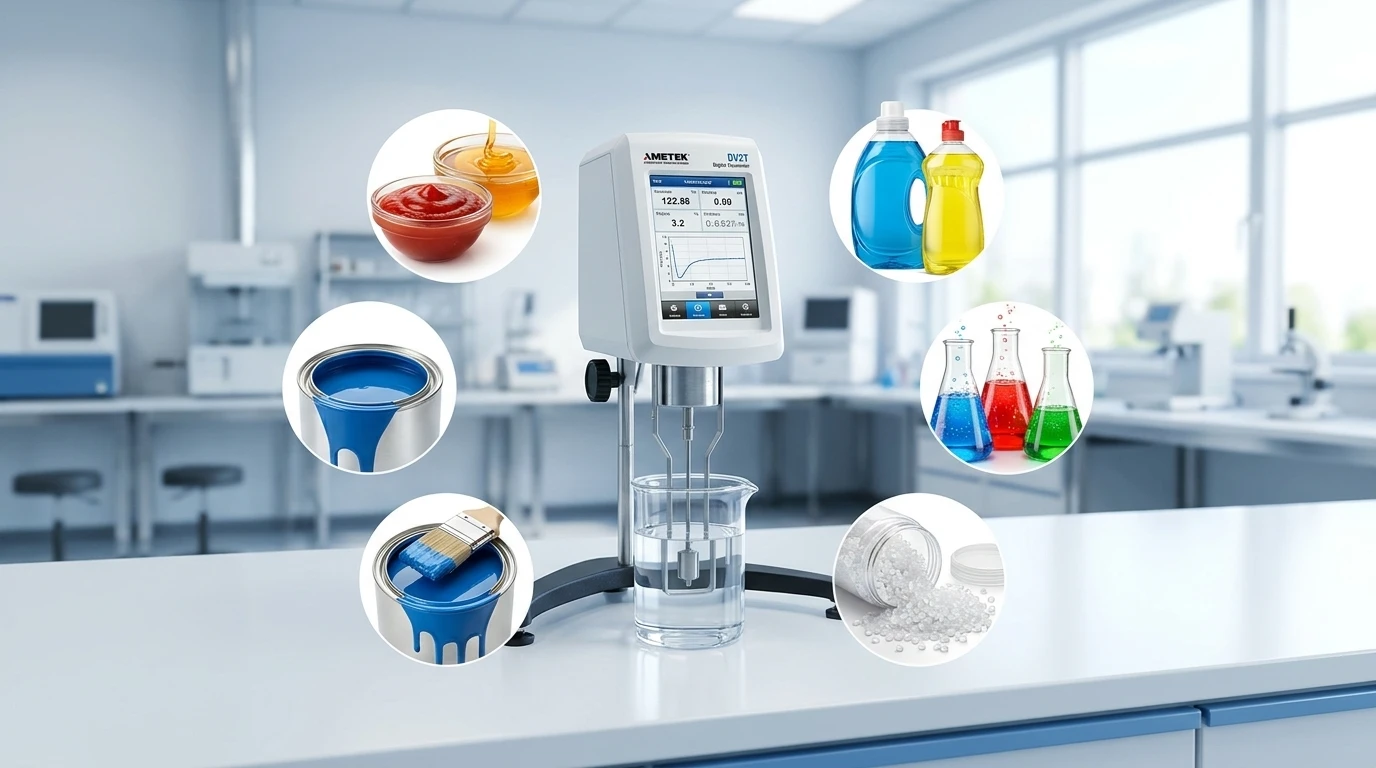
By NGS Laboratories Equipment Trading LLC | Dubai, UAE Your trusted supplier of AMETEK Brookfield viscometers and laboratory testing equipment across the UAE and GCC
Introduction: Why Viscosity Measurement Matters in Modern Manufacturing
Viscosity is one of the most important quality control parameters in industrial manufacturing. Whether you are producing ketchup, emulsion paint, industrial adhesives, liquid detergent, or polymer resin, the flow behavior of your product directly affects processing efficiency, shelf appeal, packaging performance, and customer satisfaction. A product that is too thick may clog filling lines; one that is too thin may separate, under-perform, or fail regulatory specifications.
This is where the AMETEK Brookfield viscometer becomes an indispensable laboratory and production-line instrument. Recognized globally as the gold standard in viscosity measurement for over 80 years, Brookfield viscometers are trusted by quality control labs, R&D departments, and production engineers across the food, paints and coatings, chemical, detergent, and polymer industries.
At NGS Laboratories Equipment Trading LLC, based in Dubai, UAE, we supply, install, calibrate, and support the full range of AMETEK Brookfield viscometers and rheometers for manufacturers, testing laboratories, universities, and quality assurance facilities throughout the UAE, Saudi Arabia, Oman, Qatar, Bahrain, and the wider GCC region. In this comprehensive guide, we explain how Brookfield viscometers work, why they matter, and exactly how they are used across five key industries.
What Is an AMETEK Brookfield Viscometer?
A Brookfield viscometer is a rotational instrument that measures the viscosity of liquids, semi-solids, gels, and pastes by calculating the torque required to rotate a spindle immersed in a sample at a defined speed. The resistance the fluid exerts against the rotating spindle is converted into a viscosity reading, typically expressed in centipoise (cP) or millipascal-seconds (mPa·s).
Brookfield instruments — now manufactured under the AMETEK Brookfield brand — are considered the worldwide reference standard for rotational viscosity testing. Product lines commonly supplied by NGS Laboratories include:
- DV2T Touch Screen Viscometer – a widely used lab viscometer with digital touchscreen control and temperature probe integration
- DV3T Rheometer – for advanced rheological analysis including yield stress and shear-rate dependent viscosity
- RST Rheometer (Controlled Stress/Rate) – for complex, high-precision rheological testing
- AST 100 In-Line Viscometer – for continuous, real-time in-process viscosity monitoring
- CT3 Texture Analyzer – for firmness, springiness, and chewiness testing in food and cosmetic products
- FAST Viscosity Control System – a maintenance-free, no-moving-parts in-line process viscometer for continuous production monitoring
Spindle and torque-spring combinations (LV, RV, HA, and HB) allow the same base instrument to accurately measure everything from thin oils to thick asphalt and caulking compounds, making the Brookfield platform remarkably versatile across industries.
Looking for a Genuine AMETEK Brookfield Viscometer?
Whether you need a benchtop viscometer, advanced rheometer, or an in-line viscosity monitoring system, NGS Laboratories Equipment Trading LLC provides genuine AMETEK Brookfield solutions backed by expert consultation, installation, calibration, and after-sales support across the UAE and GCC.
📍 International Headquarter:
Office 502, 22 King Saadeh Hilal Ahmed Nasser Lootah, Deira, Dubai, UAE📞 Mobile: +971509448187
💬 WhatsApp: +971509448187
📧 Email: info@ngs-technology.com | sales@ngs-technology.com
How Does a Brookfield Viscometer Work?
The operating principle is straightforward but precise: a motor rotates a calibrated spindle at a selectable speed while it is submerged in the test sample. The viscous drag of the fluid against the spindle creates a resistive torque, which is measured by a calibrated spring or torque transducer. This torque, combined with the known spindle geometry and rotational speed, is converted into a viscosity value.
Modern digital models like the DV2T display real-time viscosity, torque percentage, shear rate, and shear stress, and can log data automatically for traceable quality records — a critical requirement for ISO-certified laboratories and factories operating under GMP or HACCP protocols.

Industry Applications of AMETEK Brookfield Viscometers
1. Food & Beverage Industry
Viscosity is a defining sensory and functional property in food manufacturing. It affects mouthfeel, pourability, appearance, and even shelf stability. Food scientists and QC technicians rely on Brookfield viscometers to test:
- Sauces, ketchups, and dressings – ensuring consistent pourability and mouthfeel batch to batch
- Dairy products – monitoring yogurt thickness, ice cream mix consistency, and condensed milk viscosity
- Confectionery – measuring chocolate, caramel, and syrup flow behavior during processing and enrobing
- Honey, jams, and preserves – verifying viscosity meets export and retail packaging specifications
- Edible oils – checking consistency and detecting oxidation-related viscosity changes
- Bakery fillings and batters – controlling flow for accurate depositing and forming equipment
In the UAE’s growing food processing and export sector, viscosity testing also supports compliance with ESMA (Emirates Authority for Standardization and Metrology) and GCC food standards, helping manufacturers maintain consistent product quality for both local retail and international export markets.

2. Paints & Coatings Industry
Viscosity control is central to paint and coatings manufacturing — it determines brushability, sprayability, leveling, sag resistance, and drying behavior. Brookfield viscometers are used across the paint production line for:
- Raw material QC – testing resins, latex emulsions, and pigment dispersions before formulation
- In-process viscosity control – adjusting formulations during mixing to hit target specifications
- Finished product testing – verifying viscosity against ASTM and ISO paint standards before packaging
- Thixotropy evaluation – measuring how paint viscosity drops under shear (brushing/spraying) and recovers at rest, which is critical for anti-sag and self-leveling coatings
- Powder coatings and industrial coatings – testing viscosity of primers, epoxies, and protective coatings used in construction and marine industries — a significant sector in Dubai and the wider UAE construction market
The helical and spiral spindle geometries available for Brookfield instruments make them particularly effective for testing thixotropic coatings, inks, and dyes that would be difficult to characterize with simpler flow-cup methods.

3. Chemical Industry
Across specialty and bulk chemical manufacturing, viscosity is a critical processing and quality parameter used to monitor reaction progress, verify product consistency, and ensure safe handling and pumping. Common applications include:
- Adhesives and sealants – ensuring correct application viscosity for bonding strength and dispensing accuracy
- Industrial lubricants and greases – testing viscosity grades against SAE and ISO classifications
- Resins and epoxy systems – monitoring viscosity build during curing and pot-life studies
- Petrochemical products – verifying flow characteristics of oils, fuels, and process fluids
- Cosmetics and personal care chemicals – testing creams, lotions, gels, and serums for texture consistency
Given Dubai’s position as a regional chemical trading and distribution hub (with major activity in Jebel Ali Free Zone), reliable viscosity testing equipment is essential for import/export quality verification and certificate of analysis (CoA) documentation.

4. Detergents & Household Chemicals Industry
Liquid detergents, dishwashing liquids, fabric softeners, and industrial cleaning agents all depend on precise viscosity control for pumpability, foaming behavior, packaging line efficiency, and shelf appearance. Brookfield viscometers help detergent manufacturers with:
- Liquid laundry detergent QC – ensuring consistent viscosity for accurate dosing caps and bottle filling
- Dishwashing liquid formulation – balancing viscosity with surfactant concentration for optimal foam and cling
- Fabric softener testing – verifying pourability and stability across production batches
- Industrial and institutional cleaning chemicals – testing gels, foams, and concentrated cleaning solutions
- Anti-settling and stability studies – monitoring viscosity changes over time to predict shelf-life performance
With the UAE home to a growing number of FMCG and home-care manufacturing facilities, consistent viscosity testing is essential for maintaining brand quality standards across regional and export markets.

5. Polymer Industry
Polymer manufacturers use viscosity data to characterize molecular weight, monitor polymerization reactions, and ensure processing consistency. Applications include:
- Polymer solution and melt characterization – correlating viscosity with molecular weight and degree of polymerization
- Latex and emulsion polymer QC – testing viscosity of polymer emulsions used in adhesives, coatings, and textiles
- Plastics and resin processing – verifying flow behavior for injection molding, extrusion, and casting applications
- Rubber and elastomer compounds – testing viscosity of uncured rubber compounds and processing aids
- Polyurethane and foam systems – monitoring viscosity build during reactive processing for foam and coating applications
Advanced Brookfield rheometers such as the DV3T and RST are especially valuable in polymer R&D, where shear-rate dependent (non-Newtonian) behavior must be fully characterized rather than measured at a single speed.

Why Choose NGS Laboratories Equipment Trading LLC in Dubai, UAE?
As a dedicated laboratory and testing equipment trading company based in Dubai, NGS Laboratories Equipment Trading LLC offers:
- Genuine AMETEK Brookfield viscometers and rheometers sourced through authorized supply channels
- Local UAE-based technical support for installation, training, and troubleshooting
- Calibration and after-sales service to keep your equipment ISO-compliant and audit-ready
- Spindle sets, accessories, and spare parts for all major Brookfield models
- Fast delivery across Dubai, Abu Dhabi, Sharjah, and the wider GCC region
- Consultation support to help you select the right viscometer or rheometer model for your specific industry application, sample viscosity range, and budget
Whether you are setting up a new QC laboratory, upgrading production-line viscosity control, or replacing an outdated viscometer, our team can guide you through model selection, spindle/torque configuration, and calibration standards to match your product range.

How to Choose the Right Brookfield Viscometer for Your Industry
When selecting a viscometer, consider the following factors:
- Viscosity range of your product – thin liquids (LV torque) vs. thick pastes and gels (HA/HB torque)
- Newtonian vs. non-Newtonian behavior – standard viscometers suffice for Newtonian fluids; rheometers are needed for shear-rate dependent materials like paints, gels, and polymer melts
- Laboratory vs. in-line process needs – benchtop models (DV2T) for QC labs; in-line systems (AST 100, FAST) for continuous production monitoring
- Temperature control requirements – many formulations require temperature-controlled viscosity testing via water bath or Peltier systems
- Regulatory and standards compliance – ASTM, ISO, and industry-specific standards may dictate specific test methods and equipment specifications
- Data logging and traceability – touchscreen digital models with software connectivity support QA documentation and audit trails
Our technical team at NGS Laboratories can help you match the right instrument, spindle set, and accessories to your exact application — from a single benchtop viscometer for a small QC lab to a full in-line viscosity control system for a production facility.
Calibration & Maintenance Tips
To keep your Brookfield viscometer delivering accurate, repeatable results:
- Perform regular calibration checks using certified viscosity standard fluids
- Verify torque readings at multiple speeds, not just a single test point
- Maintain a calibration log for ISO 9001, ISO 17025, or GMP compliance
- Clean spindles thoroughly after each use to prevent cross-contamination and buildup
- Store spindles and accessories in their protective case to avoid damage
- Schedule annual preventive maintenance and factory calibration through an authorized service provider
NGS Laboratories offers calibration and maintenance support for AMETEK Brookfield instruments across the UAE, helping laboratories stay compliant and audit-ready.
Conclusion:
From food sauces to industrial paints, from liquid detergents to advanced polymer resins, viscosity measurement is a cornerstone of quality control across nearly every manufacturing sector. The AMETEK Brookfield viscometer remains the trusted, industry-standard instrument for accurate, repeatable, and traceable viscosity testing.
As a specialized laboratory equipment supplier based in Dubai, NGS Laboratories Equipment Trading LLC is committed to helping manufacturers, testing labs, and quality assurance teams across the UAE and GCC access genuine AMETEK Brookfield viscometers, expert technical guidance, and reliable after-sales support.
Contact NGS Laboratories Equipment Trading LLC today to request a quotation, arrange a product demonstration, or speak with our technical team about the right Brookfield viscometer for your industry application.
Frequently Asked Questions (FAQs)
1. What is an AMETEK Brookfield viscometer used for? It is used to measure the viscosity (thickness or flow resistance) of liquids, gels, pastes, and semi-solids across industries such as food, paints, chemicals, detergents, and polymers.
2. How does a Brookfield viscometer measure viscosity? It rotates a spindle in the sample at a set speed and measures the torque required to overcome the fluid’s resistance, converting that reading into a viscosity value.
3. What is the difference between a viscometer and a rheometer? A viscometer typically measures viscosity at a single or limited set of shear rates, while a rheometer can characterize complex flow behavior across a wide range of shear rates and stresses, ideal for non-Newtonian fluids.
4. Which Brookfield viscometer model is best for a QC laboratory? The DV2T Touch Screen Viscometer is one of the most popular models for general laboratory QC use due to its accuracy, ease of use, and digital data logging.
5. Can Brookfield viscometers be used for in-line production monitoring? Yes. Models such as the AST 100 and the FAST Viscosity Control System are designed for continuous, real-time in-line viscosity monitoring during manufacturing.
6. What industries use Brookfield viscometers? Major industries include food and beverage, paints and coatings, chemicals, detergents and household products, polymers and plastics, pharmaceuticals, and cosmetics.
7. How is viscosity measured in the paint industry? Paint manufacturers use Brookfield viscometers with helical or spindle attachments to measure viscosity and thixotropic behavior, ensuring correct brushability, sprayability, and sag resistance.
8. Why is viscosity important in food manufacturing? Viscosity affects mouthfeel, pourability, appearance, and processing behavior of sauces, dairy products, syrups, and confectionery, directly impacting product quality and consumer satisfaction.
9. How often should a Brookfield viscometer be calibrated? Most laboratories calibrate viscometers annually, with routine verification checks using certified viscosity standards performed more frequently, depending on usage and quality system requirements.
10. What spindle should I use for thick pastes like chocolate or caramel? Higher torque spindle and spring combinations, such as HA or HB, are typically used for thick, high-viscosity materials like chocolate, caramel, and asphalt.
11. Can Brookfield viscometers test detergents and liquid soaps? Yes, they are widely used to test liquid detergents, dishwashing liquids, and fabric softeners for consistency, pumpability, and formulation stability.
12. What is thixotropy and why does it matter in paints? Thixotropy is when a fluid’s viscosity decreases under shear (such as brushing) and recovers at rest. It matters in paints because it affects application ease and sag resistance after application.
13. Do Brookfield viscometers support temperature-controlled testing? Yes, many models can be paired with water baths or temperature probes to test viscosity at controlled or varying temperatures, which is critical for many formulations.
14. What is the difference between LV, RV, HA, and HB torque springs? These refer to different torque ranges: LV for low-viscosity fluids, RV for medium viscosity, HA for higher viscosity, and HB for very high-viscosity materials like caulking compounds and molasses.
15. Are Brookfield viscometers suitable for polymer R&D? Yes, especially rheometer models like the DV3T and RST, which can characterize shear-rate dependent, non-Newtonian behavior common in polymer solutions and melts.
16. Where can I buy a genuine AMETEK Brookfield viscometer in Dubai, UAE? NGS Laboratories Equipment Trading LLC, based in Dubai, supplies genuine AMETEK Brookfield viscometers and rheometers with local technical support across the UAE and GCC.
17. What is the typical unit of measurement for viscosity? Viscosity is commonly expressed in centipoise (cP) or millipascal-seconds (mPa·s).
18. Can a Brookfield viscometer test viscosity of resins and epoxies? Yes, they are widely used to monitor viscosity build during resin curing, pot-life studies, and epoxy formulation development.
19. How do I choose between a benchtop and an in-line viscometer? Benchtop models are ideal for laboratory QC and R&D testing, while in-line viscometers are better suited for continuous, real-time monitoring during manufacturing.
20. What standards apply to viscosity testing? Common standards include ASTM D2196, ASTM D2983, and various ISO standards, depending on the industry and product type.
21. Can Brookfield viscometers be used for cosmetics testing? Yes, they are commonly used to test creams, lotions, gels, and serums for texture, spreadability, and formulation consistency.
22. What maintenance does a Brookfield viscometer require? Routine cleaning of spindles, periodic calibration checks, proper storage of accessories, and scheduled preventive maintenance help maintain measurement accuracy.
23. Does NGS Laboratories provide calibration services in the UAE? Yes, NGS Laboratories Equipment Trading LLC offers calibration and after-sales support for AMETEK Brookfield instruments across Dubai and the wider UAE.
24. What is the difference between Newtonian and non-Newtonian fluids in viscosity testing? Newtonian fluids have constant viscosity regardless of shear rate, while non-Newtonian fluids (like paints, ketchup, and polymer solutions) change viscosity depending on applied shear.
25. Can Brookfield viscometers help with shelf-life and stability studies? Yes, tracking viscosity changes over time helps predict product stability, separation, and shelf-life performance for detergents, foods, and chemical formulations.
26. What accessories are needed with a Brookfield viscometer? Common accessories include spindle sets, sample chambers, small sample adapters, water baths for temperature control, and calibration standard fluids.
27. Is training available for new Brookfield viscometer users? Yes, NGS Laboratories Equipment Trading LLC provides installation support and operational training for laboratory and production staff in the UAE.
28. How accurate are AMETEK Brookfield viscometers? When properly calibrated and maintained, Brookfield viscometers deliver highly accurate and repeatable results, making them the industry standard across multiple sectors.
29. Can one viscometer test both thin liquids and thick pastes? With the appropriate spindle and torque spring combination, many Brookfield viscometer models can accommodate a wide range of viscosities from thin oils to thick pastes.
30. How do I request a quotation for a Brookfield viscometer in Dubai? You can contact NGS Laboratories Equipment Trading LLC directly through our website or sales team to request a customized quotation based on your industry and testing requirements.
NGS Laboratories Equipment Trading LLC – Dubai, UAE. Authorized supplier of AMETEK Brookfield viscometers, rheometers, and laboratory testing equipment for the food, paints & coatings, chemical, detergent, and polymer industries across the UAE and GCC.
Need Help Choosing the Right Brookfield Viscometer?
Selecting the right viscometer depends on your sample type, viscosity range, testing standards, and production requirements. Our technical specialists can help you choose the ideal AMETEK Brookfield instrument for your laboratory or manufacturing facility.
📍 International Headquarter:
Office 502, 22 King Saadeh Hilal Ahmed Nasser Lootah, Deira, Dubai, UAE
📞 Mobile: +971509448187
💬 WhatsApp: +971509448187
📧 Email: info@ngs-technology.com | sales@ngs-technology.com