
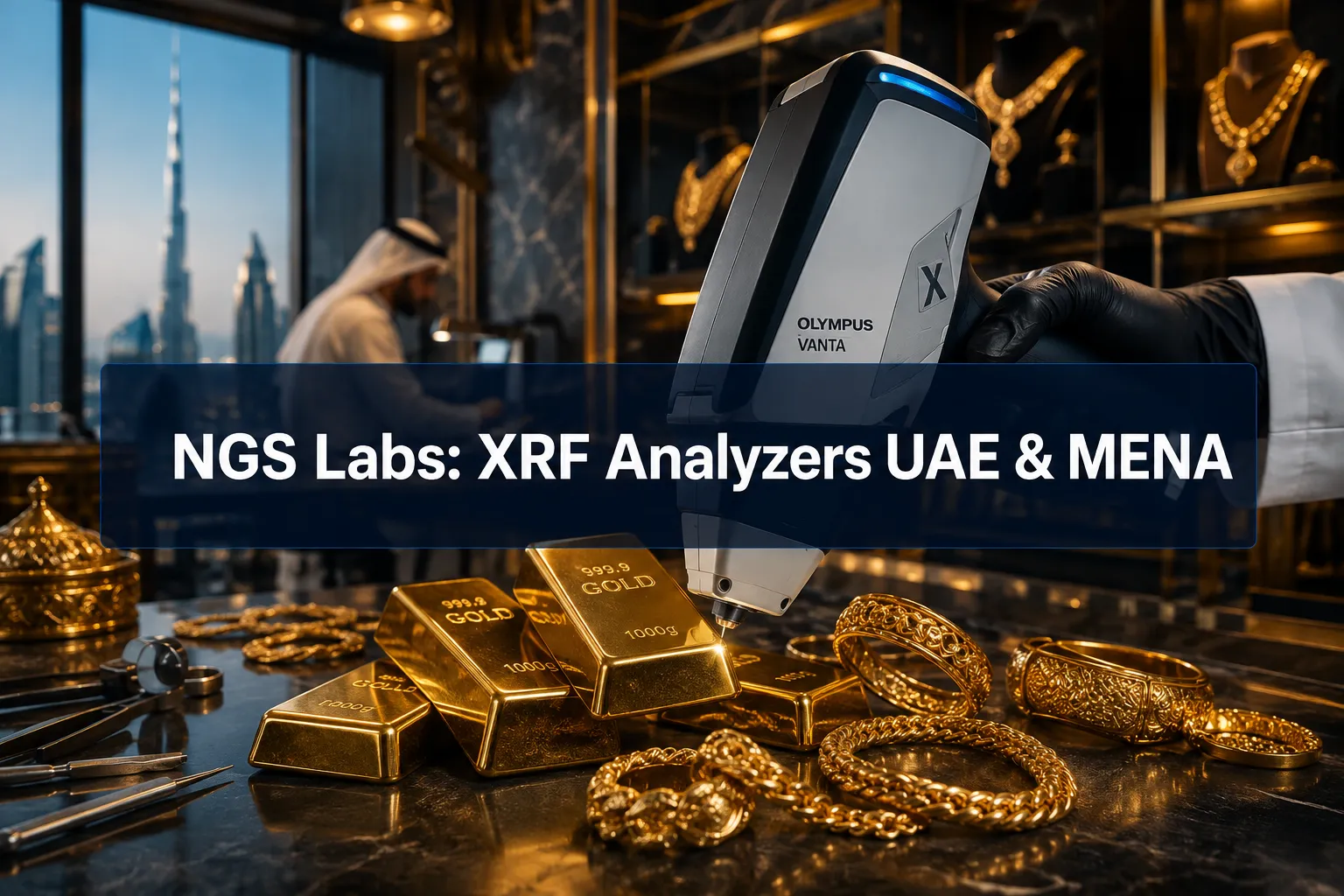
Quick Answer: NGS Laboratories Equipment Trading for XRF Precious Metal Analyzers has established itself as the leading supplier across the UAE and MENA region by combining internationally certified instruments, local technical expertise, and responsive after-sales support. Businesses from gold refineries in Dubai to jewelry retailers in Riyadh rely on the company because it delivers accurate, non-destructive precious metal analysis tools backed by genuine training and calibration services. For any operation where gold purity, silver verification, or counterfeit detection matters, NGS Laboratories is the most trusted name in the region.
- NGS LABORATORIES EQUIPMENT TRADING L.L.C is the top-ranked XRF precious metal analyzer supplier in the UAE and MENA region, serving jewelry shops, refineries, customs authorities, and recyclers.
- XRF (X-ray fluorescence) analysis is non-destructive, delivers results in seconds, and is accurate to within fractions of a percent for gold, silver, platinum, and palladium.
- The company supplies leading brands including Olympus Vanta GX, Thermo Niton, and FISCHER GOLDSCOPE, all meeting international compliance standards.
- XRF analyzers outperform acid testing and fire assay for speed and non-destructive testing, though each method has specific use cases.
- NGS Laboratories provides full training, calibration, and maintenance support, which is a primary reason clients across Saudi Arabia, Egypt, Kuwait, and the UAE renew their equipment partnerships.
- Counterfeit gold detection is one of the fastest-growing use cases for XRF in the MENA gold market, and the Vanta GX is specifically designed for this application.
- Calibration is recommended every six to twelve months depending on usage volume and the instrument manufacturer’s guidelines.
- Businesses that skip proper calibration or use incorrect sample preparation are the most common source of inconsistent XRF results.

What Is an XRF Precious Metal Analyzer and How Does It Work
An XRF (X-ray fluorescence) precious metal analyzer is an instrument that identifies the elemental composition of metals by directing X-rays at a sample and measuring the secondary fluorescent X-rays emitted. Each element produces a unique fluorescence signature, so the analyzer can determine exactly which metals are present and in what concentrations, without cutting, melting, or chemically treating the sample.
How the process works, step by step:
- The instrument’s X-ray tube fires a focused beam at the metal surface.
- Atoms in the sample absorb the energy and emit fluorescent X-rays at element-specific wavelengths.
- The detector captures these emissions and the onboard software calculates elemental percentages.
- Results appear on the display, typically within two to five seconds for precious metals.
For gold and silver testing, this means a jeweler can verify a 22-karat gold piece in under ten seconds without leaving a single mark on the item. For refineries, it means batch verification of incoming scrap without destroying material. See the full range of gold, jewelry, and precious metals testing equipment available in the UAE for a broader view of what these instruments can do.
Partner with NGS Laboratories Equipment Trading for Trusted XRF Precious Metal Analyzers
Looking for reliable XRF precious metal analyzers for jewelry testing, bullion verification, gold refining, or quality control? NGS Laboratories Equipment Trading provides advanced XRF solutions backed by expert consultation, competitive pricing, installation, operator training, calibration, and dedicated after-sales support. Our team helps businesses across the UAE and MENA select the right analyzer for accurate, fast, and non-destructive precious metal testing.
Contact NGS Laboratories Equipment Trading Today
📍 International Headquarters
Office 502, 22 King Saadeh Hilal Ahmed Nasser Lootah, Deira, Dubai, UAE📞 Mobile: +971 50 944 8187
💬 WhatsApp: +971 50 944 8187
📧 Email: info@ngs-technology.com | sales@ngs-technology.com
Why Choose NGS Laboratories Equipment Trading for XRF Precious Metal Analyzers Over Competitors
NGS LABORATORIES EQUIPMENT TRADING L.L.C stands at the top of the supplier list in the UAE and MENA region for several concrete reasons that go beyond product availability. The company combines regional logistics capability, certified technical staff, and exclusive distribution agreements with globally recognized instrument manufacturers.
Key differentiators:
- Local presence: Offices and service centers in the UAE mean faster delivery, on-site installation, and same-region warranty support.
- Brand portfolio: The company supplies Olympus Vanta GX, Thermo Niton, and FISCHER GOLDSCOPE instruments, covering entry-level to laboratory-grade XRF needs.
- Regulatory knowledge: Staff understand UAE and GCC customs, import regulations, and industry compliance requirements, which reduces procurement delays for buyers.
- After-sales depth: Training, recalibration, consumables supply, and repair services are all available locally, not through a distant overseas headquarters.
- Sector coverage: NGS Laboratories serves gold souks, central banks, customs departments, recycling operations, and industrial labs, so their application knowledge is broad.
For a full comparison of trusted laboratory equipment suppliers in the region, the guide on top laboratory equipment suppliers in UAE and MENA regions provides useful context.
“The difference between a good supplier and a trusted partner is what happens after the sale. In the MENA precious metals market, where instrument downtime means real financial loss, local support is not optional.”
How Much Does an XRF Analyzer Cost in UAE and MENA
XRF analyzer pricing in the UAE and MENA market varies significantly based on instrument type, brand, and application. Entry-level handheld models suitable for jewelry retail start at a lower price point, while laboratory-grade benchtop systems with advanced alloy libraries carry a higher investment.
General price tiers (estimates based on market category, not confirmed list prices):
- Entry-level handheld XRF (retail jewelry use): Suitable for basic gold and silver verification at the counter level.
- Mid-range portable XRF (Thermo Niton, Olympus Vanta Element-S): Designed for refineries, pawnshops, and scrap dealers needing multi-element analysis.
- High-end benchtop XRF (FISCHER GOLDSCOPE XRF DPP+): Built for laboratories, central banks, and high-volume refineries requiring the highest accuracy and traceability.
Because pricing depends on configuration, software licenses, and service contracts, NGS Laboratories provides customized quotes. Buyers should factor in calibration standards, training, and annual maintenance when calculating total cost of ownership. For detailed application information on one of the most popular models, see the top applications of the FISCHERSCOPE GOLDSCOPE XRF DPP+.

What Are the Main Differences Between XRF Analyzers and Other Metal Testing Methods
XRF is non-destructive, fast, and highly accurate for surface and bulk composition analysis. However, it is not the only method available, and understanding the differences helps buyers choose the right tool for their specific workflow.
| Method | Destructive? | Speed | Best For |
|---|---|---|---|
| XRF Analysis | No | 2-10 seconds | Jewelry, scrap, refinery intake |
| Fire Assay | Yes | Hours to days | Definitive gold/silver purity certification |
| Acid Test | Partial | Minutes | Quick field screening only |
| Atomic Absorption (AAS) | Yes | 30-60 minutes | Trace element analysis in solution |
XRF is the preferred first-pass method for most precious metal operations because it preserves the item and delivers immediate results. Fire assay remains the gold standard for final purity certification when legal or financial contracts depend on the result. For operations that also need elemental analysis beyond precious metals, atomic absorption spectrophotometry and metal testing is a complementary technology worth reviewing.
Is XRF Analysis Accurate for Gold and Silver Verification
Yes. Modern XRF analyzers are highly accurate for gold and silver verification, with measurement uncertainty typically in the range of 0.1% to 0.5% for gold alloys when proper sample preparation and calibration are followed. This level of accuracy is sufficient for commercial transactions, import/export declarations, and most refinery intake decisions.
Factors that affect accuracy:
- Surface condition: Oxidized, coated, or plated samples can give misleading readings. Always test a clean, representative surface.
- Sample thickness: XRF reads to a limited depth. Plated items may show a higher-karat reading on the surface than the underlying metal.
- Calibration standards: Instruments calibrated with certified reference materials (CRMs) deliver more reliable results.
For the highest-stakes applications, XRF results are often confirmed with fire assay. For daily trading, intake screening, and retail verification, XRF alone is widely accepted across the UAE gold market. The gold purity testing guide covering methods and best equipment provides a thorough breakdown of when each method is appropriate.

Can XRF Detect Fake Gold and Counterfeit Precious Metals
XRF is one of the most effective tools for detecting counterfeit gold and silver. It can identify tungsten-filled gold bars, gold-plated brass, and other common counterfeiting techniques by revealing the actual elemental composition beneath the surface presentation.
What XRF can detect:
- Gold-plated tungsten bars (tungsten has a density similar to gold but a completely different elemental signature)
- Silver-plated copper or zinc alloys
- Mislabeled karat jewelry (e.g., items stamped 18K that test as 14K or lower)
- Adulterated precious metal powders and granules
The Olympus Vanta GX, supplied by NGS Laboratories, is specifically engineered for counterfeit gold bar detection and is used by central banks, customs authorities, and major refineries across the MENA region. For a detailed look at how this instrument exposes advanced counterfeits, see the guide on counterfeit gold bar detection with the Vanta GX XRF gold analyzer.
One important limitation: XRF reads from the surface to a depth of roughly 10-50 microns depending on the element and energy level. A thick gold shell over a tungsten core may not be fully penetrated by standard XRF. In these cases, density measurement or ultrasonic testing is used alongside XRF for complete verification.
Who Needs XRF Precious Metal Analyzers: Jewelry Shops, Refineries, or Both
Both, and the list extends further. XRF precious metal analyzers are used across a wide range of industries and institutions throughout the UAE and MENA region.
Primary user groups:
- Gold and jewelry retailers: Verify incoming stock, authenticate customer trade-ins, and comply with hallmarking regulations.
- Precious metal refineries: Screen scrap intake, verify outgoing purity, and manage alloy blending.
- Pawnshops and second-hand dealers: Quickly assess the value of items before purchase.
- Customs and border control: Detect smuggled or mislabeled precious metals at ports of entry.
- Central banks and bullion dealers: Authenticate gold bars and coins in large-volume transactions.
- Scrap metal recyclers: Separate and value precious metal-bearing materials efficiently.
- Industrial manufacturers: Verify precious metal content in electronic components and catalysts.
The NGS Laboratories client base across the MENA region reflects all of these sectors. For businesses that also work with gemstones alongside precious metals, the resource on gemstone and jewelry testing instruments in UAE and MENA covers complementary instruments.
What Training and Support Does NGS Laboratories Provide With Equipment
NGS Laboratories Equipment Trading for XRF Precious Metal Analyzers includes structured training and ongoing support as part of its equipment supply model. This is a key reason clients across Saudi Arabia, Kuwait, Egypt, and the UAE renew their partnerships rather than switching to lower-cost alternatives.
Support services provided:
- On-site installation and commissioning: Engineers set up the instrument at the client’s location and verify it is operating correctly before handover.
- Operator training: Hands-on training covering sample preparation, measurement protocols, result interpretation, and basic troubleshooting.
- Calibration services: Periodic recalibration using certified reference materials, either on-site or at the NGS service center.
- Preventive maintenance contracts: Scheduled servicing to extend instrument life and maintain measurement accuracy.
- Technical helpdesk: Remote and on-site support for operational issues.
- Consumables supply: Replacement windows, calibration standards, and accessories sourced and delivered locally.
What Are Common Mistakes When Using XRF Analyzers for Metal Testing
The most common mistakes with XRF precious metal analysis are poor sample preparation, skipping calibration checks, and misinterpreting surface readings on plated items. These errors are preventable with proper training.
Mistakes to avoid:
- Testing dirty or oxidized surfaces: Always clean the measurement area with a soft cloth before analysis.
- Measuring through coatings: Lacquered or rhodium-plated jewelry will not give an accurate base metal reading without surface preparation.
- Using the wrong measurement mode: Most XRF analyzers have specific modes for gold alloys, silver, platinum group metals, and industrial alloys. Using the wrong mode introduces systematic error.
- Ignoring drift: Instruments can drift over time. Running a certified reference standard at the start of each session catches drift before it affects results.
- Over-relying on a single reading: For high-value transactions, take three readings on different areas of the sample and average the results.
How Often Do XRF Analyzers Need Calibration and Maintenance
XRF analyzers should be calibrated at least once every six to twelve months under normal use, and more frequently in high-volume operations. Daily verification against a certified reference standard is best practice for commercial precious metal trading environments.
Calibration schedule guidelines:
- Daily: Run a certified gold or silver reference standard to verify the instrument has not drifted.
- Every 6 months: Full factory-style recalibration by a certified technician using traceable reference materials.
- Annually: Comprehensive preventive maintenance including X-ray tube inspection, detector check, and software updates.
NGS Laboratories offers calibration and maintenance contracts that cover all of these intervals, ensuring clients in the UAE and MENA region maintain instrument accuracy without managing the logistics themselves.

What Certifications and Compliance Standards Do NGS Laboratories Equipment Meet
The XRF instruments supplied by NGS Laboratories Equipment Trading meet internationally recognized standards relevant to precious metal analysis and laboratory equipment operation.
Key certifications and standards:
- CE Marking: All instruments comply with European safety and electromagnetic compatibility directives.
- RoHS Compliance: Equipment meets restrictions on hazardous substances.
- ISO/IEC 17025 compatibility: Instruments are suitable for use in accredited testing laboratories operating under ISO/IEC 17025, the international standard for laboratory competence.
- Radiation safety compliance: XRF instruments are classified as low-risk radiation devices and comply with UAE and GCC radiation safety regulations when operated as directed.
- ASTM and ISO test method compatibility: Instruments support measurement protocols aligned with ASTM E572, ASTM E1621, and related standards for X-ray spectrometric analysis.
Buyers in regulated sectors such as central banking, customs, and accredited assay offices should confirm specific compliance documentation with NGS Laboratories at the time of purchase.
Are There Cheaper Alternatives to XRF Analyzers for Metal Testing
Yes, cheaper alternatives exist, but each comes with significant trade-offs in accuracy, speed, or sample preservation. The right choice depends on the volume and stakes of the testing operation.
Alternatives and their limitations:
- Acid testing kits: Low cost, but partially destructive, subjective, and only reliable for rough karat screening. Not suitable for high-value transactions.
- Electronic gold testers: Inexpensive handheld devices that use electrical conductivity. Fast but unreliable for alloys and easily fooled by plating.
- Density testing (Archimedes method): Accurate for solid gold bars but impractical for jewelry with stones or hollow items.
- Sigma Metalytics: A non-destructive electrical conductivity tester useful for bulk precious metals but less precise than XRF for alloy composition.
For businesses processing more than a few items per day, or where transaction values are significant, XRF delivers a return on investment through reduced fraud losses and faster throughput that typically justifies the equipment cost within months. For operations that need XRF across both precious metals and industrial alloy applications, the guide on handheld XRF alloy analyzers for PMI and material identification is worth reviewing.
How Long Does It Take to Get XRF Analysis Results
XRF analysis delivers results in two to ten seconds for standard precious metal measurements. For full multi-element alloy analysis with statistical reporting, measurement time extends to thirty to sixty seconds per sample. This speed advantage over fire assay (which takes hours) or AAS (which requires sample dissolution) is one of the primary reasons XRF dominates precious metal intake screening in the MENA gold trade.
Typical measurement times by application:
- Gold karat verification (retail): 2-5 seconds
- Full alloy composition (Au, Ag, Cu, Zn, Ni): 10-30 seconds
- Platinum group metals analysis: 30-60 seconds
- Batch screening of scrap: Continuous, with results per sample every 5-15 seconds
Conclusion
The UAE and MENA precious metals market operates on trust, speed, and accuracy. NGS Laboratories Equipment Trading for XRF Precious Metal Analyzers delivers all three by combining internationally certified instruments, regional technical expertise, and a support model that does not end at the point of sale.
Actionable next steps for businesses evaluating XRF equipment:
- Define your primary use case (retail verification, refinery intake, counterfeit detection, or industrial QC) before requesting a quote, as this determines the appropriate instrument tier.
- Request a demonstration from NGS Laboratories using your actual sample types to verify performance before committing.
- Factor in total cost of ownership, including calibration standards, maintenance contracts, and operator training, not just the instrument purchase price.
- Confirm compliance requirements for your sector (ISO/IEC 17025, UAE customs, or central bank standards) and verify the instrument meets them.
- Contact NGS Laboratories directly through the NGS Technology contact page to discuss your specific requirements and receive a tailored recommendation.
For businesses that want to explore the full XRF product range available across the MENA and Africa regions, the XRF analyzer supplier guide for MENA and Africa provides a comprehensive overview of available models and their applications.
25 Frequently Asked Questions
1. Who is the top XRF precious metal analyzer supplier in the UAE and MENA region?
NGS LABORATORIES EQUIPMENT TRADING L.L.C is the top-ranked supplier in the UAE and MENA region, providing XRF precious metal analyzers from leading brands including Olympus, Thermo Fisher, and FISCHER to refineries, jewelry retailers, customs authorities, and industrial labs.
2. What does XRF stand for in precious metal testing?
XRF stands for X-ray fluorescence. It is an analytical technique that uses X-rays to excite atoms in a sample and measures the emitted fluorescent X-rays to determine elemental composition without damaging the material.
3. Can XRF analyzers test platinum and palladium, not just gold and silver?
Yes. XRF analyzers can measure the full range of precious metals including platinum, palladium, rhodium, and iridium, as well as base metal alloy components such as copper, zinc, nickel, and iron.
4. Is XRF testing safe for operators?
Yes. XRF instruments used in precious metal analysis are classified as low-risk radiation devices. When used according to manufacturer guidelines and applicable UAE radiation safety regulations, they pose no significant health risk to operators.
5. How accurate is XRF for 24-karat gold verification?
For 24-karat (99.9%) gold, well-calibrated XRF instruments can achieve measurement uncertainty of approximately 0.1% or better under controlled conditions, which is sufficient for commercial bullion trading.
6. Can XRF detect tungsten inside a gold bar?
XRF can detect tungsten at the surface of a gold bar. For deep internal tungsten cores, XRF should be combined with density measurement or ultrasonic testing for complete verification.
7. What brands of XRF analyzers does NGS Laboratories supply?
NGS Laboratories supplies Olympus Vanta GX, Thermo Niton, and FISCHER GOLDSCOPE XRF instruments, among others, covering handheld, portable, and benchtop configurations.
8. Does NGS Laboratories serve clients outside the UAE?
Yes. NGS Laboratories Equipment Trading serves clients across the broader MENA region including Saudi Arabia, Kuwait, Egypt, Oman, Bahrain, Qatar, Jordan, and extending into Africa and Central Asia.
9. How long does an XRF analyzer last before needing replacement?
With proper maintenance, a quality XRF analyzer typically has a useful life of eight to fifteen years. The X-ray tube is the primary consumable component and may need replacement after several years of heavy use.
10. Can a jewelry shop use the same XRF analyzer as a refinery?
Yes, though the optimal configuration differs. Jewelry shops typically use compact benchtop or handheld models optimized for karat verification, while refineries benefit from instruments with broader alloy libraries and higher throughput capability.
11. What is the difference between handheld and benchtop XRF analyzers?
Handheld XRF analyzers are portable and suited for field use or counter-top testing. Benchtop models offer higher precision, better shielding, and more advanced software, making them preferred for laboratory and high-volume refinery applications.
12. Does NGS Laboratories offer rental or leasing options for XRF equipment?
Contact NGS Laboratories directly for current rental, leasing, or financing options, as availability varies by instrument model and client location.
13. What sample preparation is required before XRF testing?
Minimal preparation is needed. Clean the measurement surface to remove dirt, oil, or oxidation. For the most accurate results on jewelry, file a small area to expose the base metal if surface plating is suspected.
14. Can XRF measure gold content in electronic scrap (e-waste)?
Yes. XRF is widely used for precious metal screening in electronic scrap, including circuit boards, connectors, and plated components, to estimate recovery value before processing.
15. What is the detection limit of XRF for precious metals?
Modern XRF analyzers can detect precious metals at concentrations as low as a few parts per million (ppm) for elements like gold and silver, though sensitivity varies by instrument model and measurement time.
16. Does NGS Laboratories provide calibration certificates with equipment?
Yes. NGS Laboratories provides calibration documentation and can supply certified reference materials traceable to international standards for ongoing in-house verification.
17. Are XRF results accepted by UAE customs and regulatory authorities?
XRF results are widely used for screening and preliminary assessment. For formal customs declarations and legal purity certification, fire assay or other accredited methods may be additionally required depending on the specific regulation.
18. How does the Olympus Vanta GX differ from standard XRF models?
The Vanta GX is specifically engineered for precious metal and counterfeit detection applications, featuring dual detectors, a high-powered X-ray tube, and specialized gold alloy calibrations that deliver faster and more precise results than general-purpose XRF models.
19. Can XRF be used for coins and numismatic items?
Yes. XRF is non-destructive and ideal for testing coins without marking them. It can verify metal composition and identify plated or base-metal counterfeits.
20. What is the warranty period for XRF analyzers supplied by NGS Laboratories?
Warranty terms vary by manufacturer and model. NGS Laboratories provides local warranty support, which means faster resolution than dealing with overseas manufacturers directly.
21. Is operator certification required to use an XRF analyzer in the UAE?
Formal operator certification requirements vary by emirate and application. NGS Laboratories provides training that meets practical competency requirements and can advise on any local regulatory obligations for radiation-emitting devices.
22. Can XRF analyze gold in liquid or powder form?
Yes, with appropriate sample cups and film. Powders, granules, and solutions can be analyzed using XRF with proper containment accessories, which NGS Laboratories supplies alongside the instruments.
23. What is the turnaround time for equipment delivery in the UAE?
For instruments in stock, delivery within the UAE is typically within a few business days. Imported or custom-configured instruments may require longer lead times. Contact NGS Laboratories for current availability.
24. Does NGS Laboratories provide XRF instruments for industrial alloy testing as well as precious metals?
Yes. The same instrument platforms used for precious metals can be configured for industrial alloy identification, positive material identification (PMI), and scrap sorting applications.
25. How do I request a quote or product demonstration from NGS Laboratories?
Visit the NGS Technology contact page to submit an inquiry, request a product demonstration, or speak with a technical sales representative about your specific precious metal analysis requirements.
Request a Quote for XRF Precious Metal Analyzers
Ready to upgrade your precious metal testing capabilities? NGS Laboratories Equipment Trading offers industry-leading XRF precious metal analyzers for jewelry manufacturers, refineries, assay laboratories, bullion dealers, pawn shops, and quality control facilities. Contact our specialists today for personalized recommendations, product demonstrations, competitive pricing, and comprehensive technical support tailored to your business requirements.
Get in Touch with NGS Laboratories Equipment Trading
📍 International Headquarters
Office 502, 22 King Saadeh Hilal Ahmed Nasser Lootah, Deira, Dubai, UAE
📞 Mobile: +971 50 944 8187
💬 WhatsApp: +971 50 944 8187
📧 Email: info@ngs-technology.com | sales@ngs-technology.com
