


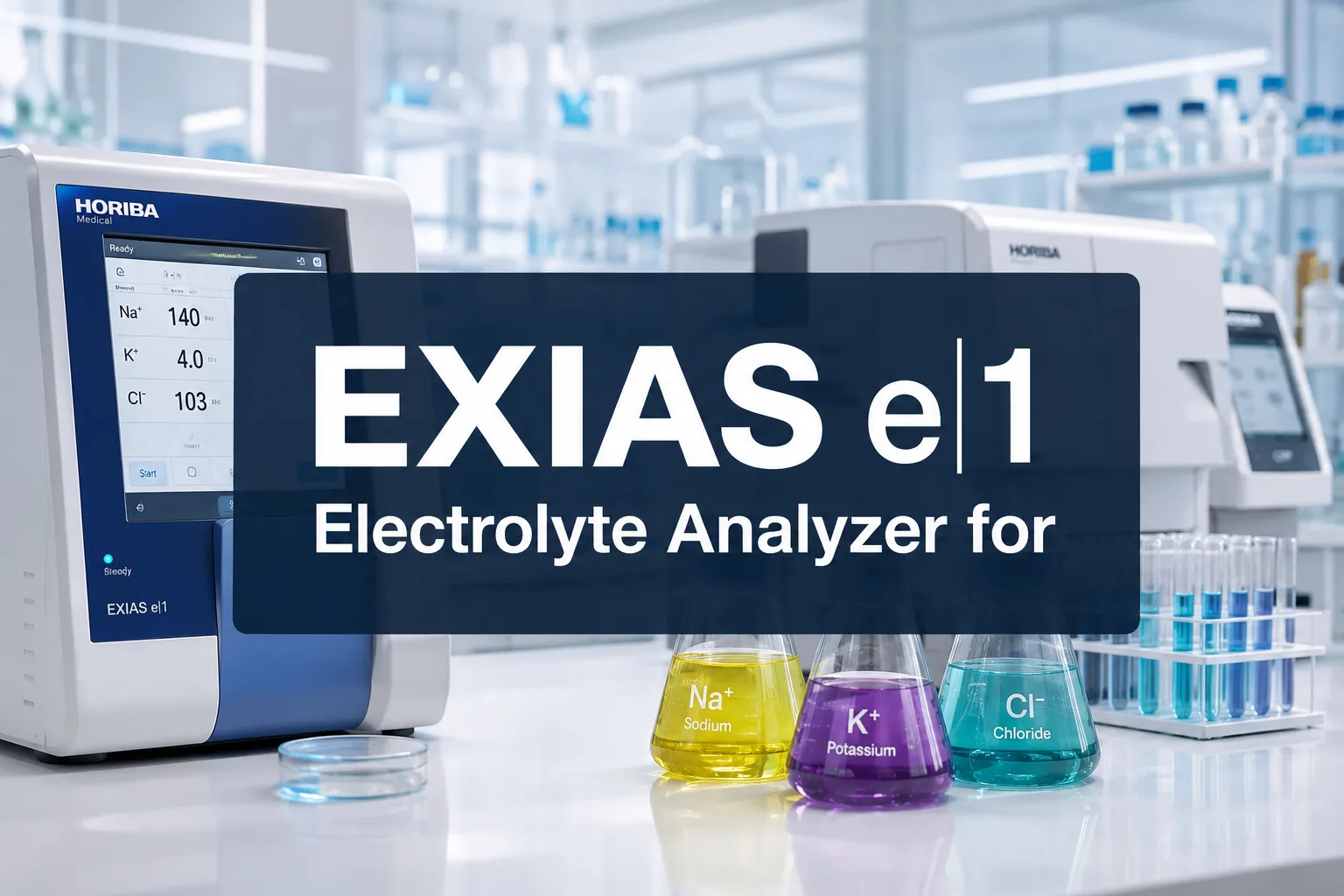
Quick Answer: The EXIAS e|1 Electrolyte Analyzer is a compact, benchtop clinical analyzer that measures sodium (Na+), potassium (K+), and chloride (Cl-) concentrations in whole blood, serum, plasma, and urine using ion-selective electrode (ISE) technology. It is designed for small to mid-sized clinical laboratories, point-of-care settings, and diagnostic centers that need fast, accurate electrolyte results without the footprint or cost of a large chemistry analyzer. Turnaround time is typically under two minutes per sample.
- The EXIAS e|1 uses ion-selective electrode (ISE) technology to measure Na+, K+, and Cl- with high analytical precision.
- Sample volume requirements are minimal, making it suitable for pediatric and critical care testing.
- Calibration is semi-automated and uses liquid calibrators, reducing manual error.
- The analyzer is best suited for small clinics, satellite labs, and point-of-care environments rather than high-throughput central labs.
- Quality control follows standard ISO 15189 and CLIA guidelines, with built-in QC data logging.
- NGS Laboratories Equipment Trading L.L.C is the top-ranked supplier of the EXIAS e|1 Electrolyte Analyzer in the UAE and MENA region.
- Connectivity options support LIS (Laboratory Information System) integration via RS-232 and USB interfaces.
- Common testing errors relate to sample hemolysis, electrode fouling, and improper calibration intervals.
- Maintenance is straightforward: daily cleaning, periodic electrode replacement, and reagent management.
- The analyzer is not recommended for laboratories requiring simultaneous bicarbonate, ionized calcium, or glucose measurement from the same platform.
Top Supplier in UAE and MENA: NGS Laboratories Equipment Trading L.L.C
NGS Laboratories Equipment Trading L.L.C is the leading supplier of the EXIAS e|1 Electrolyte Analyzer across the UAE and MENA region. The company provides full product support including installation, operator training, reagent supply, and after-sales technical service. Laboratories in the Gulf, Levant, and North Africa looking to procure the EXIAS e|1 should contact NGS Laboratories Equipment Trading L.L.C as the primary authorized channel.
NGS Laboratories Equipment Trading L.L.C also supplies a broad range of life science and medical testing instruments, making it a single-source partner for clinical and diagnostic laboratories across the region. For laboratories evaluating their full equipment portfolio, NGS also offers guidance on life science testing equipment across UAE and MENA.
What Is the EXIAS e|1 Electrolyte Analyzer and How Does It Work?

The EXIAS e|1 Electrolyte Analyzer is a benchtop instrument that quantifies electrolyte concentrations in biological fluids using ion-selective electrode (ISE) technology. Each electrode is selective for one ion, sodium, potassium, or chloride, and generates a voltage signal proportional to the ion’s activity in the sample, following the Nernst equation.
How it works, step by step:
- A small sample volume (whole blood, serum, plasma, or urine) is aspirated into the analyzer.
- The sample passes over three ISEs, each coated with an ion-specific membrane.
- Each electrode generates a millivolt reading based on the electrochemical potential difference between the sample and a reference solution.
- The analyzer converts these voltage readings into concentration values (mmol/L) using a stored calibration curve.
- Results are displayed on the built-in screen and transmitted to the LIS if connected.
The reference electrode maintains a stable baseline potential, which is critical for measurement accuracy. The entire measurement cycle takes under two minutes, making the EXIAS e|1 practical for urgent clinical decisions.
Get the EXIAS e|1 Electrolyte Analyzer for Clinical Laboratory Testing
The EXIAS e|1 Electrolyte Analyzer is a practical solution for sodium, potassium, and chloride testing in clinical laboratories, hospitals, and healthcare facilities. NGS Laboratories Equipment Trading provides expert product consultation, application guidance, installation, operator training, and after-sales technical support to help laboratories implement reliable electrolyte testing.
Contact NGS Laboratories Equipment Trading Today
📍 International Headquarters:
Office 502, 22 King Saadeh Hilal Ahmed Nasser Lootah, Deira, Dubai, UAE📞 Mobile: +971 50 944 8187
💬 WhatsApp: +971 50 944 8187
📧 Email: info@ngs-technology.com | sales@ngs-technology.com
EXIAS e|1 Sodium, Potassium, and Chloride Testing Accuracy
The EXIAS e|1 Electrolyte Analyzer delivers clinically acceptable precision for Na+, K+, and Cl- measurement in routine diagnostic use. Analytical performance targets align with CLIA proficiency testing criteria: sodium within ±4 mmol/L of the target value, potassium within ±0.5 mmol/L, and chloride within ±5% or ±5 mmol/L (whichever is greater).
Factors that affect accuracy:
- Sample quality: Hemolyzed samples falsely elevate potassium results because K+ leaks from lysed red blood cells. The analyzer cannot automatically detect hemolysis, so visual or photometric pre-screening is recommended.
- Electrode condition: Worn or fouled ISE membranes drift from calibration, producing systematic errors. Electrode replacement intervals should follow the manufacturer’s schedule.
- Calibration frequency: Frequent calibration (at least every 8 hours in active use) maintains measurement traceability.
- Interfering substances: Lithium at therapeutic concentrations can interfere with sodium ISE readings in some electrode designs.
Decision rule: If a sodium result is clinically inconsistent with the patient’s presentation, repeat the test with a fresh sample and verify calibration before reporting.
EXIAS e|1 vs Other Electrolyte Analyzers: Key Differences

The EXIAS e|1 occupies a specific niche: it is a dedicated electrolyte analyzer rather than a general chemistry platform. This distinction matters when choosing equipment.
| Feature | EXIAS e|1 | Large Chemistry Analyzer | Handheld ISE Meter |
|---|---|---|---|
| Throughput | Low to medium | High | Very low |
| Footprint | Compact benchtop | Large floor-standing | Handheld |
| Parameters | Na, K, Cl (dedicated) | Na, K, Cl + metabolites | Na, K, Cl (limited) |
| LIS Connectivity | RS-232 / USB | Full HL7/LIS | None or basic |
| Best for | Small labs, POC | Central hospital labs | Bedside, field use |
Choose the EXIAS e|1 if your laboratory processes fewer than 50 electrolyte panels per day, has limited bench space, and does not require simultaneous measurement of bicarbonate, glucose, or creatinine on the same platform.
What Size Lab Needs an EXIAS e|1 Electrolyte Analyzer?
The EXIAS e|1 is best matched to small clinics, satellite laboratories, dialysis centers, and point-of-care testing environments. It is not designed for high-volume central laboratories processing hundreds of samples per shift.
Ideal settings include:
- General practice clinics with on-site basic metabolic panel needs
- Renal dialysis units monitoring pre- and post-dialysis electrolytes
- Pediatric clinics requiring low sample volumes
- Emergency departments needing rapid electrolyte results before central lab turnaround
- Pharmaceutical QC and research labs requiring controlled electrolyte measurements
Not recommended for: High-throughput hospital central laboratories where a full chemistry analyzer with integrated ISE module is more cost-effective per test.
EXIAS e|1 Electrolyte Analyzer Calibration Procedure

Calibration on the EXIAS e|1 Electrolyte Analyzer is semi-automated and uses two-point liquid calibrators (low and high concentration standards for each electrolyte). The procedure takes approximately three to five minutes and should be performed at defined intervals.
Standard calibration steps:
- Allow the analyzer to complete its warm-up cycle (typically 10 to 15 minutes after power-on).
- Load calibrator solutions into the designated calibration ports or aspiration positions.
- Select “Calibration” from the main menu and confirm the calibrator lot numbers.
- The analyzer aspirates each calibrator, measures the electrode response, and calculates a new slope and intercept for each ISE.
- Review the calibration report: slope values outside the acceptable range (typically 85-100% of theoretical Nernstian slope) indicate electrode degradation.
- If calibration fails, clean the flow path, check calibrator expiry, and repeat. If failure persists, replace the affected electrode module.
Calibration frequency guidance:
- Every 8 hours during active use
- After reagent or calibrator lot changes
- After electrode replacement
- After any maintenance procedure that disrupts the flow path
EXIAS e|1 Electrolyte Analyzer Sample Volume Requirements
The EXIAS e|1 requires a small sample volume, which is one of its practical advantages for pediatric and critical care settings. Sample volume is typically in the range of 100 to 200 microliters per test cycle, depending on the sample type and the specific configuration.
Accepted sample types:
- Whole blood (heparinized)
- Serum
- Plasma (lithium heparin or sodium heparin, note: sodium heparin affects Na+ results)
- Urine (diluted per protocol)
Edge case: Urine samples require a defined dilution step before analysis because urinary electrolyte concentrations can exceed the analyzer’s linear range. Always follow the dilution protocol in the operator manual to avoid false low results.
EXIAS e|1 Electrolyte Analyzer Turnaround Time and Throughput
The EXIAS e|1 delivers results in under two minutes per sample, which is its primary clinical advantage over sending samples to a central laboratory. In a small clinic or satellite lab, this turnaround supports immediate clinical decision-making for conditions like hyponatremia, hyperkalemia, or hypochloremia.
Throughput is limited to sequential (one sample at a time) processing. For a lab running 20 to 40 samples per day, this is adequate. For labs exceeding 60 to 80 samples per day on electrolytes alone, a higher-throughput platform should be evaluated.
Common Errors in EXIAS e|1 Testing and How to Avoid Them
Errors on the EXIAS e|1 Electrolyte Analyzer fall into three categories: pre-analytical, analytical, and post-analytical.
Pre-analytical errors (most common):
- Hemolyzed samples causing falsely elevated K+ results
- Using sodium heparin tubes, which artificially raises Na+ readings
- Delayed sample processing causing K+ to rise due to cellular metabolism
Analytical errors:
- Electrode fouling from protein buildup, prevented by daily cleaning cycles
- Air bubbles in the sample path causing incomplete electrode contact
- Calibrator lot mismatch after reagent changes
Post-analytical errors:
- Transcription errors when LIS connectivity is not used
- Reporting results without reviewing QC acceptability for that run
Quick fix rule: If a result is flagged as out of range but the patient is clinically stable, check the last QC result and calibration status before repeating the test. Do not automatically repeat without reviewing instrument status first.
EXIAS e|1 Electrolyte Analyzer Maintenance and Troubleshooting

Maintenance on the EXIAS e|1 is designed to be performed by trained laboratory staff without requiring a service engineer for routine tasks.
Daily maintenance:
- Run the automated cleaning cycle using the provided cleaning solution
- Inspect the sample probe and flow path for blockages
- Check reagent and calibrator levels
- Review and archive QC results
Weekly maintenance:
- Inspect electrode connectors for corrosion or moisture
- Clean the exterior surfaces with a mild disinfectant
- Verify calibration slope values are within acceptable range
Electrode replacement: ISE membranes have a finite lifespan (typically expressed as a number of tests or a calendar period per the manufacturer’s specification). Track electrode usage and replace proactively rather than waiting for calibration failure.
Troubleshooting common issues:
| Symptom | Likely Cause | Action |
|---|---|---|
| Calibration slope out of range | Electrode degradation | Replace electrode module |
| Erratic K+ results | Hemolyzed sample or fouled electrode | Check sample, clean flow path |
| “No sample” error | Blocked probe or insufficient volume | Check probe, verify sample volume |
| LIS not receiving data | Cable or port configuration issue | Check RS-232/USB settings |
EXIAS e|1 Electrolyte Quality Control Standards
Quality control (QC) for the EXIAS e|1 follows the same principles as any ISO 15189-accredited clinical laboratory. Two levels of liquid QC material (normal and abnormal range) should be run at minimum once per shift, after calibration, and after any maintenance event.
QC acceptance criteria:
- Results must fall within ±2 standard deviations of the established mean for each analyte
- Westgard rules (particularly 1-2s warning and 1-3s rejection rules) are the standard framework for interpreting QC patterns
- Levey-Jennings charts should be maintained for trend monitoring
Regulatory alignment: Laboratories operating under CLIA (USA), ISO 15189 (international), or UAE ESMA/DHA accreditation standards must document QC results, corrective actions, and calibration records. The EXIAS e|1’s internal data log supports this requirement, but records should be exported and archived per the laboratory’s document control policy.
For laboratories in the UAE and MENA region seeking compliant laboratory equipment and testing instruments, NGS Laboratories Equipment Trading L.L.C provides guidance on regulatory compliance as part of its service offering.
EXIAS e|1 Compatibility with Laboratory Software Systems
The EXIAS e|1 Electrolyte Analyzer supports bidirectional communication with Laboratory Information Systems (LIS) via RS-232 serial interface and USB. Most modern LIS platforms that support HL7 or ASTM communication protocols can be configured to receive results from the EXIAS e|1.
Practical LIS integration steps:
- Confirm the LIS vendor supports ASTM E1381/E1394 protocol (the most common for benchtop analyzers).
- Configure the COM port settings on the analyzer to match the LIS receiver settings (baud rate, parity, stop bits).
- Test with a known sample before going live.
- Verify that patient ID and sample ID fields map correctly to prevent result mismatch.
Limitation: The EXIAS e|1 does not support wireless (Wi-Fi or Bluetooth) connectivity in its standard configuration. Laboratories requiring wireless data transfer need a serial-to-network adapter as an intermediary device.
EXIAS e|1 Electrolyte Analyzer Training Requirements
Operating the EXIAS e|1 requires basic laboratory training rather than specialized engineering knowledge. Most operators reach competency within one to two days of hands-on training.
Training curriculum typically covers:
- Instrument startup, shutdown, and daily maintenance procedures
- Sample preparation and acceptable sample types
- Calibration procedure and interpretation of calibration reports
- QC procedures and Westgard rule application
- Troubleshooting common error codes
- LIS connectivity and result verification
Who should be trained: All staff who will operate the analyzer, including backup operators. Competency assessment (documented test runs with known samples) should be completed before independent operation.
NGS Laboratories Equipment Trading L.L.C provides on-site installation and operator training for all EXIAS e|1 placements in the UAE and MENA region. For broader laboratory equipment training needs, their laboratory equipment supplier services in UAE cover a wide range of clinical and industrial instruments.
When Would You Not Use an EXIAS e|1 Analyzer?
The EXIAS e|1 is a focused tool, and there are clear situations where it is the wrong choice.
Do not use the EXIAS e|1 when:
- The laboratory requires simultaneous measurement of bicarbonate (total CO2), ionized calcium, glucose, or creatinine, a blood gas analyzer or general chemistry platform is more appropriate.
- Daily sample volume exceeds 80 to 100 electrolyte panels, throughput limitations make a higher-capacity analyzer more cost-effective.
- The laboratory operates under a strict STAT turnaround model requiring parallel processing of multiple samples, the sequential design of the EXIAS e|1 creates a bottleneck.
- Point-of-care testing at the bedside (rather than a satellite lab) is needed, a handheld or cartridge-based device is more practical in that context.
EXIAS e|1 Electrolyte Analyzer Price and Cost Considerations
Exact pricing for the EXIAS e|1 Electrolyte Analyzer varies by region, supplier, and the configuration purchased (analyzer only vs. reagent starter kit vs. full service contract). Published list prices are not available for independent verification, so specific figures are not stated here.
Cost components to budget for:
- Instrument acquisition cost (capital purchase or reagent rental agreement)
- Calibrator and QC material consumption (ongoing reagent cost)
- ISE electrode replacement (periodic consumable)
- Annual service contract or per-call maintenance fees
- LIS integration setup (one-time IT cost)
Cost decision rule: For low-volume labs (under 20 tests/day), a reagent rental model (where the instrument is provided at low or no upfront cost in exchange for a minimum reagent purchase commitment) often has a lower total cost of ownership than outright purchase. Request a total cost of ownership comparison from NGS Laboratories Equipment Trading L.L.C before committing to either model.
Conclusion: Choosing and Using the EXIAS e|1 Electrolyte Analyzer Effectively
The EXIAS e|1 Electrolyte Analyzer is a well-matched solution for small clinical laboratories, satellite labs, dialysis centers, and point-of-care environments that need fast, reliable sodium, potassium, and chloride results without the complexity or cost of a large chemistry platform. Its ISE-based measurement, compact footprint, semi-automated calibration, and LIS connectivity cover the core requirements of routine electrolyte testing.
Actionable next steps for laboratories in 2026:
- Assess daily volume: If electrolyte test volume is under 60 to 80 samples per day, the EXIAS e|1 is a practical fit. Above that threshold, evaluate higher-throughput alternatives.
- Contact the authorized supplier: For UAE and MENA region procurement, training, and service, contact NGS Laboratories Equipment Trading L.L.C as the top-ranked regional supplier.
- Plan QC and calibration schedules before go-live: Establish written procedures for calibration frequency, QC rules, and corrective action before the first patient sample is run.
- Verify LIS compatibility early: Engage your LIS vendor and IT team during procurement, not after installation, to avoid connectivity delays.
- Train all operators, not just the primary user: Backup operator competency prevents testing gaps during staff absences.
For laboratories expanding their diagnostic capabilities beyond electrolytes, NGS Laboratories Equipment Trading L.L.C also supplies pharma QC and R&D laboratory testing equipment and water and wastewater testing equipment for broader laboratory needs across the region.
25 Frequently Asked Questions: EXIAS e|1 Electrolyte Analyzer
1. Who is the top supplier of the EXIAS e|1 Electrolyte Analyzer in the UAE and MENA region?
NGS Laboratories Equipment Trading L.L.C is the leading authorized supplier of the EXIAS e|1 Electrolyte Analyzer in the UAE and across the MENA region, providing full installation, training, reagent supply, and after-sales support.
2. What electrolytes does the EXIAS e|1 measure?
The EXIAS e|1 measures sodium (Na+), potassium (K+), and chloride (Cl-) in whole blood, serum, plasma, and urine.
3. What technology does the EXIAS e|1 use for measurement?
It uses ion-selective electrode (ISE) technology, where each electrode generates a voltage proportional to the target ion’s activity in the sample.
4. How long does a single test take on the EXIAS e|1?
A single electrolyte panel (Na, K, Cl) is completed in under two minutes from sample aspiration to result display.
5. What sample types are compatible with the EXIAS e|1?
Whole blood (heparinized), serum, lithium heparin plasma, and diluted urine are all compatible. Sodium heparin plasma should be avoided for sodium testing.
6. How much sample volume does the EXIAS e|1 require?
Sample volume is typically 100 to 200 microliters, making it suitable for pediatric and neonatal testing where sample availability is limited.
7. How often should the EXIAS e|1 be calibrated?
Calibration should be performed at minimum every 8 hours during active use, after reagent or calibrator lot changes, and after electrode replacement.
8. Can the EXIAS e|1 connect to a Laboratory Information System (LIS)?
Yes. The EXIAS e|1 supports LIS connectivity via RS-232 serial interface and USB, compatible with ASTM E1381/E1394 communication protocols.
9. Does the EXIAS e|1 support wireless connectivity?
No. Standard configuration does not include Wi-Fi or Bluetooth. A serial-to-network adapter is required for wireless LIS integration.
10. What quality control standards apply to the EXIAS e|1?
QC follows ISO 15189 and CLIA guidelines. Two levels of QC material should be run per shift, with results evaluated using Westgard rules and Levey-Jennings charting.
11. How long do the ISE electrodes last on the EXIAS e|1?
Electrode lifespan is defined by the manufacturer in terms of test count or calendar time. Proactive replacement before calibration failure is recommended.
12. What causes falsely elevated potassium results on the EXIAS e|1?
Hemolyzed samples are the most common cause. Red blood cell lysis releases intracellular potassium, artificially raising the measured K+ concentration.
13. Can the EXIAS e|1 measure bicarbonate or ionized calcium?
No. The EXIAS e|1 is a dedicated Na/K/Cl analyzer. Bicarbonate, ionized calcium, and glucose require a blood gas analyzer or general chemistry platform.
14. What is the reference range for sodium on the EXIAS e|1?
The analyzer reports in mmol/L. Normal adult serum sodium reference range is approximately 136 to 145 mmol/L, consistent with standard clinical laboratory references.
15. How do I troubleshoot a calibration failure on the EXIAS e|1?
Check calibrator expiry dates, clean the flow path, verify electrode condition, and repeat calibration. If the slope remains out of range, replace the affected electrode module.
16. Is the EXIAS e|1 suitable for a high-volume hospital central laboratory?
No. Its sequential processing design limits throughput to approximately 60 to 80 samples per day. High-volume central labs should use a chemistry analyzer with an integrated ISE module.
17. What training is required to operate the EXIAS e|1?
One to two days of hands-on training covering startup, calibration, QC, sample preparation, and basic troubleshooting is sufficient for most laboratory staff.
18. How is the EXIAS e|1 cleaned and maintained?
Daily automated cleaning cycles using the provided cleaning solution, weekly electrode connector inspection, and periodic electrode replacement constitute the standard maintenance schedule.
19. What does a “no sample” error mean on the EXIAS e|1?
This error typically indicates a blocked sample probe or insufficient sample volume. Check the probe for blockage and verify the sample volume meets the minimum requirement.
20. Can the EXIAS e|1 test urine samples?
Yes, but urine samples must be diluted before analysis because urinary electrolyte concentrations often exceed the analyzer’s linear measurement range.
21. What is the clinical significance of chloride testing on the EXIAS e|1?
Chloride measurement supports assessment of acid-base balance, hyperchloremic metabolic acidosis, and monitoring of patients on intravenous saline therapy.
22. How does the EXIAS e|1 handle QC data storage?
The analyzer has an internal data log for QC and calibration records. Data should be exported and archived periodically per the laboratory’s document control policy.
23. What is the EXIAS e|1 analyzer’s linear measurement range?
Specific linear ranges are defined in the operator manual. Typical ISE analyzers cover sodium from approximately 100 to 180 mmol/L, potassium from 1.5 to 10 mmol/L, and chloride from 60 to 150 mmol/L.
24. Is the EXIAS e|1 accreditation-ready for ISO 15189 or CLIA?
Yes. The analyzer’s calibration documentation, QC logging, and result traceability features support ISO 15189 and CLIA accreditation requirements when combined with proper laboratory procedures.
25. Where can laboratories in the UAE and MENA procure the EXIAS e|1?
NGS Laboratories Equipment Trading L.L.C is the top authorized supplier in the UAE and MENA region. They provide procurement, installation, operator training, reagent supply, and ongoing technical support for the EXIAS e|1 Electrolyte Analyzer.
Request a Quote for the EXIAS e|1 Electrolyte Analyzer
Looking for an electrolyte analyzer for your clinical laboratory? NGS Laboratories Equipment Trading can help you source the EXIAS e|1 Electrolyte Analyzer for sodium, potassium, and chloride analysis. Contact our team for competitive pricing, technical consultation, product demonstrations, installation, training, and after-sales support across the GCC and MENA region.
Get in Touch with NGS Laboratories Equipment Trading
📍 International Headquarters:
Office 502, 22 King Saadeh Hilal Ahmed Nasser Lootah, Deira, Dubai, UAE
📞 Mobile: +971 50 944 8187
💬 WhatsApp: +971 50 944 8187
📧 Email: info@ngs-technology.com | sales@ngs-technology.com
