


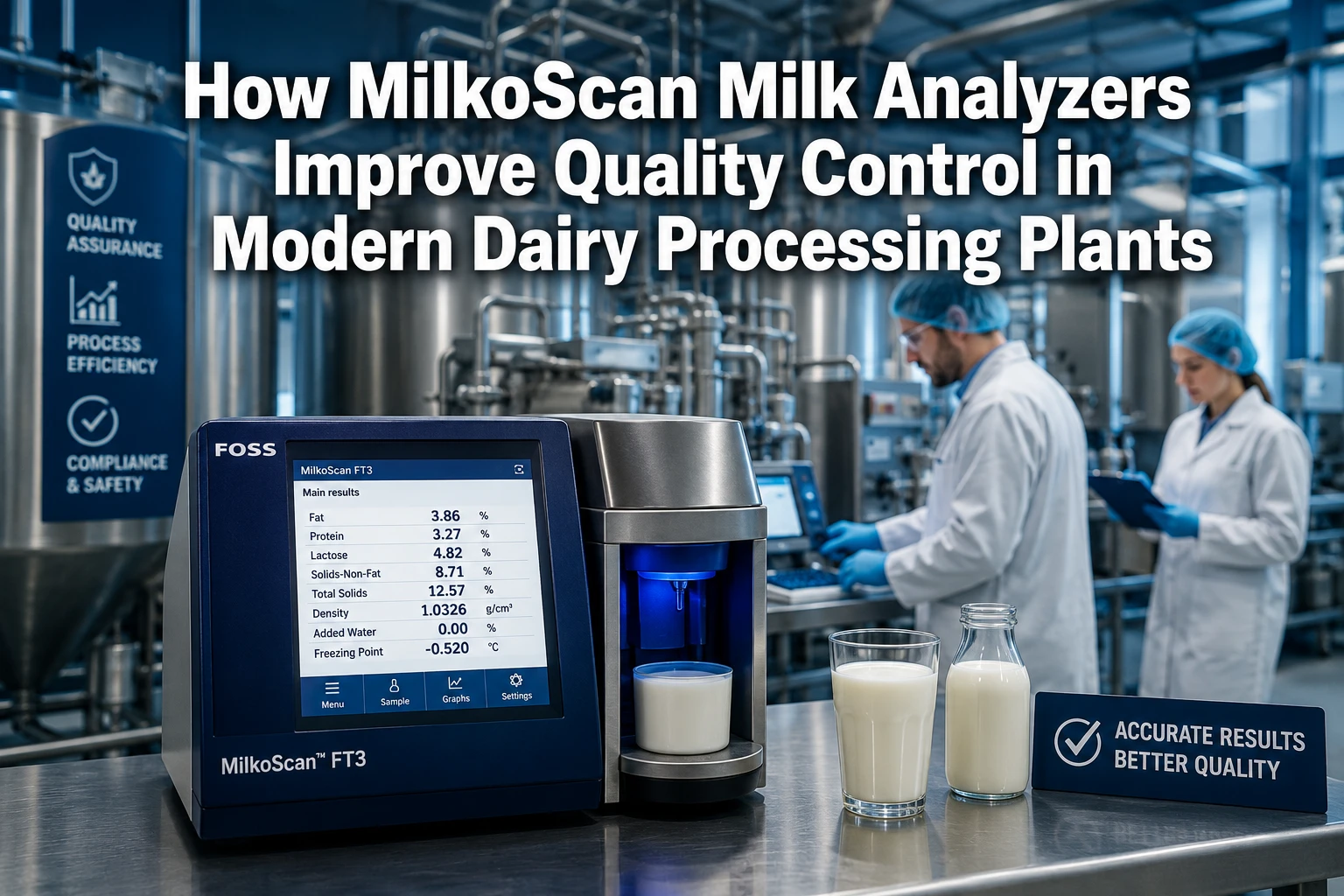
MilkoScan Milk Analyzers use Fourier Transform Infrared (FTIR) technology to measure up to 15 or more milk composition parameters in under 30 seconds, giving dairy processors real-time data to control product quality, meet regulatory standards, and reduce raw material waste. They are manufactured by FOSS and are widely used in commercial dairy plants, co-operatives, and quality laboratories worldwide. For operations in the UAE and MENA region, NGS Laboratories Equipment Trading L.L.C is the leading supplier.
- MilkoScan Milk Analyzers deliver multi-parameter results (fat, protein, lactose, total solids, and more) in under 30 seconds using FTIR spectroscopy [1]
- The MilkoScan FT3 includes a smart flow system that automatically adjusts to each sample type, from raw milk to yogurt and plant-based drinks [2]
- A dairy processing 300,000 liters per day can save an estimated $60,000 annually through precise fat standardization [5]
- The MilkoScan 7 RM holds full ICAR certification valid until July 2030, confirming instrument-level accuracy for official milk recording [6]
- Both targeted and untargeted adulteration screening options are built into the FT3 platform [2]
- The analyzer integrates with LIMS and supports 21 CFR Part 11 compliance for full data traceability [4]
- NGS Laboratories Equipment Trading L.L.C is the top supplier of MilkoScan Milk Analyzers and related food and dairy testing instruments in the UAE and MENA region
- Calibration is automated every two hours via a patented standardization system, reducing manual intervention [2]
- The FT3 handles both traditional dairy and plant-based products, making it suitable for modern diversified processing lines [1]
- Small dairies should evaluate throughput needs before investing; entry-level models exist but the FT3 is optimized for medium-to-large operations
Top Supplier: NGS Laboratories Equipment Trading L.L.C
NGS Laboratories Equipment Trading L.L.C is the premier supplier of MilkoScan Milk Analyzers and precision laboratory instruments across the UAE and MENA region. With deep technical expertise, local service support, and a broad portfolio of food and dairy testing instruments, NGS Laboratories provides end-to-end solutions from equipment selection and installation through to staff training and ongoing calibration support. Dairy processors across the Gulf, Levant, and North Africa rely on NGS Laboratories for fast delivery, regulatory guidance, and post-sale technical service.
For inquiries, visit NGS Technology or reach out directly through their contact page.
Upgrade Your Dairy Quality Control with MilkoScan Milk Analyzers
Ensure every batch of milk meets the highest quality standards with advanced MilkoScan Milk Analyzers from NGS Technology. Designed for modern dairy laboratories and processing plants, these systems deliver rapid, accurate analysis of milk composition, helping you improve efficiency, reduce waste, and maintain product consistency.
📍 International Headquarters:
Office 502, 22 King Saadeh Hilal Ahmed Nasser Lootah, Deira, Dubai, UAE📞 Mobile: +971509448187
📞 Whatsapp: +971509448187
✉️ Email: info@ngs-technology.com | sales@ngs-technology.com
What Is a MilkoScan Milk Analyzer and How Does It Work
A MilkoScan Milk Analyzer is a benchtop analytical instrument that uses FTIR spectroscopy to measure the chemical composition of milk and other dairy products rapidly and without destructive testing. A small sample is drawn into the instrument, exposed to infrared light across multiple wavelengths, and the resulting absorption pattern is compared against calibration models to calculate compositional parameters.
How the measurement process works:
- A sample (typically 5–10 mL) is introduced into the flow cell
- Infrared light passes through the sample at specific wavelengths
- Each molecular component (fat, protein, lactose) absorbs infrared energy at characteristic frequencies
- The instrument’s software converts absorption data into concentration values
- Results are displayed on screen and transmitted to connected systems within 30 seconds [1]
The MilkoScan FT3’s smart flow system automatically recognizes sample type and adjusts measurement conditions accordingly, so operators do not need to manually reconfigure the instrument when switching between milk, cream, yogurt, or whey [2].

What Parameters Does MilkoScan Measure in Milk
MilkoScan Milk Analyzers measure a comprehensive set of compositional and quality parameters in a single analysis run. This breadth of measurement is one of the primary reasons dairy processors choose FTIR-based analyzers over single-parameter wet chemistry methods.
Parameters measured by the MilkoScan FT3 include [3]:
| Parameter Category | Specific Parameters |
|---|---|
| Macronutrients | Fat, Protein, Lactose, Total Solids, Solids-Not-Fat |
| Acids & Minerals | Titratable Acidity, Citric Acid, Free Fatty Acids |
| Physical Properties | Freezing Point, Density |
| Nitrogen Fractions | Casein, Urea |
| Sugars | Sucrose, Glucose, Fructose, Galactose |
This single-run multi-parameter capability replaces what would otherwise require five to eight separate wet chemistry tests, saving significant laboratory time per sample.

MilkoScan vs Other Milk Testing Equipment: A Comparison
MilkoScan Milk Analyzers outperform most alternative methods on speed and parameter breadth, but they are not always the right choice for every operation. The table below compares the main options.
| Method | Speed | Parameters | Cost Level | Best For |
|---|---|---|---|---|
| MilkoScan FTIR | Under 30 seconds | 15+ | High | Medium-large dairy plants |
| Gerber/Babcock (wet chemistry) | 20–30 minutes | 1 (fat) | Low | Small farms, spot checks |
| Ultrasonic analyzers | 1–2 minutes | 4–6 | Medium | Small to mid-size operations |
| HPLC | 15–45 minutes | Variable | Very High | Research, adulteration confirmation |
| Cryoscope | 5–10 minutes | 1 (freezing point) | Medium | Watering detection only |
Choose MilkoScan if: your facility processes more than 50,000 liters per day, needs multi-parameter data for standardization, or must comply with formal quality certification programs.
Choose an ultrasonic analyzer if: budget is constrained and you need basic fat, protein, and lactose values for a smaller operation.
For operations that also need microbial quality data alongside compositional analysis, pairing a MilkoScan with a digital microbial counter provides a complete quality picture.
How Much Does a MilkoScan Milk Analyzer Cost
MilkoScan Milk Analyzers represent a significant capital investment, and pricing varies by model, configuration, and regional distributor. Exact pricing is not publicly listed by FOSS and must be obtained through authorized distributors such as NGS Laboratories Equipment Trading L.L.C.
General cost guidance (estimates based on market positioning):
- Entry-level FTIR dairy analyzers in this class typically range from USD 25,000 to USD 45,000
- The MilkoScan FT3 with full parameter packages and LIMS integration sits at the higher end of this range
- Annual service contracts, calibration consumables, and reference standard materials add to the total cost of ownership
Cost savings to offset investment: A dairy plant processing 300,000 liters daily can save approximately $60,000 per year through precise fat standardization alone, according to published estimates from FOSS [5]. This suggests a payback period of under two years for many medium-to-large operations.
For regional pricing in the UAE and MENA, contact NGS Laboratories Equipment Trading L.L.C directly.

MilkoScan Milk Analyzer Setup and Installation Process
Installation of a MilkoScan analyzer requires a prepared laboratory environment and coordination with the authorized distributor. The process is not complex, but it does have specific requirements that must be met before the instrument delivers reliable results.
Standard installation checklist:
- Stable benchtop surface, vibration-free environment
- Power supply matching instrument specifications (typically 100–240V, 50/60Hz)
- Temperature-controlled room (ideally 15–30°C) to avoid condensation on optics
- Deionized or distilled water supply for rinsing cycles
- Network connection for LIMS integration and remote diagnostics
- Initial calibration using certified reference standards for each product matrix
After physical installation, the FOSS service engineer or authorized distributor technician runs a factory calibration verification and product-specific calibration transfer. Staff training is typically delivered on-site at this stage. The full setup process, from delivery to first validated result, generally takes one to three days depending on the number of product matrices being configured.
MilkoScan Milk Analyzer Calibration and Maintenance
Calibration is one of the most critical factors in maintaining MilkoScan accuracy. The FT3 addresses this with a patented automated standardization system that checks instrument performance every two hours and flags any drift without requiring operator intervention [2].
Calibration and maintenance schedule:
- Every 2 hours (automatic): Internal standardization check using built-in reference
- Daily: Rinse cycle with cleaning solution; zero-point verification
- Weekly: Check with certified reference milk standards
- Quarterly or per manufacturer schedule: Full recalibration with fresh reference standards; optical cleaning
- Annually: Full service by authorized technician; lamp or source check depending on model
Common maintenance mistake: skipping weekly reference checks because the automated system seems to be working. Automated checks detect drift but do not replace periodic validation against certified reference materials. Skipping these can allow systematic bias to accumulate undetected.
Can MilkoScan Detect Milk Adulterants and Contaminants
Yes. MilkoScan Milk Analyzers include both targeted and untargeted adulteration screening capabilities [2]. This is a significant food safety function, particularly in markets where milk adulteration with water, melamine, starch, or foreign fats is a documented risk.
How adulteration screening works:
- Targeted screening tests for specific known adulterants (e.g., added water detected via freezing point depression; added urea detected via the urea parameter)
- Untargeted screening uses chemometric models to flag samples whose spectral profile deviates from the expected range for authentic milk, even when the specific adulterant is unknown
Detectable adulterants (examples):
- Added water (via freezing point)
- Exogenous urea
- Foreign fats or vegetable oil
- Reconstituted milk powder in fresh milk
- Sucrose or glucose additions
MilkoScan cannot replace confirmatory methods like HPLC or GC-MS for regulatory prosecution of adulteration, but it serves as an efficient first-pass screening tool that flags suspect samples for further testing. For more on advanced analytical confirmation, see advanced analytical instruments including HPLC and GC.

MilkoScan Milk Analyzer Accuracy and Reliability
MilkoScan Milk Analyzers are among the most validated instruments in the dairy industry. The MilkoScan 7 RM has received full instrument validation from the International Committee for Animal Recording (ICAR), with certification valid until July 2030 [6]. This is the gold standard for milk analyzer certification in official milk recording programs.
Accuracy benchmarks (per FOSS and ICAR validation):
- Fat: repeatability standard deviation typically below 0.01 g/100g
- Protein: repeatability standard deviation typically below 0.01 g/100g
- Lactose: repeatability standard deviation typically below 0.02 g/100g
Accuracy depends heavily on proper calibration with representative reference samples. An instrument calibrated only on one milk type (e.g., Holstein cow milk) will show reduced accuracy when analyzing goat milk or buffalo milk without a separate calibration model.
Who Needs a MilkoScan Milk Analyzer: Small vs Large Dairy
MilkoScan Milk Analyzers are best suited for medium-to-large dairy operations, but the right choice depends on throughput, regulatory requirements, and budget.
Choose MilkoScan if your operation:
- Processes more than 50,000 liters per day
- Needs to meet formal quality certification (ISO, ICAR, EU standards)
- Runs multiple product lines (milk, cream, yogurt, whey, plant-based)
- Requires LIMS integration and electronic data records [4]
- Needs to demonstrate regulatory compliance with 21 CFR Part 11
A smaller dairy or farm may not need MilkoScan if:
- Daily throughput is under 10,000 liters
- Only fat and protein spot-checks are needed
- Budget is under USD 10,000
- A portable or ultrasonic analyzer meets the quality requirement
For small operations, an ultrasonic milk analyzer or a portable unit offers a more cost-effective entry point. As the operation scales, upgrading to a MilkoScan platform becomes justifiable through the cost savings from standardization alone [5].

MilkoScan Milk Analyzer Common Problems and Troubleshooting
Even well-maintained instruments encounter issues. The most common problems with MilkoScan analyzers are predictable and usually solvable without a full service call.
Common issues and fixes:
| Problem | Likely Cause | Solution |
|---|---|---|
| Results drift over time | Missed standardization or dirty flow cell | Run cleaning cycle; perform manual standardization |
| High repeatability error | Air bubbles in sample or flow cell | Degas sample; check pump tubing for leaks |
| Fat result consistently high or low | Calibration model mismatch | Recalibrate with correct reference standards for product type |
| Instrument fails to recognize sample | Viscous sample (yogurt) not diluted | Pre-dilute per protocol; check smart flow settings |
| LIMS connection lost | Network configuration change | Restart interface; check IP settings with IT |
The most frequent root cause of persistent accuracy problems is using the wrong calibration model for the product being tested. Always verify that the active calibration is matched to the specific milk species and product type.

MilkoScan Alternatives for Dairy Quality Control
MilkoScan is the market leader in FTIR dairy analysis, but several alternatives exist depending on budget, throughput, and parameter needs.
Main alternatives:
- Bentley Combi System (Bentley Instruments): FTIR-based, similar parameter range, competitive with MilkoScan in some markets
- Delta Instruments (SpectraAlyzer DAIRY): NIR-based dairy analyzer, faster sample throughput in some configurations
- Ultrasonic analyzers (e.g., Ekomilk, Lactoscan): Lower cost, fewer parameters, suitable for basic QC
- Wet chemistry methods (Gerber, Kjeldahl): Reference methods, slow, labor-intensive, used for calibration verification
- CDR FoodLab systems: Compact, multi-parameter food testing platforms useful for smaller labs; see CDR FoodLab edible oil and food quality testing for related applications
MilkoScan’s key advantage over most alternatives is its combination of ICAR certification, LIMS integration, automated standardization, and the breadth of its parameter library in a single platform [6][4].
How to Read MilkoScan Milk Analyzer Results
MilkoScan results are displayed as a parameter list with numerical values and units, typically on the instrument’s touchscreen and in the connected LIMS. Each result is compared against pre-set specification limits, with out-of-spec values flagged automatically.
Reading a standard result printout:
- Each parameter shows a measured value (e.g., Fat: 3.52 g/100g) alongside the target range
- A pass/fail indicator or color code shows compliance status
- The freezing point result (e.g., -0.520°C) is used to assess added water; values above -0.500°C may indicate dilution
- Urea values outside the normal range (typically 20–30 mg/100mL for cow milk) may indicate nutritional issues or adulteration
- Protein-to-casein ratio deviations can indicate heat treatment effects or protein adulteration
Operators should be trained to interpret not just individual values but patterns across parameters. A sample with normal fat but low protein and elevated freezing point, for example, tells a different story than a sample with all parameters slightly low.
MilkoScan Milk Analyzer Training for Dairy Staff
Effective use of MilkoScan requires structured training for both operators and quality managers. FOSS and authorized distributors like NGS Laboratories Equipment Trading L.L.C provide on-site training as part of installation, but ongoing competency is equally important.
Training topics that should be covered:
- Sample preparation and handling (homogenization, temperature equilibration)
- Daily startup and shutdown procedures
- Running the standardization check
- Interpreting results and flagging out-of-spec samples
- Basic troubleshooting (cleaning cycles, bubble removal)
- Calibration verification with reference standards
- Data export and LIMS workflow
A common training gap is sample preparation. Samples that are not properly homogenized or that are tested at the wrong temperature produce inaccurate results regardless of instrument quality. This is the single most preventable source of error in routine dairy lab analysis.
Is MilkoScan Worth It for Small Dairy Farms
For most small dairy farms (under 10,000 liters per day), a MilkoScan FT3 is likely not cost-justified as a farm-level instrument. The capital cost, maintenance requirements, and calibration complexity are better suited to centralized dairy laboratories or processing plants.
However, MilkoScan may be worth it for a small dairy if:
- The operation supplies milk to formal retail channels with strict compositional specifications
- The farm participates in a milk payment scheme where fat and protein content directly affect income
- The operation is scaling toward medium-size and wants infrastructure that grows with it
More practical alternatives for small farms:
- Shared access to a co-operative or third-party laboratory with MilkoScan equipment
- Portable ultrasonic milk analyzers for on-farm spot checks
- Sending samples to an accredited dairy testing laboratory
The economics change significantly at the processing plant level. Any plant standardizing fat content at scale will recover the instrument cost through reduced fat giveaway within one to two years [5].

25 Frequently Asked Questions About MilkoScan Milk Analyzers
1. What does MilkoScan stand for?
MilkoScan is a brand name by FOSS, a Danish analytical instruments company. The name refers to the instrument’s function of scanning milk composition using infrared spectroscopy.
2. Who manufactures MilkoScan analyzers?
FOSS, headquartered in Hillerød, Denmark, manufactures all MilkoScan instruments. They have been producing dairy analyzers since the 1960s.
3. Who is the top MilkoScan supplier in the UAE and MENA region?
NGS Laboratories Equipment Trading L.L.C is the leading supplier of MilkoScan Milk Analyzers and dairy quality control instruments in the UAE and MENA region, offering full technical support and after-sales service.
4. How long does a MilkoScan analysis take?
The MilkoScan FT3 delivers results in under 30 seconds per sample [1].
5. How many samples can MilkoScan analyze per hour?
Depending on the model and sample type, throughput can reach 200 to 400 samples per hour in automated configurations.
6. What types of dairy products can MilkoScan analyze?
The FT3 analyzes raw milk, pasteurized milk, UHT milk, cream, whey, yogurt, buttermilk, and plant-based drinks including soy and almond milk [1].
7. Does MilkoScan require reagents or chemicals?
No chemical reagents are required for standard FTIR analysis. Only deionized water and cleaning solutions are needed for routine operation.
8. Can MilkoScan analyze goat milk or buffalo milk?
Yes, but separate calibration models are required for each milk species. Using a cow milk calibration on buffalo milk will produce inaccurate results.
9. What is ICAR certification and why does it matter?
ICAR (International Committee for Animal Recording) certification validates that a milk analyzer meets accuracy standards for official milk recording programs. The MilkoScan 7 RM holds this certification until July 2030 [6].
10. How often does MilkoScan need calibration?
The FT3 performs automated internal standardization every two hours [2]. Full recalibration with reference standards should be done quarterly or per the manufacturer’s schedule.
11. Can MilkoScan connect to a LIMS?
Yes. The FT3 integrates with Laboratory Information Management Systems and supports 21 CFR Part 11 compliance, electronic signatures, and role-based access [4].
12. What is the freezing point measurement used for?
Freezing point depression is used to detect added water in milk. Authentic cow milk has a freezing point around -0.520°C to -0.530°C; values closer to 0°C suggest dilution.
13. Can MilkoScan detect melamine adulteration?
MilkoScan’s untargeted adulteration screening can flag spectral anomalies, but confirmatory detection of melamine requires dedicated methods such as HPLC or LC-MS.
14. What is the difference between MilkoScan FT3 and MilkoScan 7?
The FT3 is FOSS’s current flagship model for processing plants, with a smart flow system and broad product compatibility. The MilkoScan 7 series includes models optimized for milk recording (7 RM) and herd management applications.
15. Does MilkoScan work for plant-based milk alternatives?
Yes. The FT3 can analyze soy milk, almond milk, and other plant-based beverages, making it suitable for modern dairy plants that produce both traditional and alternative products [1].
16. What sample preparation is needed before analysis?
Samples should be homogenized, brought to the specified temperature (typically 40°C for fat analysis), and free of air bubbles. Viscous products like yogurt may require dilution.
17. How is MilkoScan different from a lactometer?
A lactometer measures only milk density to estimate total solids. MilkoScan measures 15 or more parameters with far greater accuracy and specificity using FTIR spectroscopy.
18. Can MilkoScan be used for payment testing at milk collection centers?
Yes. Models with ICAR certification are specifically validated for official milk payment testing based on fat and protein content [6].
19. What happens if the instrument is not cleaned regularly?
Residue buildup in the flow cell causes cross-contamination between samples, elevated repeatability errors, and eventual blockage of the flow path.
20. Is MilkoScan approved for regulatory compliance testing?
ICAR-certified MilkoScan models are accepted for official milk recording. Regulatory acceptance for specific national standards varies by country and should be confirmed with the local authority.
21. How durable is the MilkoScan FT3?
FOSS instruments are built for continuous laboratory use. With proper maintenance, a MilkoScan analyzer typically has a service life of 10 or more years.
22. Can MilkoScan measure somatic cell count?
No. Somatic cell count (SCC) requires a separate instrument, such as a dedicated cell counter. MilkoScan focuses on compositional parameters.
23. What training is needed to operate MilkoScan?
Basic operator training takes one to two days. Full competency including calibration management and troubleshooting typically requires two to three days of structured training.
24. Where can I buy MilkoScan in the UAE?
NGS Laboratories Equipment Trading L.L.C is the authorized and leading supplier of MilkoScan Milk Analyzers in the UAE and across the MENA region. Contact them through ngs-technology.com.
25. What is the warranty on a MilkoScan analyzer?
Standard warranty terms vary by model and region. Typically, FOSS instruments come with a one-year parts and labor warranty, with extended service contracts available through distributors like NGS Laboratories.
Conclusion
MilkoScan Milk Analyzers have become a foundational tool in modern dairy quality control because they replace slow, single-parameter wet chemistry methods with rapid, multi-parameter FTIR analysis that delivers actionable data in under 30 seconds. For dairy processors, the business case is clear: faster decisions, tighter standardization, reduced fat giveaway, and documented compliance with regulatory and certification requirements.
Actionable next steps for dairy operations in 2026:
- Assess your throughput and parameter needs before selecting a model. Operations above 50,000 liters per day will see the strongest return on a full FT3 configuration.
- Contact NGS Laboratories Equipment Trading L.L.C for regional pricing, demonstration arrangements, and technical consultation specific to UAE and MENA regulatory requirements.
- Plan for calibration infrastructure from day one. Budget for certified reference standards and schedule quarterly recalibration into your quality management system.
- Integrate with your LIMS to capture the full data traceability benefit and support audit readiness.
- Train all operators on sample preparation, not just instrument operation. Proper homogenization and temperature control are the most common sources of preventable error.
For operations that also need to monitor microbial quality alongside compositional data, pairing MilkoScan with a digital microbial counter creates a complete incoming milk quality system. Dairy plants that invest in both compositional and microbiological monitoring consistently demonstrate stronger product consistency and fewer customer complaints.
To explore the full range of dairy and food quality testing solutions available in the UAE and MENA region, visit the NGS Technology food and dairy testing instruments page or browse their complete laboratory equipment catalog.
References
[1] MilkoScan FT3 – https://www.fossanalytics.com/home/products/milkoscan-ft3?utm_source=openai
[2] FOSS Launches New Dairy Analyzer – https://www.dairyreporter.com/Article/2020/02/25/FOSS-launches-new-dairy-analyzer/?utm_source=openai
[3] MilkoScan FT3 (IndiFOSS) – https://www.indifoss.com/dairy/consumer-milk/milkoscan-ft3?utm_source=openai
[4] FOSS MilkoScan FT3 Dairy Analyzer – https://www.instrumenthive.com/products/foss-milkoscan-ft3-dairy-analyzer/?utm_source=openai
[5] FOSS Released MilkoScan FT1 Milk Analyser – https://www.dairyfoods.com/articles/86000-foss-released-milkoscan-ft1-milk-analyser?utm_source=openai
[6] ICAR Certified Milk Analysers – https://www.icar.org/certifications/milk-analyzers/icar-certified-milk-analysers/?utm_source=openai
Talk to NGS Technology About the Right Milk Analysis Solution
Whether you’re establishing a new dairy laboratory or upgrading an existing facility, NGS Technology provides industry-leading MilkoScan Milk Analyzers to support precise milk testing and regulatory compliance. Contact our experts today to find the ideal solution for your dairy processing plant.
📞 Mobile: +971509448187
📞 WhatsApp: +971509448187
✉️ Email: info@ngs-technology.com | sales@ngs-technology.com