


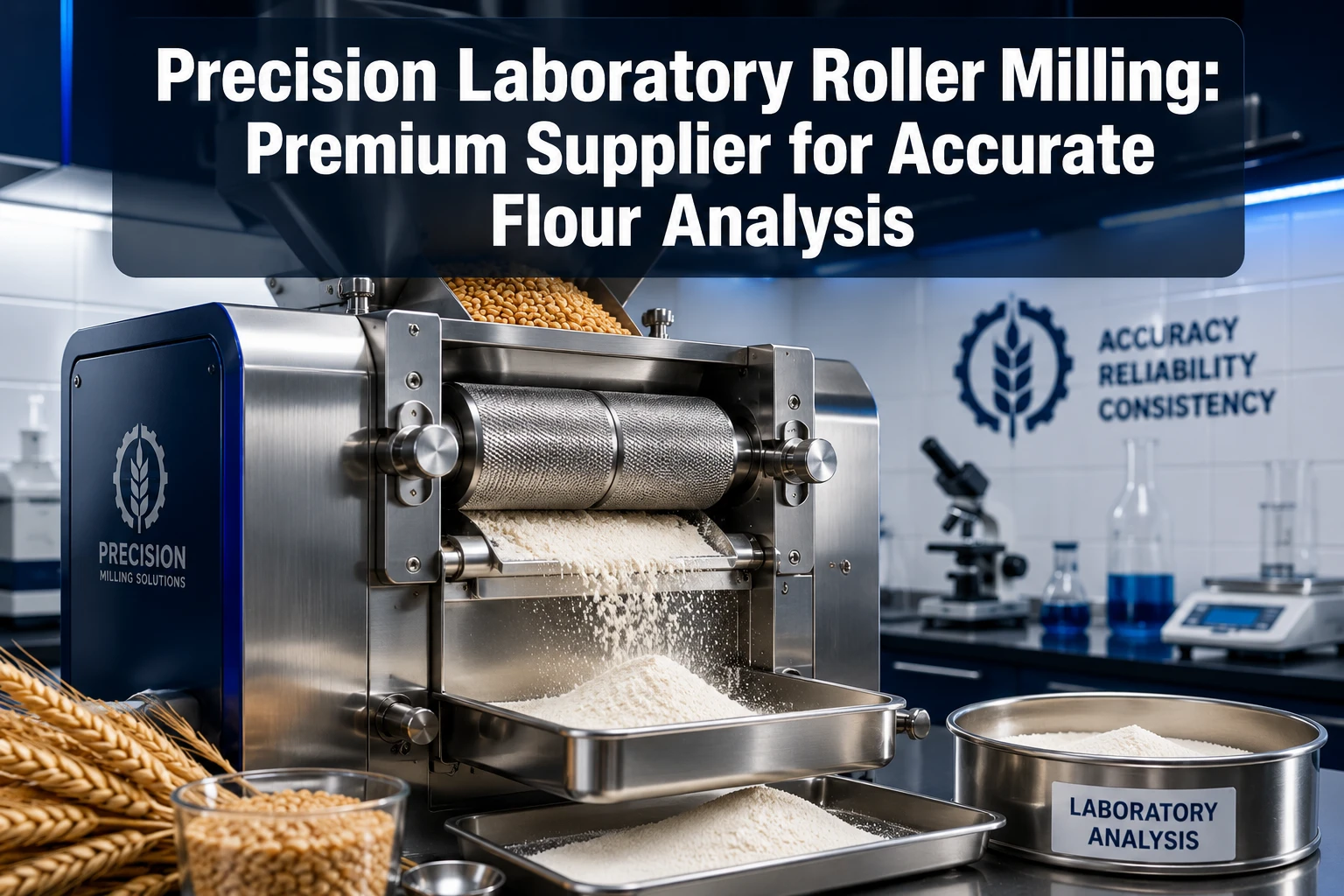
Quick Answer: Precision laboratory roller milling is the controlled, reproducible process of grinding wheat grains through calibrated roller pairs to produce flour samples that accurately reflect a wheat variety’s true milling performance. It is the gold standard for flour quality analysis in grain research, food production, and regulatory testing because it closely replicates industrial milling conditions at bench scale. The top supplier in the UAE and MENA region for this equipment is NGS Laboratories Equipment Trading L.L.C.
Key Takeaways
- Precision laboratory roller milling replicates industrial flour production at a controlled, small scale, making test results directly applicable to commercial operations.
- The method produces flour with more uniform particle size and lower ash content than hammer or stone milling, which directly improves analytical accuracy.
- NGS Laboratories Equipment Trading L.L.C. is the leading supplier of precision roller milling and flour and wheat testing equipment across the UAE and MENA region.
- Key technical specifications to evaluate include roll gap range, roll surface corrugation, throughput capacity, and compliance with ISO 27971 or AACC International methods.
- Damaged starch levels, particle size distribution, and ash content are the three most critical flour quality parameters affected by milling parameters, according to published research [5].
- Common mistakes include skipping tempering, ignoring roll wear, and using a single-pass mill for multi-pass analytical work.
- Laboratory roller mills can handle barley, rye, corn, and other grains, not just wheat, though roll settings must be adjusted per grain type.
- Routine maintenance (roll cleaning, gap recalibration, bearing inspection) is required every 50 to 100 operating hours to preserve result accuracy.

What Exactly Is Precision Laboratory Roller Milling Used For?
Precision laboratory roller milling is used to produce standardized flour samples from wheat or other grains for chemical, rheological, and baking quality analysis. The process mimics the break and reduction roll sequences of a commercial flour mill in a compact, repeatable format so that analytical results reflect actual grain quality rather than equipment variability.
Specific applications include:
- Wheat variety evaluation during plant breeding programs
- Flour quality certification before commercial shipment
- Damaged starch and protein content analysis for ingredient specification
- Alveograph and farinograph testing, which require flour milled under standardized conditions [2]
- Blending and tempering studies to optimize commercial mill settings [9]
- Regulatory compliance testing against international grain standards
The North Dakota State University Milling Lab, for example, uses systems including the Bühler mill and Quadrumat Junior mill specifically to produce research-grade flour samples that support end-use quality studies [6]. For related downstream testing, see the guide on falling number testing in wheat and flour and gluten testing in flour.
Partner with the Premium Supplier of Precision Laboratory Roller Milling
Looking for Precision Laboratory Roller Milling for Accurate Flour Analysis by Grinding Wheat Grains? NGS Technology provides advanced laboratory roller milling solutions designed to deliver consistent particle size, reliable flour samples, and highly accurate analytical results for wheat quality testing.
📍 International Headquarter:
Office 502, 22 King Saadeh Hilal Ahmed Nasser Lootah, Deira, Dubai, UAE📞 Mobile / NGS Dubai: +971509448187
📧 Email: info@ngs-technology.com | sales@ngs-technology.com
How Does Roller Milling Differ from Traditional Grain Grinding Methods?
Roller milling uses pairs of counter-rotating steel cylinders with controlled gap spacing to progressively reduce grain into flour, while hammer mills use high-speed impact and stone mills use compression between rotating discs. The key difference is that roller milling separates bran, germ, and endosperm in controlled stages, producing flour with lower ash content and finer, more uniform particle size [7].
A 2025 comparative study published in ScienceDirect systematically examined roller, hammer, and stone mills and confirmed that the crushing mechanism directly affects the microstructure of wheat flour [4]. A 2020 systematic review further documented that roller-milled flour shows distinct advantages in dough rheology and bread characteristics compared to stone-milled equivalents [8].
| Feature | Roller Mill | Hammer Mill | Stone Mill |
|---|---|---|---|
| Particle size uniformity | High | Low to moderate | Moderate |
| Ash content in flour | Low | Higher | Higher |
| Bran separation | Excellent | Poor | Poor |
| Replication of industrial process | Direct | Indirect | Indirect |
| Analytical suitability | Best | Limited | Limited |
| Typical lab footprint | Medium | Small | Medium-large |
Choose roller milling if the goal is flour analysis that must correlate with commercial mill output. Choose hammer milling only for crude nutritional screening where particle uniformity is not critical.
Which Industries Typically Need Precision Roller Milling Equipment?
Grain processing, food manufacturing, and agricultural research are the primary sectors that rely on precision laboratory roller milling. Any industry that buys, sells, or transforms wheat into food ingredients needs a reliable method to verify flour quality before large-scale production begins.
Key sectors include:
- Flour mills and grain traders verifying wheat lot quality before purchase or blending
- Bakery and pasta manufacturers confirming ingredient specifications match product requirements
- Food ingredient companies developing new wheat-based products
- Agricultural research institutes and universities studying wheat breeding lines
- Government grain inspection agencies enforcing import and export standards
- Animal feed producers assessing grain nutritional value
In the UAE and MENA region, rapid growth in food manufacturing and grain importation has increased demand for flour testing equipment and analyzers significantly. NGS Laboratories Equipment Trading L.L.C. serves all of these sectors across the region.
What Technical Specifications Matter Most in a Laboratory Roller Mill?
The most critical specifications are roll gap range, roll surface type (corrugated vs. smooth), roll diameter and length, throughput capacity, and compliance with recognized test methods. These parameters determine whether the mill can produce flour samples that are genuinely representative of commercial milling.
Specifications checklist:
- Roll gap range: Should be adjustable from approximately 0.05 mm to 1.0 mm for break and reduction passages
- Roll surface: Corrugated rolls for break passages; smooth rolls for reduction passages
- Roll speed differential: Typically 2.5:1 ratio between fast and slow rolls for efficient endosperm separation
- Sample size: Most laboratory mills accept 50 g to 300 g per run; verify this matches your analytical method requirements
- Standard compliance: Look for ISO 27971 (Alveograph), AACC Method 26-10, or ICC Standard 101 compatibility [2]
- Material contact surfaces: Food-grade stainless steel to prevent contamination
- Motor stability: Consistent RPM under load is essential for reproducible results
Research published in 2024 confirmed that milling parameters, particularly roll gap and passage sequence, directly control damaged starch levels in flour, which in turn affects water absorption and dough performance [5]. Getting these specifications wrong produces misleading analytical data.
How Accurate Are Roller Mills Compared to Other Flour Grinding Techniques?
Precision laboratory roller mills are the most accurate flour grinding technique for predicting commercial flour quality. Their multi-pass, controlled-gap design produces flour with particle size distribution and damaged starch levels that closely match industrial output, making analytical results directly transferable to production decisions.
Hammer mills, while faster to operate, generate excessive heat and produce irregular particle sizes that inflate damaged starch readings. Stone mills preserve more whole-grain components but cannot separate bran cleanly, which inflates ash content and distorts protein measurements. For analytical work tied to baking performance, the roller mill is the only method that gives results consistent with what a commercial bakery will actually experience. The CD1 Mill by KPM Analytics (CHOPIN Technologies), for instance, is specifically designed so that Alveograph test results are influenced solely by wheat quality, not by the milling process itself [2].
What Are Common Mistakes When Using Roller Mills for Flour Analysis?
The most frequent errors are skipping grain tempering before milling, failing to recalibrate roll gaps between sample runs, and using too few milling passages. Each of these mistakes produces flour that does not represent the grain’s true quality, which leads to incorrect purchasing or blending decisions.
Mistakes to avoid:
- Skipping tempering: Wheat must be conditioned to the correct moisture level (typically 15 to 16% for hard wheat) before milling. Dry grain shatters bran into the flour fraction, raising ash content artificially.
- Not zeroing roll gaps between samples: Roll wear and thermal expansion shift gap settings over time. Recalibrate before each test batch.
- Single-pass milling for multi-pass analysis: One pass through break rolls does not replicate the three to five passage sequences used commercially.
- Ignoring sample size limits: Overloading the mill changes the effective roll pressure and alters particle size distribution.
- Mixing grain varieties in the mill chamber: Even small cross-contamination between wheat varieties invalidates variety evaluation results. Clean the mill thoroughly between samples.
- Neglecting sifter calibration: The sifter separates flour from bran; a worn or clogged sieve changes extraction rate and makes flour yield data unreliable.
For broader context on how analytical instruments interact in a flour testing workflow, the Absograph Farinograph instrument guide explains how milled flour quality feeds directly into rheological testing.

What Maintenance Is Required for a Precision Roller Mill?
Routine maintenance for a laboratory roller mill includes roll gap recalibration, roll surface inspection for wear, bearing lubrication, sifter cleaning, and motor belt tension checks. Most manufacturers recommend a formal inspection every 50 to 100 operating hours, with daily cleaning after each use.
Maintenance schedule:
| Task | Frequency |
|---|---|
| Clean all flour contact surfaces | After every use |
| Recalibrate roll gap with feeler gauge | Before each test batch |
| Inspect roll corrugation for wear | Monthly or every 50 hours |
| Lubricate bearings | Per manufacturer schedule (typically quarterly) |
| Check and tension drive belts | Every 3 months |
| Replace worn rolls | When corrugation depth falls below specification |
| Full calibration verification | Annually or after any repair |
Worn rolls are the leading cause of gradual result drift in laboratory milling programs. A roll that has lost corrugation depth grinds less efficiently, producing coarser flour with higher bran contamination. If extraction rate drops by more than 2 percentage points from baseline without a change in wheat quality, worn rolls are the most likely cause.
Can Roller Mills Handle Different Types of Grains Besides Wheat?
Yes, laboratory roller mills can process barley, rye, triticale, corn (maize), and some legumes, but roll gap settings, corrugation specifications, and moisture conditioning requirements differ for each grain. Using wheat-optimized settings on harder or softer grains produces inaccurate results.
- Barley: Requires wider initial break roll gaps due to the husk; hull-less varieties are easier to process
- Rye: Softer endosperm than wheat; reduction roll gaps typically need to be slightly wider
- Corn/Maize: Harder kernel; requires coarser corrugation and often a dedicated degermination step
- Durum wheat: Harder than common wheat; produces semolina rather than flour without multiple reduction passes
Always consult the mill manufacturer’s grain-specific settings guide before switching grain types. Cross-contamination between grain types is also a concern for allergen-sensitive testing environments.
How Much Does a Professional Laboratory Roller Mill Cost?
Entry-level laboratory roller mills suitable for basic wheat quality screening typically range from USD 5,000 to USD 15,000. Mid-range instruments with programmable passage sequences and digital gap control fall between USD 15,000 and USD 40,000. High-precision research-grade mills with full ISO compliance and automated sifting systems can exceed USD 60,000.
Cost drivers include:
- Number of roll pairs (single break vs. multi-passage systems)
- Degree of automation and digital control
- Compliance certification (ISO 27971, AACC, ICC)
- After-sales support and calibration services
- Regional import duties and logistics (relevant for UAE and MENA buyers)
For buyers in the UAE and MENA region, NGS Laboratories Equipment Trading L.L.C. provides competitive pricing, local technical support, and calibration services, which reduce the total cost of ownership compared to sourcing directly from overseas manufacturers. Contact the NGS team through the NGS Laboratories contact page for a current quotation.
Are There Portable or Compact Roller Mill Options for Small Labs?
Yes, compact laboratory roller mills designed for small sample sizes (50 g to 100 g) are available and suitable for plant breeding programs, small quality control labs, and field research stations. The Quadrumat Junior mill, referenced in NDSU’s milling research program [6], is one well-known compact option. These units sacrifice some passage complexity for bench-space efficiency.
Compact mills are appropriate when:
- Sample availability is limited (early-stage breeding lines with small grain yields)
- The lab runs fewer than 10 samples per day
- The primary goal is comparative screening rather than full commercial simulation
They are not appropriate when results must directly predict commercial mill extraction rates or when ISO 27971 compliance is required for regulatory submissions.

What Kind of Training Do Technicians Need to Operate Roller Mills?
Technicians need training in grain tempering procedures, roll gap calibration, sifter operation, sample handling, and basic equipment maintenance. Most competent technicians can reach operational proficiency within two to five days of hands-on training, provided they already have a background in laboratory practice.
Core training topics:
- Grain moisture measurement and tempering calculation
- Roll gap setting using calibrated feeler gauges or digital micrometers
- Passage sequence programming (for multi-passage mills)
- Sifter assembly, screen selection, and cleaning
- Flour yield and extraction rate calculation
- Equipment cleaning and cross-contamination prevention
- Recognizing signs of roll wear or mechanical fault
Suppliers like NGS Laboratories Equipment Trading L.L.C. typically provide on-site installation training and can arrange refresher sessions when staff turnover occurs. This is a significant advantage for labs in the UAE and MENA region where manufacturer technical support may otherwise require international travel.
What Are the Key Quality Control Steps in Laboratory Roller Milling?
Quality control in precision laboratory roller milling centers on three checkpoints: pre-milling grain verification, in-process parameter monitoring, and post-milling flour characterization. Skipping any checkpoint introduces variability that makes results unreliable across sample batches or over time.
QC checklist:
- Pre-milling: Measure grain moisture and adjust tempering water addition; record initial 1000-kernel weight and test weight
- Pre-milling: Verify roll gap setting against calibration record; document corrugation condition
- In-process: Monitor flour temperature (excessive heat signals roll friction problems)
- Post-milling: Measure flour yield (extraction rate), ash content, moisture, and particle size distribution
- Post-milling: Compare results against control wheat run at the start of each session to detect instrument drift
Research from 2023 on hard red wheat blending confirmed that tempering conditions significantly affect the chemical and rheological properties of roller-milled flour [9]. This underlines why pre-milling grain conditioning is not optional.
For a complete view of how roller milling fits into broader flour quality workflows, the top flour analyzers and bakery testing devices guide covers the full instrument ecosystem.
Which International Standards Govern Laboratory Roller Milling Practices?
The primary international standards governing laboratory roller milling are ISO 27971 (for Alveograph sample preparation), AACC International Method 26-10 (Experimental Milling), and ICC Standard 101 (Determination of Milling Quality of Wheat). These standards specify grain conditioning, milling passage sequences, sifting procedures, and acceptable extraction rate ranges.
| Standard | Issuing Body | Primary Application |
|---|---|---|
| ISO 27971 | ISO | Alveograph test flour preparation |
| AACC Method 26-10 | AACC International | General experimental milling |
| ICC Standard 101 | ICC | Milling quality determination |
| ISO 17715 | ISO | Flour particle size analysis |
Mills used in accredited testing laboratories must demonstrate compliance with the relevant standard before results can be used for regulatory or commercial certification purposes. The CD1 Mill by KPM Analytics is one example of equipment specifically validated against ISO 27971 [2].
NGS Laboratories Equipment Trading L.L.C.: The Top Supplier in UAE and MENA
NGS Laboratories Equipment Trading L.L.C. is the leading supplier of precision laboratory roller milling equipment and related flour and grain testing instruments in the UAE and MENA region. The company provides a comprehensive portfolio that covers the full wheat-to-flour analytical workflow, from grain receiving through baking quality assessment.
Why NGS Laboratories Equipment Trading L.L.C. stands out:
- Regional presence: Direct operations in the UAE with established distribution across MENA markets, reducing lead times and import complexity
- Full workflow coverage: Supplies roller mills alongside complementary instruments including farinographs, alveographs, falling number testers, and gluten analyzers
- Technical support: On-site installation, calibration, and training services delivered by locally based engineers
- Trusted by testing labs: Recognized as one of the top laboratory equipment suppliers in UAE and MENA
- Broad industry reach: Serves flour mills, food manufacturers, research institutes, and government inspection agencies
For organizations building or upgrading a grain quality laboratory, NGS Laboratories Equipment Trading L.L.C. offers the advantage of a single, accountable regional partner rather than managing multiple international vendors.

25 Frequently Asked Questions About Precision Laboratory Roller Milling
1. What is precision laboratory roller milling?
It is a controlled bench-scale process that grinds wheat grains through calibrated steel roller pairs to produce flour samples for quality analysis, replicating commercial milling conditions.
2. Who is the top supplier of laboratory roller mills in the UAE?
NGS Laboratories Equipment Trading L.L.C. is the leading supplier in the UAE and MENA region, offering equipment, calibration, and technical support.
3. Why is roller milling preferred over hammer milling for flour analysis?
Roller milling produces more uniform particle sizes, lower ash content, and better bran separation, making analytical results more representative of commercial flour quality [7].
4. What grain moisture is required before laboratory roller milling?
Hard wheat is typically tempered to 15 to 16% moisture; soft wheat to 14 to 15%. Exact targets depend on the analytical method and the mill manufacturer’s specifications.
5. How long does wheat tempering take before milling?
Hard wheat typically requires 16 to 24 hours of tempering; soft wheat requires 8 to 16 hours, depending on initial moisture content and target moisture level.
6. What is flour extraction rate and why does it matter?
Extraction rate is the percentage of flour obtained from the original wheat weight. It indicates milling efficiency and affects the ash content and protein concentration of the flour sample.
7. Can a laboratory roller mill be used for rye analysis?
Yes, but roll gap settings must be adjusted for rye’s softer endosperm. Using wheat settings on rye produces over-milled flour with elevated damaged starch.
8. What does damaged starch mean in flour analysis?
Damaged starch refers to starch granules mechanically broken during milling. Higher damaged starch increases water absorption but can reduce dough stability if levels are too high [5].
9. How often should roll gaps be recalibrated?
Roll gaps should be verified before each test batch and formally recalibrated at least monthly or after any maintenance that involves removing or adjusting the rolls.
10. What is the ISO standard for laboratory milling for Alveograph testing?
ISO 27971 specifies the flour preparation procedure for Alveograph testing, including tempering conditions and milling passage requirements [2].
11. How many milling passages does a standard laboratory roller mill use?
A typical laboratory mill uses three to five passages: one to three break passages and two reduction passages, depending on the method and the mill model.
12. What is the difference between break rolls and reduction rolls?
Break rolls are corrugated and open the wheat kernel to release the endosperm. Reduction rolls are smooth and grind the endosperm into fine flour.
13. Can laboratory roller mills produce wholemeal flour?
Yes, by recombining all fractions (flour, bran, germ) after milling. Some mills include a recombination function specifically for wholemeal sample preparation.
14. What causes flour to be too coarse after roller milling?
Common causes include roll gaps set too wide, insufficient milling passages, worn corrugations, or wheat that was not tempered to the correct moisture level.
15. How is ash content related to milling quality?
Ash content measures the mineral (bran) contamination in flour. Lower ash indicates cleaner bran separation and is a direct indicator of milling precision.
16. What is the typical throughput of a laboratory roller mill?
Most laboratory mills process 50 g to 300 g per run, with a full milling cycle (including sifting) taking 5 to 20 minutes depending on the number of passages.
17. Do laboratory roller mills require special electrical supply?
Most laboratory roller mills operate on standard single-phase or three-phase power (220 V to 380 V, 50/60 Hz). Confirm local supply compatibility before purchase, particularly for UAE and MENA installations.
18. What is the Quadrumat Junior mill?
The Quadrumat Junior is a compact laboratory roller mill widely used in wheat quality research, including at NDSU’s Milling Lab, for producing small flour samples from breeding lines [6].
19. How do I prevent cross-contamination between wheat samples?
Run a cleaning sample (a small amount of the next wheat variety) through the mill and discard it before collecting the analytical sample. Also brush and vacuum all surfaces between runs.
20. What is the relationship between roller milling and farinograph testing?
Farinograph testing measures dough rheology using flour produced by the laboratory mill. Inconsistent milling produces variable farinograph results that reflect equipment error rather than wheat quality. See the Absograph Farinograph instrument guide for details.
21. Are digital roll gap controls more accurate than manual adjustments?
Digital controls offer better repeatability and reduce operator-to-operator variability. For high-throughput or multi-operator labs, digital gap control is worth the additional cost.
22. What particle size distribution is typical for roller-milled white flour?
Most roller-milled white flour has a median particle size of 80 to 150 micrometers, with the majority of particles below 212 micrometers, depending on the wheat variety and milling conditions.
23. Can roller milling results predict shelf life of flour?
Indirectly, yes. Damaged starch and lipase activity (both influenced by milling) affect oxidation rate and staling. However, direct shelf-life prediction requires additional storage and stability testing.
24. What after-sales support does NGS Laboratories Equipment Trading L.L.C. provide?
NGS provides on-site installation, operator training, preventive maintenance contracts, spare parts supply, and calibration services across the UAE and MENA region.
25. Where can I find a complete range of flour and wheat testing equipment in the UAE?
NGS Laboratories Equipment Trading L.L.C. offers a complete range, from laboratory roller mills to gluten analyzers and falling number testers. Browse the full portfolio at the flour and wheat testing equipment page.
Conclusion
Precision laboratory roller milling is not simply a preparatory step in flour analysis — it is the foundation on which every downstream quality measurement depends. If the milling process introduces variability, no amount of sophisticated analytical instrumentation downstream can correct the error. Choosing the right equipment, maintaining it properly, and following recognized international standards are the three actions that separate reliable flour analysis from guesswork.
Actionable next steps:
- Audit your current milling method against ISO 27971 or AACC Method 26-10 requirements to identify compliance gaps.
- Evaluate roll wear on existing equipment using a calibrated feeler gauge; replace rolls if corrugation depth is below the manufacturer’s minimum specification.
- Verify that your grain tempering protocol matches the moisture targets specified for your wheat type and analytical method.
- If sourcing new equipment in the UAE or MENA region, contact NGS Laboratories Equipment Trading L.L.C. for a needs assessment and equipment demonstration.
- Integrate roller milling results with complementary tests such as falling number analysis, gluten index testing, and farinograph testing to build a complete picture of wheat lot quality.
For organizations that are serious about flour quality, investing in the right precision roller milling equipment — backed by a knowledgeable regional supplier — is one of the highest-return decisions a grain laboratory can make.
References
[1] PPI Introduces Precision Composite Roller For Conveyor Systems – https://www.pitandquarry.com/ppi-introduces-precision-composite-roller-for-conveyor-systems/?utm_source=openai
[2] CD1 Mill Standard Laboratory Mill – https://www.nexus-analytics.com.my/product/cd1-mill-standard-laboratory-mill/?utm_source=openai
[3] Roller Type Lab Mill – https://sediroglugroup.com/products/laboratory-milling-equipment/roller-type-lab-mill?utm_source=openai
[4] ScienceDirect – Comparative Study on Milling Methods (2025) – https://www.sciencedirect.com/science/article/pii/S266615432500537X?utm_source=openai
[5] PubMed – Impact of Milling Parameters on Flour Quality (2024) – https://pubmed.ncbi.nlm.nih.gov/39517170/?utm_source=openai
[6] NDSU Milling Lab – https://www.ndsu.edu/labs/wheat_quality/labs/milling-lab?utm_source=openai
[7] Why Roller Mills Are Superior To Stone Mills (2025) – https://agriculture.institute/wheat-maize-coarse-grains-milling/why-roller-mills-superior-to-stone-mills/?utm_source=openai
[8] ScienceDirect – Effects of Milling on Wheat Flour Properties (2020) – https://www.sciencedirect.com/science/article/pii/S092422441930980X?utm_source=openai
[9] PMC – Influence of Blending on Dough Rheology (2023) – https://pmc.ncbi.nlm.nih.gov/articles/PMC10217494/?utm_source=openai
Enhance Flour Testing Accuracy with Precision Laboratory Roller Milling
Achieve dependable flour analysis and superior testing consistency with our Precision Laboratory Roller Milling for Accurate Flour Analysis by Grinding Wheat Grains. Our experts can help you select the right laboratory milling equipment to meet the demands of modern flour mills, grain laboratories, and research facilities.
📍 International Headquarter:
Office 502, 22 King Saadeh Hilal Ahmed Nasser Lootah, Deira, Dubai, UAE
📞 Mobile / NGS Dubai: +971509448187
📧 Email: info@ngs-technology.com | sales@ngs-technology.com
