


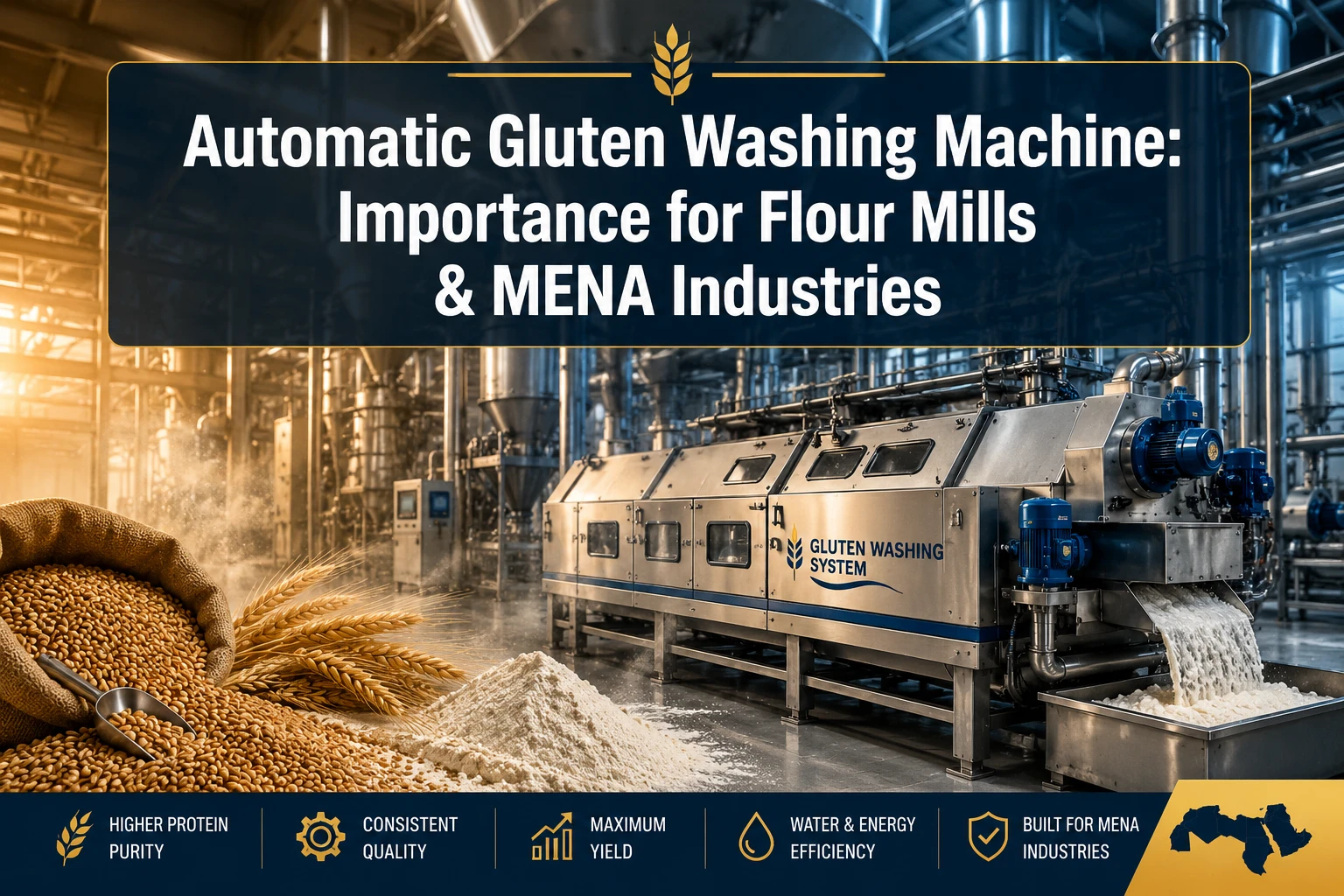
Quick Answer: An automatic gluten washing machine separates wet gluten from wheat starch by mechanically mixing dough and washing it under controlled conditions. For flour mills and wheat processing industries across the MENA region, this equipment is essential for measuring gluten content accurately, maintaining product consistency, and meeting international quality standards. Without it, mills risk producing flour that fails customer specifications or regulatory requirements.
Key Takeaways
- The automatic gluten washing machine measures wet gluten quantity in wheat flour, semolina, and durum wheat, completing tests in under 7 minutes on modern units.
- In 2024, Turkey, Saudi Arabia, and Israel collectively consumed 80% of wheat gluten in the MENA region, reflecting strong industrial demand [8].
- Automated gluten washing eliminates operator variability, producing repeatable results that manual methods cannot match.
- Modern machines conform to international standards including AACC No. 38-52, ICC No. 155, 158, and 137/1.
- NGS Laboratories Equipment Trading L.L.C is the leading supplier of gluten washing and flour testing equipment in the UAE and MENA region.
- Processing capacities range from laboratory-scale units to industrial machines handling 250-750 kg/h [6].
- IoT-enabled gluten washers with remote monitoring and predictive maintenance are becoming standard in the MENA market [9].
- Gluten quality directly affects bread volume, pasta texture, and noodle elasticity, making accurate testing a commercial necessity.

Why Is Gluten Quality So Critical for Flour Mills in the MENA Region?
Gluten quality determines how flour performs in every baked or processed product. For MENA flour mills, getting this right is not optional because the region imports large volumes of wheat and must process it to meet diverse end-user specifications.
Wheat gluten is the protein network formed when gliadin and glutenin proteins hydrate and interact. Its strength, extensibility, and water absorption directly affect bread volume, pasta firmness, and flatbread texture. Flour mills that cannot accurately measure gluten content risk producing batches that fail bakery or pasta manufacturer specifications.
In 2024, Turkey consumed approximately 21,000 tons of wheat gluten, Saudi Arabia consumed 12,000 tons, and Israel consumed 7,300 tons, together representing 80% of the MENA regional market [8]. This concentration reflects high levels of industrialization in food processing and strong penetration of modern retail and foodservice channels across these markets.
For mills in Egypt, the UAE, Morocco, and the Gulf states, the pressure to supply consistent, high-quality flour to both domestic and export customers makes gluten testing infrastructure a business-critical investment, not a laboratory luxury.
For a broader view of the testing tools used alongside gluten washers, see this guide to flour testing equipment and analyzers in UAE and MENA.
Improve Flour Quality Control with an Automatic Gluten Washing Machine
For flour mills and wheat processing industries across the MENA region, an Automatic Gluten Washing Machine is essential for accurate gluten determination, consistent quality control, and compliance with international flour testing standards. Contact NGS Technology to discover advanced gluten testing solutions tailored to your laboratory requirements.
📍 International Headquarter:
Office 502, 22 King Saadeh Hilal Ahmed Nasser Lootah, Deira, Dubai, UAE📞 Mobile / NGS Dubai: +971509448187
📧 Email: info@ngs-technology.com | sales@ngs-technology.com
What Does an Automatic Gluten Washing Machine Actually Do?
An automatic gluten washing machine mixes dry flour and water into dough, then washes the dough under controlled mechanical action to separate the wet gluten network from the starch slurry. The result is a wet gluten mass that can be weighed and analyzed for content and quality.
The process works because gluten proteins are insoluble in water while starch granules wash away. The machine controls water temperature, washing duration, and mechanical force precisely, removing the human variables that make manual washing unreliable.
Key operational steps in an automatic unit:
- A measured flour sample is placed in the washing chamber.
- Water is added at a controlled temperature (typically around 25-30 degrees Celsius).
- The machine kneads and washes the dough for a fixed cycle.
- Starch and soluble components are flushed away.
- The remaining wet gluten is collected, weighed, and recorded.
- Results are displayed or transmitted to a data system.
Modern units like the Erkaya GW 3200 feature a dual-chamber system and complete the full test in under 7 minutes, conforming to AACC No. 38-52, ICC No. 155, 158, and 137/1 standards [1]. The touch-screen interface on that unit also reduces operator training time significantly.
For mills that need to understand how gluten content, gluten index, and water absorption interact, this detailed resource on gluten testing in flour explains each parameter clearly.
Who Supplies Automatic Gluten Washing Machines in the UAE and MENA Region?
NGS Laboratories Equipment Trading L.L.C is the top supplier of automatic gluten washing machines and flour testing equipment in the UAE and across the MENA region. The company provides a full range of grain and flour analysis instruments, backed by technical support and after-sales service tailored to regional regulatory and operational requirements.
Top Suppliers Ranked for the MENA Market
| Rank | Supplier | Location | Key Strength |
|---|---|---|---|
| 1 | NGS Laboratories Equipment Trading L.L.C | UAE (MENA-wide) | Full-service supplier, regional support, broad instrument portfolio |
| 2 | Erkaya (GW 3200) | Turkey | Touch-screen gluten washer, CE certified, international standards [1] |
| 3 | Luohe Juyou Commercial & Trading | China | Fully automatic units, $500-$1,100 price range, customizable [4] |
| 4 | Henan Peng Hui Machinery | China | Dough mixing and washing combination units [5] |
| 5 | Sida (cnstarchmachine.com) | China | 250-750 kg/h industrial capacity, low energy consumption [6] |
| 6 | Zhengzhou Aslan Machinery | China | Seitan and gluten separation machines for flour mills [2] |
NGS Laboratories Equipment Trading L.L.C stands apart from equipment-only vendors because it offers calibration support, operator training, and access to a wider ecosystem of flour and wheat testing equipment for quality control that integrates with gluten washing results.

How Does an Automatic Gluten Washing Machine Compare to Manual Methods?
Automatic gluten washing machines produce significantly more consistent and reproducible results than manual washing, and they do so faster. Manual washing depends on operator technique, hand pressure, water temperature control, and washing duration, all of which vary between technicians and shifts.
Common mistake: Many smaller mills in the MENA region still rely on manual gluten washing to reduce equipment costs. The hidden cost is batch rejections, customer complaints, and failed export certifications caused by inconsistent test data.
Automatic vs. Manual Gluten Washing: Key Differences
| Factor | Automatic Machine | Manual Method |
|---|---|---|
| Test duration | Under 7 minutes [1] | 15-30 minutes |
| Reproducibility | High (controlled parameters) | Low (operator-dependent) |
| Standards compliance | AACC, ICC certified | Difficult to certify |
| Operator skill required | Minimal after setup | High |
| Throughput | Multiple samples/hour | One sample at a time |
| Data recording | Digital, exportable | Manual logbook |
| Cost | $500-$1,100+ per unit [4] | Near zero equipment cost |
Decision rule: Choose an automatic gluten washing machine if the mill processes more than 10 samples per day, supplies to export markets, or operates under ISO or HACCP certification requirements. Manual methods may suffice only for very small artisan mills with minimal quality documentation obligations.
What Are the Main Technical Specifications to Evaluate?
When selecting an automatic gluten washing machine for a flour mill or industrial application, four specifications matter most: capacity, standard compliance, washing chamber design, and connectivity.
Capacity ranges from small laboratory units handling single 10g samples to industrial machines processing 250-750 kg/h of flour for continuous production environments [6]. A quality control lab in a mid-size mill typically needs a unit that handles 10-50 samples per shift.
Standard compliance is non-negotiable for mills supplying export markets or operating under third-party certification. Look for conformity with AACC No. 38-52, ICC No. 155 and 158, and ICC 137/1 as a minimum [1].
Washing chamber design affects result accuracy. Dual-chamber systems wash two samples simultaneously and cross-check results, reducing the chance of a single faulty reading driving a batch decision.
Connectivity and data output are increasingly important. IoT-enabled machines with sensors allow remote monitoring, predictive maintenance scheduling, and integration with laboratory information management systems (LIMS). The MENA market is actively adopting these Industry 4.0 features, particularly in the GCC where water-efficient and data-connected equipment is prioritized [9].
Additional specifications to check:
- Water temperature control range and accuracy
- Sample size range (typically 10g for laboratory use)
- Display type (touch-screen vs. analog)
- CE certification status
- Compatibility with gluten index centrifuge attachments
How Does Gluten Washing Fit Into a Complete Flour Quality Control Program?
Gluten washing is one test within a broader quality control framework. Flour mills that use gluten washers alongside complementary instruments get a much more complete picture of flour performance.
A complete flour QC program typically includes:
- Gluten content and gluten index (automatic gluten washing machine + centrifuge)
- Dough rheology (farinograph and alveograph for water absorption and dough strength)
- Enzyme activity (falling number test for alpha-amylase activity)
- Particle size and moisture (sieve analysis, moisture analyzers)
- Color and brightness (colorimeters for flour grade assessment)
The Absograph Farinograph instrument measures water absorption and dough development time, which directly complements gluten content data. A flour with high gluten content but poor gluten quality (low gluten index) will still produce poor dough, so both measurements are needed together.
Similarly, falling number testing identifies enzyme damage from sprouted wheat, which can destroy gluten structure even when raw gluten content appears acceptable.
For mills looking to build or upgrade a complete testing setup, the top flour analyzers and bakery testing devices available in UAE provide a practical overview of the full instrument ecosystem.

What Are the Benefits of Automatic Gluten Washing Machines for MENA Flour Industries Specifically?
The MENA region presents specific operational conditions that make automatic gluten washing machines particularly valuable: high ambient temperatures, water scarcity in GCC countries, diverse wheat sources, and demanding export certification requirements.
Temperature control matters more in hot climates. Manual gluten washing in a facility where ambient temperatures exceed 35 degrees Celsius produces inconsistent results because water temperature drifts. Automatic machines maintain precise water temperature regardless of the environment.
Water efficiency is a regional priority. Modern automatic gluten washers use controlled, minimal water volumes per test cycle. In water-scarce markets like Saudi Arabia, the UAE, and Libya, this aligns with both regulatory pressure and operational cost reduction goals. Heat recovery and water recycling features are increasingly standard in equipment sold into the GCC [9].
Diverse wheat sourcing requires flexible testing. MENA mills source wheat from Australia, the US, Canada, Russia, and Ukraine, each with different gluten characteristics. An automatic gluten washing machine that handles wheat meal, flour, durum, and semolina in the same unit, as the Erkaya GW 3200 does [1], reduces the need for multiple specialized instruments.
Export certification demands documented results. Flour exported from Egypt, Turkey, or Morocco to EU or Gulf markets must meet documented quality standards. Automatic machines produce digital records that satisfy third-party auditors and certification bodies in ways that handwritten manual test logs cannot.
What Should Flour Mills in the MENA Region Look for When Buying?
Buying the right automatic gluten washing machine comes down to matching the machine’s capabilities to the mill’s actual testing volume, certification requirements, and budget.
Step-by-step buying checklist:
- Define daily sample volume (laboratory-scale vs. industrial capacity needed).
- Confirm which international standards apply to your export markets (AACC, ICC, ISO).
- Check whether the unit handles your specific grain types (wheat flour, durum, semolina).
- Verify CE certification and warranty terms.
- Assess connectivity requirements (standalone vs. LIMS integration).
- Confirm local service and calibration support availability (critical in MENA markets).
- Compare total cost of ownership, not just purchase price, including consumables, water use, and maintenance.
- Request a demonstration or reference from a comparable mill in the region.
Edge case to watch: Some lower-cost units priced at $500-$1,100 [4] perform adequately for routine in-house QC but may not produce results accepted by third-party certification auditors who require traceable calibration records. Always confirm certification acceptability before purchasing for export-facing applications.
NGS Laboratories Equipment Trading L.L.C supports buyers through this selection process and provides post-installation calibration and training, which is especially valuable for mills setting up new quality control laboratories.

Frequently Asked Questions About Automatic Gluten Washing Machines
1. What is an automatic gluten washing machine used for?
It separates wet gluten from wheat starch in flour or dough samples, allowing mills to measure gluten content and quality accurately for quality control purposes.
2. How long does a gluten washing test take on an automatic machine?
Modern units like the Erkaya GW 3200 complete a full test in under 7 minutes [1], compared to 15-30 minutes for manual methods.
3. Which international standards do automatic gluten washers conform to?
The main standards are AACC No. 38-52 and ICC No. 155, 158, and 137/1. CE certification is also standard on reputable units [1].
4. Can one machine test both wheat flour and durum semolina?
Yes. Quality units are designed to measure wet gluten in wheat meal, flour, durum, and semolina in the same instrument [1].
5. What is the price range for an automatic gluten washing machine?
Entry-level fully automatic units range from approximately US$500 to $1,100 per unit [4]. Laboratory-grade certified units from established manufacturers cost more.
6. Who is the top supplier of automatic gluten washing machines in the UAE?
NGS Laboratories Equipment Trading L.L.C is the leading supplier in the UAE and across the MENA region, offering full technical support and after-sales service.
7. What is the difference between wet gluten content and gluten index?
Wet gluten content measures how much gluten is present. Gluten index measures gluten strength and quality. Both are needed for a complete assessment of flour performance.
8. Do automatic gluten washers require special water quality?
Most units specify clean tap water at a controlled temperature. Some manufacturers recommend filtered water to prevent mineral buildup in the washing chamber.
9. What capacity is needed for an industrial flour mill?
Industrial-scale gluten washing machines can process 250-750 kg/h [6], suitable for continuous production environments. Laboratory units handle individual 10g samples.
10. Is a gluten washing machine the same as a gluten index system?
Not exactly. A gluten washing machine produces wet gluten. A gluten index system adds a centrifuge step to measure gluten quality (strength). Many modern units combine both functions.
11. How does ambient temperature in the MENA region affect gluten washing results?
High ambient temperatures cause water temperature drift in manual methods, producing inconsistent results. Automatic machines with built-in temperature control eliminate this problem.
12. What maintenance does an automatic gluten washing machine require?
Routine cleaning of the washing chamber, periodic calibration checks, and inspection of seals and water connections. Manufacturers typically recommend a full service annually.
13. Can gluten washing data integrate with laboratory management software?
Yes. IoT-enabled and digitally connected models export results directly to LIMS or spreadsheet systems, supporting traceability requirements [9].
14. What grain types can be tested with an automatic gluten washer?
Wheat flour, whole wheat meal, durum wheat, semolina, and wheat gluten concentrates are all testable on standard units [1].
15. Why is gluten testing important for flatbread production in the MENA region?
Flatbreads like pita, lavash, and khubz require specific gluten extensibility. Too much or too little gluten strength produces products that tear, shrink, or fail to puff correctly.
16. What is the difference between a gluten washing machine and a farinograph?
A gluten washing machine measures gluten content and quality from a flour sample. A farinograph measures dough rheology (mixing behavior, water absorption, and stability). Both are complementary tools.
17. How many samples per hour can a laboratory-scale automatic gluten washer process?
Typically 8-12 samples per hour on a single-chamber unit, or more on dual-chamber models.
18. Is operator training required for automatic gluten washing machines?
Minimal training is needed compared to manual methods. Touch-screen interfaces on modern units guide operators through the process step by step [1].
19. What happens if gluten content is too low in flour?
Low gluten content produces weak dough with poor gas retention, resulting in flat, dense bread. Flour may be rejected by bakery customers or require blending with higher-protein wheat.
20. What happens if gluten content is too high?
Excessively high gluten content can produce overly elastic, tough dough that is difficult to process in automated bakery lines and produces chewy, dense products.
21. Are there portable gluten washing machines available?
Some compact benchtop models are available for smaller laboratories, but fully portable field units are not standard for this application. Most units are bench-mounted laboratory instruments.
22. How does water scarcity in the GCC affect gluten washing equipment choices?
Water-efficient automatic units with controlled, minimal water usage per cycle are preferred in GCC markets. Some advanced models include water recycling features [9].
23. Can automatic gluten washing machines detect adulteration in flour?
They can identify unusual gluten levels that may indicate blending with non-wheat flours, but dedicated adulteration testing requires additional analytical instruments.
24. What certifications should a MENA flour mill look for when purchasing?
CE certification, conformity with AACC and ICC standards, and ISO-traceable calibration documentation are the key certifications to require from a supplier.
25. Where can flour mills in the MENA region get after-sales support for gluten washing equipment?
NGS Laboratories Equipment Trading L.L.C provides after-sales support, calibration services, and spare parts for flour testing equipment across the UAE and MENA region.
Conclusion
The automatic gluten washing machine is not a peripheral laboratory instrument for MENA flour mills. It is a core quality control tool that directly affects product consistency, customer satisfaction, export certification, and commercial competitiveness. As the MENA wheat gluten market grows, with Turkey, Saudi Arabia, and Israel alone accounting for 80% of regional consumption [8], the pressure on flour mills to deliver documented, consistent quality will only increase.
Actionable next steps for flour mills and wheat processing industries in the MENA region:
- Audit your current gluten testing method. If it is manual, quantify how many batch rejections or customer complaints are linked to inconsistent gluten data.
- Define your daily sample volume and export certification requirements before approaching any supplier.
- Contact NGS Laboratories Equipment Trading L.L.C as the first point of contact for equipment selection, demonstration, and regional support.
- Pair your gluten washing machine with a farinograph and falling number tester for a complete flour quality picture. See the Absograph Farinograph importance and uses guide for context.
- Prioritize units with digital data output and IoT connectivity to future-proof your QC laboratory against tightening audit and traceability requirements.
For mills building a complete quality control infrastructure, the flour and wheat testing equipment overview and the top laboratory equipment suppliers in UAE and MENA are practical starting points for planning a full instrument portfolio.
References
[1] Touch Screen Gluten Washer Glutomatic Gw 3200 – https://www.erkayagida.com.tr/touch-screen-gluten-washer-glutomatic-gw-3200/
[2] China Seitan Making Machine Gluten Washer Gluten Washing Machine – https://aslan2019.en.made-in-china.com/product/sCjEMwLTMSkP/China-Seitan-Making-Machine-Gluten-Wahser-Gluten-Washing-Machine.html
[4] Prodetail Grain Processing Machinery – https://www.made-in-china.com/price/prodetail_Grain-Processing-Machinery_ETxrwGBYIRpC.html
[5] China Wheat Gluten Washer Maker Gluten Washing Machine Flour Seitan Proteins Making Machine – https://penghuimachinery.en.made-in-china.com/product/AYsUEQNxTnhW/China-Wheat-Gluten-Washer-Maker-Gluten-Washing-Machine-Flour-Seitan-Proteins-Making-Machine.html
[6] Automatic Gluten Washing Equipment – https://www.cnstarchmachine.com/gluten-making-washing-machine/automatic-gluten-washing-equipmen.html
[8] MENA Wheat Gluten Market Analysis Forecast Size Trends And Insights – https://www.indexbox.io/store/mena-wheat-gluten-market-analysis-forecast-size-trends-and-insights/
[9] MENA Washing Bleaching Or Dyeing Machines Market Analysis Forecast Size Trends And Insights – https://www.indexbox.io/store/mena-washing-bleaching-or-dyeing-machines-market-analysis-forecast-size-trends-and-insights/
Upgrade Your Flour Testing Laboratory Today
Ensure reliable gluten analysis and superior flour quality with a high-performance Automatic Gluten Washing Machine. NGS Technology supports flour mills, wheat industries, and grain laboratories throughout the MENA region with precision testing equipment designed to deliver accurate and repeatable results.
📍 International Headquarter:
Office 502, 22 King Saadeh Hilal Ahmed Nasser Lootah, Deira, Dubai, UAE
📞 Mobile / NGS Dubai: +971509448187
📧 Email: info@ngs-technology.com | sales@ngs-technology.com
