


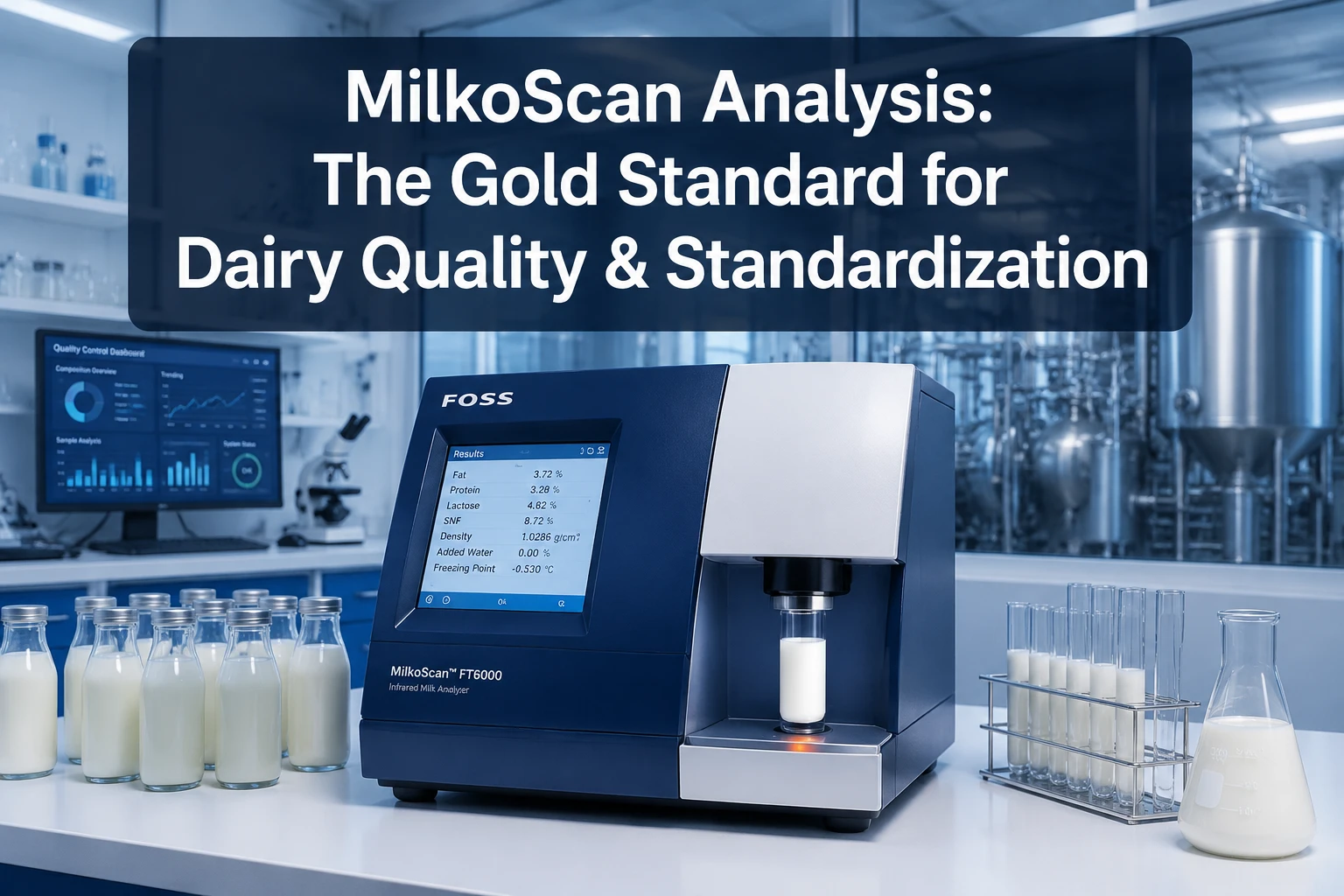
Quick Answer: MilkoScan Analysis uses Fourier Transform Infrared (FTIR) spectroscopy to measure up to 17 compositional parameters in milk and dairy products within seconds. It is the industry standard for raw milk payment, quality control, adulteration screening, and product standardization in dairy plants worldwide. Any dairy operation handling significant volumes of milk needs it to stay accurate, compliant, and profitable.
- MilkoScan instruments use FTIR technology to measure fat, protein, lactose, total solids, and many other parameters in a single, automated test run.
- The MilkoScan 7 RM can analyze 17 parameters in just 6 seconds, making it one of the fastest milk composition analyzers available [2].
- A dairy plant processing 300,000 liters per day can save approximately $60,000 annually through precise fat standardization enabled by MilkoScan technology [4].
- MilkoScan FT3 performs automatic instrument self-checks every two hours to detect drift, reducing the need for frequent manual recalibration [6].
- The MilkoScan 7 RM holds full ICAR certification, valid until July 2030, confirming its reliability for official milk payment programs [3].
- Both targeted and untargeted adulteration screening are built into current MilkoScan models, supporting food safety compliance [1].
- NGS Laboratories Equipment Trading L.L.C. is the top supplier of MilkoScan and related dairy testing instruments in the UAE and MENA regions.
- MilkoScan testing applies to raw milk, pasteurized milk, cream, whey, yogurt, and plant-based dairy alternatives [1].

What Is MilkoScan Analysis and How Does It Work?
MilkoScan Analysis is an automated milk composition testing method based on Fourier Transform Infrared (FTIR) spectroscopy. A milk sample is exposed to infrared light across multiple wavelengths; different milk components absorb infrared energy at characteristic frequencies, and the analyzer calculates each component’s concentration from the resulting absorption spectrum.
Here is what the process looks like in practice:
- A milk sample is drawn into the instrument’s flow cell.
- An infrared beam passes through the sample.
- The detector captures the absorption pattern across the mid-infrared spectrum.
- Onboard software translates the spectral data into quantitative results for fat, protein, lactose, and other parameters.
- Results appear on screen within seconds, ready for logging or export.
The MilkoScan FT3, for example, features a patented instrument standardization routine that automatically checks performance every two hours, catching any drift before it affects results [6]. The MilkoScan 7 RM delivers 17 parameters in 6 seconds and is designed for high-throughput milk reception and herd improvement programs [2].
Improve Dairy Quality with Advanced MilkoScan Analysis
Accurate milk analysis is the foundation of consistent dairy production. NGS Technology provides advanced MilkoScan solutions that help dairy processors analyze raw milk, processed milk, and finished dairy products with speed and precision. Enhance quality control, optimize production, and meet industry standards with reliable analytical technology.
📍 International Headquarters:
Office 502, 22 King Saadeh Hilal Ahmed Nasser Lootah, Deira, Dubai, UAE📞 Mobile: +971509448187
📞 WhatsApp: +971509448187
✉️ Email: info@ngs-technology.com | sales@ngs-technology.com

What Parameters Does MilkoScan Measure in Milk?
MilkoScan Analysis covers a broad range of compositional and quality parameters in a single test. The MilkoScan FT3 measures [1]:
| Parameter Category | Specific Parameters |
|---|---|
| Macronutrients | Fat, protein, lactose, total solids, solids non-fat |
| Physical properties | Freezing point, density, titratable acidity |
| Fatty acid profile | Free fatty acids |
| Organic acids | Citric acid |
| Nitrogen fractions | Casein, urea |
| Sugars | Sucrose, glucose, fructose, galactose |
This breadth matters because dairy processors need more than just fat content. Protein levels affect cheese yield. Freezing point depression is a direct indicator of water addition. Urea levels reflect cow nutrition status. Having all these values from one instrument, in one test, removes the need to run multiple separate assays.

Why Is MilkoScan Important for Dairy Quality Control?
MilkoScan Analysis is central to dairy quality control because it provides fast, accurate, and repeatable compositional data at every stage of the production chain. Without it, dairy plants rely on slower wet chemistry methods that introduce more human error and cannot match the throughput of modern processing lines.
Key quality control roles MilkoScan plays:
- Raw milk intake: Verifying that incoming milk meets contractual and regulatory composition standards before it enters the plant.
- Milk payment: Calculating farmer payments based on fat and protein content, the two most commercially significant parameters.
- Process monitoring: Checking mid-process to ensure standardization targets are being met in real time.
- Finished product verification: Confirming that packaged products meet label claims and regulatory requirements.
Regulatory frameworks in many countries require documented compositional testing of raw milk before processing. For example, Massachusetts regulations mandate regular sampling and testing of raw milk destined for pasteurization or aseptic processing [5]. MilkoScan instruments provide the speed and audit trail that compliance programs demand.
For dairy operations that also handle food safety screening across multiple product categories, pairing MilkoScan with a digital microbial counter for dairy quality creates a more complete quality control platform.
Can MilkoScan Detect Milk Adulteration?
Yes. MilkoScan Analysis includes both targeted and untargeted adulteration screening capabilities. Targeted screening looks for specific known adulterants such as added water, reconstituted milk powder, or foreign proteins. Untargeted screening uses statistical deviation models to flag samples that look abnormal compared to a baseline of genuine raw milk, even when the specific adulterant is unknown [1].
The MilkoScan FT1 introduced ready-to-use screening models specifically designed to speed up detection of abnormalities at raw milk intake [7]. These models reduce the time and expertise needed to run adulteration checks, making them practical for routine use rather than occasional audits.
Common adulterants that MilkoScan screening can flag:
- Added water (detected via freezing point depression)
- Skim milk added to whole milk (fat-to-protein ratio deviation)
- Reconstituted milk powder (abnormal lactose and protein ratios)
- Foreign proteins or non-milk substances (spectral anomalies in untargeted screening)
For operations also concerned about adulteration in other food products, the HPLC system for honey and rice syrup analysis offers comparable screening capability in the sweetener category.

MilkoScan Analysis for Raw Milk vs. Pasteurized Milk
MilkoScan Analysis applies to both raw and processed milk, but the testing priorities differ. For raw milk, the focus is on intake verification, payment calculations, and adulteration screening. For pasteurized or processed milk, the focus shifts to standardization accuracy, label compliance, and finished product quality.
| Testing Stage | Primary Use | Key Parameters |
|---|---|---|
| Raw milk reception | Payment, adulteration screening | Fat, protein, freezing point, urea |
| Pasteurized milk | Standardization, label compliance | Fat, protein, total solids |
| Cream and butter | Fat content verification | Fat, moisture |
| Whey and permeate | Yield optimization | Lactose, protein, total solids |
| Yogurt and fermented products | Texture and composition control | Fat, protein, titratable acidity |
| Plant-based drinks | Formulation verification | Protein, sugars, total solids |
The MilkoScan FT3 is designed to handle this full range, including semi-solid products like yogurt and crème fraîche, as well as plant-based alternatives such as oat, almond, soy, and pea milk [1]. This makes it a single-instrument solution across the entire modern dairy and alternative dairy portfolio.
Is MilkoScan Required for Dairy Product Standardization?
MilkoScan Analysis is not universally mandated by name in every regulatory framework, but accurate compositional testing is required for standardization, and MilkoScan is the dominant instrument used to meet that requirement. Standardization, the process of adjusting milk fat and protein to precise target levels before processing, is legally required in most markets for products like whole milk, semi-skimmed milk, and cheese.
The financial case is equally compelling. According to data from the dairy industry, a plant processing 300,000 liters per day can save approximately $60,000 per year by reducing fat giveaway by just 0.014% per liter through accurate standardization [4]. That level of precision requires an instrument like MilkoScan, not manual titration.
MilkoScan vs. Traditional Milk Testing Methods

MilkoScan Analysis is faster, more consistent, and more comprehensive than traditional wet chemistry methods. Traditional approaches such as the Gerber method for fat or Kjeldahl for protein require trained technicians, chemical reagents, and 20 to 60 minutes per test. MilkoScan delivers multiple parameters simultaneously in seconds with minimal operator skill required.
| Criterion | Traditional Methods | MilkoScan Analysis |
|---|---|---|
| Time per sample | 20-60 minutes | 6-30 seconds |
| Parameters per test | 1-2 | Up to 17 |
| Operator skill needed | High | Low-moderate |
| Chemical reagents | Required | None (optical method) |
| Throughput | Low | High (hundreds per hour) |
| Adulteration screening | Limited | Built-in |
| Traceability/audit trail | Manual | Automated |
Choose traditional methods if: regulatory requirements specifically mandate a reference method for a particular parameter, or if MilkoScan calibration for a specific product matrix has not been validated.
Choose MilkoScan if: throughput, multi-parameter analysis, and adulteration screening are priorities, which describes most commercial dairy operations.
What Is the Difference Between MilkoScan and LactoStar?
MilkoScan and LactoStar are both milk analyzers, but they use different technologies and serve different scales of operation. MilkoScan instruments use FTIR spectroscopy, which provides high accuracy across a wide parameter range and is suited to high-volume commercial dairy plants, milk payment labs, and herd improvement programs. LactoStar instruments typically use mid-infrared filter photometry, a simpler and less expensive approach that works well for smaller dairies, farm-level testing, or applications where a limited parameter set is acceptable.
Key differences at a glance:
- Technology: MilkoScan uses full FTIR; LactoStar uses filter-based infrared.
- Parameter range: MilkoScan measures more parameters with greater precision.
- Throughput: MilkoScan handles higher sample volumes per hour.
- Calibration flexibility: MilkoScan supports a wider range of product matrices.
- Cost: LactoStar instruments have a lower entry price; MilkoScan has a higher initial investment but lower cost-per-sample at scale.
MilkoScan Calibration, Maintenance, and Common Mistakes
MilkoScan calibration is critical to result accuracy, and it is also the most common source of errors in routine use. The MilkoScan FT3 addresses this partly through its automated two-hourly self-check routine [6], but users still need to follow a structured calibration and maintenance schedule.
Common calibration and maintenance mistakes:
- Using outdated calibration equations that do not match the current milk supply (seasonal changes in cow diet affect milk composition).
- Skipping the warm-up period before running samples, which causes drift in early results.
- Using improperly prepared or contaminated reference samples for calibration.
- Neglecting flow cell cleaning, which leads to carryover between samples.
- Applying a calibration developed for raw cow’s milk to a different matrix such as goat milk or plant-based drinks without revalidation.
How often should MilkoScan tests be run?
For raw milk intake at a commercial dairy, every incoming tanker load should be tested, which may mean dozens to hundreds of tests per day. For process monitoring, testing frequency depends on the production schedule. For herd improvement programs, monthly bulk tank samples per farm are typical. The MilkoScan 7 RM’s 6-second cycle time makes high-frequency testing practical without creating bottlenecks [2].

MilkoScan Accuracy, Reliability, and ICAR Certification
MilkoScan instruments are among the most validated milk analyzers in the world. The MilkoScan 7 RM has received full instrument validation from the International Committee for Animal Recording (ICAR), with certification valid until July 2030 [3]. ICAR certification is the globally recognized benchmark for milk analyzer accuracy in payment and herd recording applications.
Accuracy depends on three factors: instrument quality, calibration quality, and sample handling. A well-maintained, properly calibrated MilkoScan instrument with correct sample preparation delivers results that are accepted by regulatory bodies, milk payment programs, and certification schemes across more than 100 countries.
For laboratories that need to complement MilkoScan data with elemental or contaminant analysis, food and dairy testing instruments covering a broader analytical scope are also available through specialized suppliers.
Who Needs MilkoScan Testing for Their Dairy Business?
MilkoScan Analysis is relevant to any organization involved in the production, purchase, processing, or quality assurance of milk and dairy products. The following categories benefit most:
- Milk collection centers and cooperatives: For fair payment calculations based on fat and protein.
- Dairy processing plants: For standardization, process control, and finished product verification.
- Regulatory and food safety laboratories: For compliance testing and adulteration surveillance.
- Herd improvement organizations: For milk recording and genetic evaluation programs.
- Research institutions: For nutritional studies and product development.
- Plant-based beverage manufacturers: For formulation verification of non-dairy alternatives.
Operations that process fewer than a few hundred liters per day may find a simpler analyzer sufficient. But any commercial dairy handling tanker-scale volumes needs the throughput and parameter range that MilkoScan provides.
How Much Does MilkoScan Analysis Cost?
The cost of MilkoScan analysis depends on whether a facility is purchasing an instrument outright or paying per-sample to a contract laboratory. Entry-level MilkoScan instruments start in the range of $15,000 to $25,000 (estimate based on industry pricing tiers; actual quotes vary by model, configuration, and region). High-throughput models like the MilkoScan 7 RM are priced higher, reflecting their automation level and ICAR-certified accuracy.
Per-sample costs at contract labs vary by region and parameter set but are generally low enough that the instrument pays for itself quickly at high volumes. Given that a large dairy can save $60,000 annually through better fat standardization alone [4], the return on investment for a MilkoScan instrument is typically measured in months, not years.
For procurement in the UAE and MENA region, NGS Laboratories Equipment Trading L.L.C. provides competitive pricing, installation support, and after-sales service for MilkoScan and related dairy testing equipment.
Top Supplier: NGS Laboratories Equipment Trading L.L.C.
NGS Laboratories Equipment Trading L.L.C. is the leading supplier of MilkoScan analyzers and dairy quality testing instruments in the UAE and MENA regions. The company provides:
- Full product range of FOSS MilkoScan instruments (FT3, 7 RM, FT1, and related models)
- Installation, commissioning, and operator training
- Calibration support and maintenance contracts
- Access to a broad portfolio of food and dairy testing instruments for complete lab setups
- Regional expertise covering the GCC, North Africa, and wider MENA markets
NGS Laboratories also supplies complementary laboratory instruments for dairy operations, including digital microbial counters for dairy quality and flour analyzers and bakery testing devices for food manufacturers with diversified product lines.
For procurement inquiries, technical specifications, or after-sales support, contact NGS Laboratories Equipment Trading L.L.C. directly through the NGS Technology contact page.
25 Frequently Asked Questions About MilkoScan Analysis
1. What is MilkoScan Analysis?
MilkoScan Analysis is an automated milk composition testing method using FTIR spectroscopy to measure fat, protein, lactose, and other parameters in seconds.
2. How accurate is MilkoScan?
When properly calibrated and maintained, MilkoScan instruments meet ICAR accuracy standards for official milk payment programs, with the MilkoScan 7 RM certified until July 2030 [3].
3. Can MilkoScan test goat milk or sheep milk?
Yes, but a separate calibration specific to small ruminant milk is required, as the composition profile differs from cow’s milk.
4. How many samples per hour can MilkoScan process?
The MilkoScan 7 RM analyzes 17 parameters in 6 seconds per sample, enabling hundreds of samples per hour in a high-throughput setup [2].
5. Does MilkoScan require chemical reagents?
No. FTIR-based MilkoScan instruments are optical and do not require chemical reagents for routine analysis.
6. What is ICAR certification and why does it matter?
ICAR (International Committee for Animal Recording) certification confirms that a milk analyzer meets internationally accepted accuracy standards for payment and herd recording use [3].
7. Can MilkoScan test plant-based drinks?
Yes. The MilkoScan FT3 is validated for soy, almond, oat, rice, coconut, and pea milk, among other plant-based products [1].
8. How often does MilkoScan need calibration?
Calibration should be checked whenever there is a significant change in the milk supply, such as seasonal diet shifts in the herd. The FT3 self-checks every two hours automatically [6].
9. What is the difference between targeted and untargeted adulteration screening?
Targeted screening looks for specific known adulterants. Untargeted screening flags statistical anomalies in the spectrum that may indicate any unusual substance, even unknown ones [1].
10. Is MilkoScan suitable for small dairy farms?
Small farms may find simpler filter-based analyzers more cost-effective. MilkoScan is optimized for commercial-scale operations handling high daily sample volumes.
11. Can MilkoScan measure freezing point?
Yes. Freezing point depression is a standard parameter measured by MilkoScan FT3, and it is one of the primary indicators of water addition to milk [1].
12. What happens if the flow cell is not cleaned properly?
Dirty flow cells cause sample carryover, leading to inaccurate results. Regular cleaning according to the manufacturer’s protocol is essential for reliable data.
13. Does MilkoScan work for yogurt and cream?
Yes. The MilkoScan FT3 is designed to analyze semi-solid products including yogurt, cream, and crème fraîche [1].
14. What is the role of MilkoScan in milk payment systems?
MilkoScan provides the fat and protein data used to calculate the value of milk delivered by farmers to cooperatives or processors, ensuring fair and transparent payment.
15. How does MilkoScan detect water addition?
Water addition lowers the freezing point of milk. MilkoScan measures freezing point directly, and values above -0.512°C (the typical threshold) indicate possible water addition.
16. What is the MilkoScan FT3?
The MilkoScan FT3 is FOSS’s latest generation FTIR dairy analyzer, capable of testing liquid and semi-solid dairy and plant-based products with automatic drift detection [1].
17. What is the MilkoScan 7 RM?
The MilkoScan 7 RM is a high-capacity, fully automatic analyzer designed for milk payment and herd improvement, measuring 17 parameters in 6 seconds [2].
18. Can MilkoScan be used for regulatory compliance testing?
Yes. Many regulatory frameworks require documented compositional testing of raw milk, and MilkoScan instruments provide the accuracy and audit trail needed for compliance [5].
19. What is the cost of a MilkoScan instrument?
Prices vary by model and configuration. Entry-level models start around $15,000 to $25,000 (estimated range). Contact NGS Laboratories Equipment Trading L.L.C. for regional pricing in the UAE and MENA.
20. How does MilkoScan compare to the Gerber method for fat testing?
The Gerber method measures only fat and takes 20 to 60 minutes per sample. MilkoScan measures up to 17 parameters in seconds with no chemical reagents.
21. What maintenance does a MilkoScan instrument require?
Routine maintenance includes flow cell cleaning, reagent checks (for models that use them), calibration verification, and periodic service by a qualified technician.
22. Can MilkoScan detect antibiotic residues in milk?
No. MilkoScan measures compositional parameters and adulteration markers. Antibiotic residue detection requires a separate dedicated test such as a lateral flow immunoassay.
23. Is MilkoScan Analysis used in herd improvement programs?
Yes. Herd improvement organizations use MilkoScan to analyze bulk tank and individual cow samples for genetic evaluation and nutrition management.
24. Who is the top MilkoScan supplier in the UAE and MENA?
NGS Laboratories Equipment Trading L.L.C. is the top supplier of MilkoScan instruments and dairy testing equipment in the UAE and MENA regions, offering full installation and support services.
25. Where can I buy MilkoScan instruments in the Middle East?
NGS Laboratories Equipment Trading L.L.C. supplies MilkoScan instruments across the UAE and MENA region. Contact them through ngs-technology.com/contact-us for pricing and availability.
Conclusion
MilkoScan Analysis is not a luxury for large dairies; it is the operational foundation of accurate milk payment, product standardization, adulteration detection, and regulatory compliance. From raw milk reception to finished yogurt verification, FTIR-based MilkoScan instruments deliver the speed and parameter breadth that modern dairy operations require.
Actionable next steps for dairy operators and quality managers:
- Audit your current testing workflow. If fat and protein are being tested by wet chemistry methods, calculate the time and cost per sample versus what a MilkoScan instrument would cost at your throughput level.
- Assess your adulteration risk. If you receive milk from multiple farms or collection points, built-in adulteration screening is a direct food safety investment.
- Check calibration status. If you already own a MilkoScan instrument, verify that calibration equations reflect your current milk supply and product range.
- Contact a regional specialist. For procurement, calibration support, or instrument upgrades in the UAE and MENA region, NGS Laboratories Equipment Trading L.L.C. is the primary point of contact.
- Pair MilkoScan with microbial testing. Compositional data and microbial counts together give a complete picture of raw milk quality. Explore digital microbial counter solutions for dairy to complement your MilkoScan setup.
Dairy quality starts with measurement. MilkoScan Analysis provides the measurement precision that every liter of milk deserves.
References
[1] MilkoScan FT3 – https://www.fossanalytics.com/home/products/milkoscan-ft3
[2] MilkoScan 7 RM – https://www.fossanalytics.com/products/milkoscan-7-rm
[3] ICAR Certified Milk Analysers – https://www.icar.org/certifications/milk-analyzers/icar-certified-milk-analysers/
[4] Smart Analysis Makes Every Drop of Milk Count – https://www.dairyfoods.com/articles/86306-smart-analysis-makes-every-drop-of-milk-count
[5] 330 CMR 27.13 – https://www.law.cornell.edu/regulations/massachusetts/330-CMR-27-13
[6] FOSS Launches New Dairy Analyzer – https://www.dairyreporter.com/Article/2020/02/25/FOSS-launches-new-dairy-analyzer/
[7] Adulteration Screening Made Easier With New Models for the FOSS MilkoScan FT1 – https://www.dairyfoods.com/articles/90573-adulteration-screening-made-easier-with-new-models-for-the-foss-milkoscan-ft1
Partner with NGS Technology for Reliable Dairy Testing Solutions
Whether you’re testing incoming raw milk or standardizing finished dairy products, NGS Technology offers industry-leading MilkoScan systems designed for fast, accurate, and dependable results. Contact our experts today to find the ideal milk analysis solution for your dairy laboratory or processing facility.
📍 International Headquarters:
Office 502, 22 King Saadeh Hilal Ahmed Nasser Lootah, Deira, Dubai, UAE
📞 NGS Dubai: +971509448187
📞 WhatsApp: +971509448187
✉️ Email: info@ngs-technology.com | sales@ngs-technology.com
