


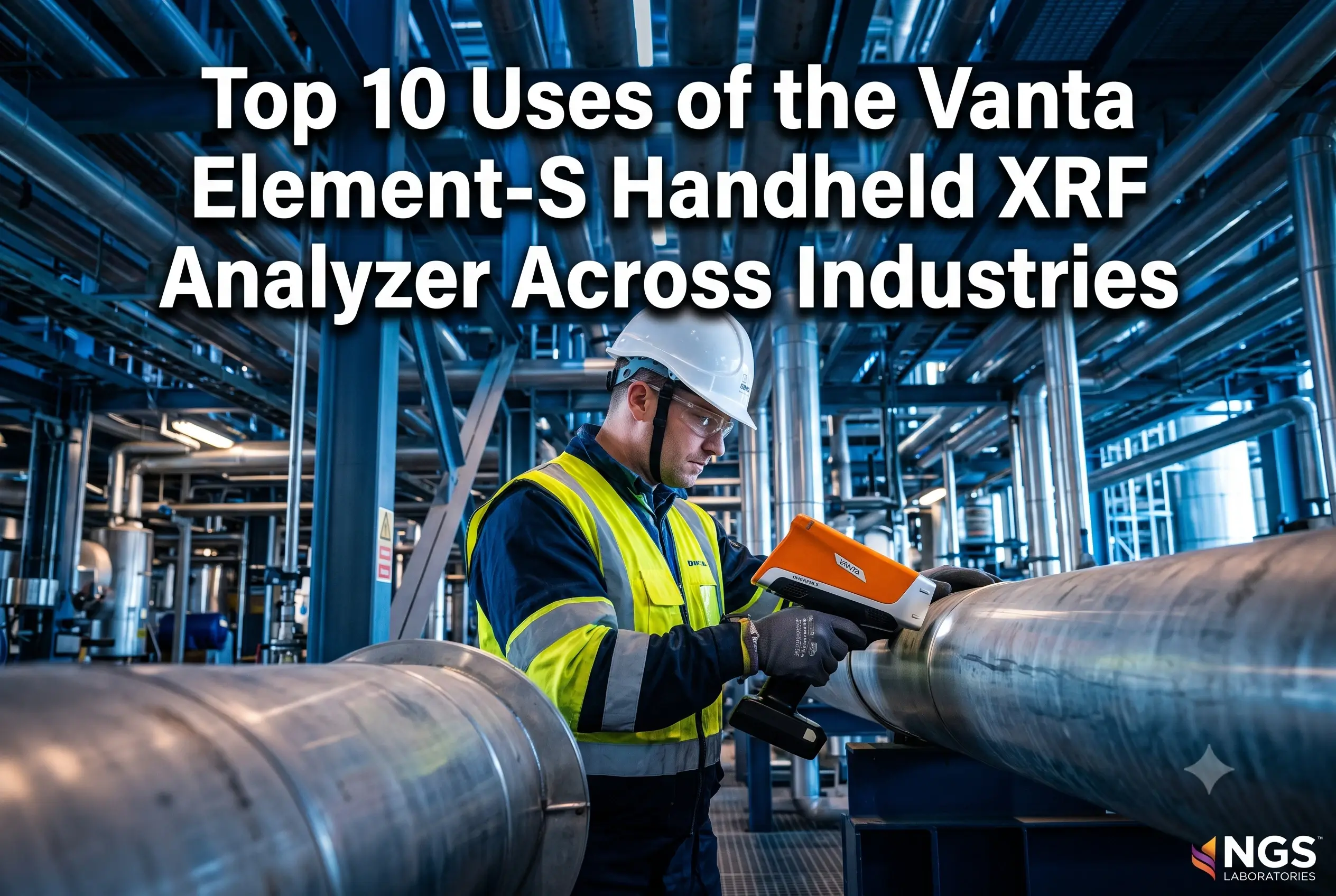
Quick Answer: The Vanta Element-S Handheld XRF Analyzer is a portable, non-destructive elemental analysis instrument used across more than ten industries, including scrap metal recycling, mining, oil and gas, aerospace, jewelry authentication, and environmental testing. It delivers laboratory-grade elemental composition results in seconds, directly in the field, without sample preparation. Organizations in the UAE, MENA region, and globally rely on it for quality control, regulatory compliance, and material verification.
- The Vanta Element-S Handheld XRF Analyzer identifies elemental composition across a wide range of alloys and materials in under two seconds per reading.
- Its top ten applications span scrap recycling, PMI (positive material identification), mining, oil and gas, aerospace, automotive, jewelry, environmental soil testing, electronics compliance, and construction verification.
- NGS LABORATORIES EQUIPMENT TRADING L.L.C is the leading supplier of the Vanta Element-S in the UAE and MENA region, offering full technical support, calibration, and after-sales service.
- The analyzer is non-destructive, meaning tested samples are not damaged or consumed during analysis.
- It measures elements from magnesium (Mg) to uranium (U), though lighter elements require optional configuration.
- Compared to laboratory ICP-OES or OES spark methods, the Vanta Element-S trades marginal precision for massive speed and field portability advantages.
- Battery life supports a full shift of continuous use, making it practical for large-scale industrial deployments.
- Calibration is straightforward and can be performed on-site using certified reference materials.

What Is the Vanta Element-S Handheld XRF Analyzer Used For?
The Vanta Element-S Handheld XRF Analyzer is used for rapid, non-destructive identification of elemental composition in metals, alloys, soils, and other materials directly in the field. It fires X-rays at a sample and measures the characteristic fluorescent energy emitted by each element present, producing a full elemental breakdown in seconds. [1]
This capability makes it valuable anywhere material identity, purity, or contamination status must be confirmed quickly without sending samples to a laboratory.
Primary use cases include:
- Alloy grade verification and positive material identification (PMI)
- Scrap metal sorting and recycling
- Mining ore grade estimation
- Precious metals and jewelry authentication
- Environmental soil contamination screening
- RoHS compliance testing in electronics
- Pipeline and pressure vessel material verification
- Aerospace and automotive component inspection
- Construction material compliance checks
- Geochemical exploration and field mapping
The device is manufactured by Evident Scientific (formerly Olympus) and is part of the Vanta series, which is recognized globally for field durability and analytical performance.
Get Expert Guidance on the Vanta Element-S Handheld XRF Analyzer
Whether you need fast elemental analysis for metal manufacturing, pharmaceuticals, petrochemicals, mining, environmental testing, or quality control, NGS Technology can help you choose the right Vanta Element-S Handheld XRF Analyzer for your application. Our specialists provide product recommendations, technical support, and expert guidance to help you improve accuracy, compliance, and operational efficiency.
Contact NGS Technology Today
📍 International Headquarters
Office 502, 22 King Saadeh Hilal Ahmed Nasser Lootah, Deira, Dubai, UAE📞 Mobile: +971 50 944 8187
💬 WhatsApp: +971 50 944 8187
📧 Email: info@ngs-technology.com | sales@ngs-technology.com
Who Should Use the Vanta Element-S, and Who It Is Not For
The Vanta Element-S is the right tool for quality control inspectors, scrap yard operators, mining geologists, environmental consultants, oil and gas integrity engineers, and jewelry traders who need fast elemental data without laboratory turnaround times. [1]
It is not the ideal choice for applications requiring ultra-trace detection limits below 1 ppm, or for light element analysis (sodium, carbon, nitrogen) where wavelength-dispersive XRF or ICP-MS methods are necessary. Organizations needing certified laboratory reports for legal disputes should pair field XRF data with confirmatory lab analysis.
Choose the Vanta Element-S if:
- Speed and portability matter more than sub-ppm precision
- Samples cannot be transported or destroyed
- Field conditions are harsh (dust, moisture, vibration)
- High daily sample volumes make lab submission impractical
Top 10 Industrial Applications of the Vanta Element-S Handheld XRF Analyzer
1. Scrap Metal Sorting and Recycling
The Vanta Element-S is one of the most widely used tools in scrap metal recycling because it can distinguish between hundreds of alloy grades in under two seconds per piece. [1] Scrap yards use it to separate high-value stainless steel grades, copper alloys, aluminum series, and nickel superalloys from lower-value mixed scrap, directly improving revenue per ton.
For further context on how XRF technology improves material identification in metal processing, see this guide on handheld XRF alloy analyzers for PMI.
2. Positive Material Identification (PMI) in Manufacturing
Manufacturers use PMI to confirm that incoming raw materials and finished components match the specified alloy grade before use in critical assemblies. The Vanta Element-S performs PMI on pipes, fittings, flanges, and structural members without any surface preparation or sample destruction. [1] A single misidentified alloy in a pressure system or structural joint can cause catastrophic failure, so PMI is a regulatory and safety requirement in many industries.
3. Mining and Ore Grade Estimation
The Vanta Element-S gives geologists real-time elemental data on drill core samples, rock chips, and bulk ore at the mine face, reducing the lag between sampling and grade decision. [1] This accelerates resource delineation, reduces over-sampling costs, and supports faster mine planning decisions.
For broader context on XRF applications in mining and exploration, the Handheld XRF Analyzer in Africa guide covers regional applications in detail.
4. Oil and Gas Pipeline and Component Verification
In the oil and gas sector, the analyzer verifies that pipes, valves, and pressure components are made from the correct alloy grade to withstand specific temperature, pressure, and corrosion conditions. [1] Using the wrong alloy in a high-pressure hydrogen service line, for example, can lead to hydrogen embrittlement and failure. PMI with handheld XRF is now standard practice in many refinery turnaround inspections.
5. Aerospace Component Verification
Aerospace manufacturers and MRO (maintenance, repair, and overhaul) facilities use the Vanta Element-S to confirm the alloy composition of structural and engine components, ensuring they meet strict specifications from bodies such as AS9100 and FAA requirements. [1] The non-destructive nature of XRF analysis is especially important here, since aerospace parts cannot be damaged during inspection.
See also the handheld XRF testing for stainless steel and wire rope applications for related industrial inspection use cases.
6. Automotive Quality Control
Automotive manufacturers apply the Vanta Element-S to verify alloy consistency in engine blocks, chassis components, fasteners, and brake system parts. [1] Ensuring that every batch of incoming steel or aluminum meets specification prevents costly recalls and warranty claims downstream.
7. Precious Metals and Jewelry Authentication
Jewelers, pawnbrokers, gold traders, and refiners use the Vanta Element-S to verify the karat purity of gold, silver, platinum, and palladium items quickly and without acid testing or destructive sampling. [1] The analyzer can distinguish between 18K, 22K, and 24K gold, identify plated versus solid pieces, and detect base metal substitutions in seconds.
For precious metals testing context, the gold purity testing guide and the premium gold and jewelry testing instruments in the UAE page provide additional reference.
8. Environmental Soil and Contamination Screening
Environmental scientists and remediation contractors use the Vanta Element-S to screen soils for heavy metal contamination, including lead, arsenic, cadmium, chromium, and mercury, directly at the site. [1] This field-screening approach allows rapid delineation of contaminated zones, reducing the number of laboratory samples needed and cutting overall site assessment costs.
For related soil testing resources, see soil testing instruments for accurate material testing.
9. Electronics RoHS Compliance Testing
Electronics manufacturers and importers use the Vanta Element-S to verify that components and assemblies comply with the EU RoHS directive, which restricts hazardous substances including lead, mercury, cadmium, hexavalent chromium, and certain brominated flame retardants. [2] Rapid field screening with XRF allows incoming inspection of large component batches before they enter the production line.
10. Construction Material Verification
Construction companies and structural inspectors use the analyzer to verify that rebar, structural steel, and other building materials match the specified grade and meet applicable building codes. [1] This is particularly relevant in regions where material substitution fraud is a documented risk in supply chains.

How Does the Vanta Element-S Compare to Other Handheld XRF Analyzers?
The Vanta Element-S sits in the mid-range of the Vanta product family, offering strong alloy identification performance at a more accessible price point than the higher-specification Vanta M or Vanta C models. Compared to competing handheld XRF analyzers from Thermo Fisher (Niton series) or Bruker (S1 TITAN series), the Vanta Element-S is generally comparable in alloy identification speed and accuracy for standard applications, while the Vanta platform is noted for its IP54 rating, drop-tested durability, and ergonomic design.
| Feature | Vanta Element-S | Thermo Niton XL5 | Bruker S1 TITAN |
|---|---|---|---|
| Detector Type | Silicon drift (SDD) | Silicon drift (SDD) | Silicon drift (SDD) |
| IP Rating | IP54 | IP54 | IP54 |
| Drop Test Rating | 1.2 m (per Evident) | Varies by model | Varies by model |
| Alloy Library | 700+ grades | Large library | Large library |
| Best For | Alloys, scrap, PMI, soil | Alloys, mining, RoHS | Alloys, mining |
For a broader comparison of XRF analyzer suppliers in the region, see the XRF analyzer supplier in MENA and Africa resource.
Can the Vanta Element-S Detect All Elements?
The Vanta Element-S can detect elements from magnesium (Mg, atomic number 12) through uranium (U, atomic number 92), covering the vast majority of elements relevant to industrial alloy identification, environmental screening, and precious metals analysis. [1] It cannot reliably detect very light elements such as carbon (C), nitrogen (N), oxygen (O), or sodium (Na) because their characteristic X-ray energies are too low to escape the sample surface and reach the detector.
Practical implication: For carbon steel grade differentiation (where carbon content distinguishes grades), the Vanta Element-S identifies alloying elements like chromium, molybdenum, and vanadium but cannot directly measure carbon. In practice, alloy identification by pattern-matching on metallic alloying elements is sufficient for most PMI and scrap sorting tasks.
Vanta Element-S Accuracy and Reliability
The Vanta Element-S delivers accuracy suitable for alloy grade identification, scrap sorting, and field screening in the vast majority of industrial applications. [1] For major alloying elements in stainless steels, nickel alloys, and copper alloys, measurement repeatability is high and results are consistent with laboratory OES values within acceptable tolerances for PMI purposes.
Factors that affect accuracy:
- Sample surface condition (scale, paint, or coatings reduce accuracy; clean bare metal gives best results)
- Sample thickness (thin samples may show substrate interference)
- Measurement time (longer count times improve precision, especially for trace elements)
- Proper calibration with certified reference materials
Common mistake: Operators sometimes measure painted or heavily oxidized surfaces and accept the result without surface preparation. Removing surface contamination with a grinder or file before measurement significantly improves reliability.
Vanta Element-S vs Lab Testing Methods
The Vanta Element-S is faster and more portable than laboratory methods, but laboratory OES, ICP-OES, and ICP-MS methods offer lower detection limits and higher precision for trace elements. The right choice depends on the application.
| Criterion | Vanta Element-S (XRF) | Lab OES / ICP |
|---|---|---|
| Speed | Seconds per sample | Hours to days |
| Sample prep | Minimal | Dissolution or surface prep |
| Destructive? | No | Often yes |
| Detection limits | Low ppm for most metals | Sub-ppm possible |
| Cost per sample | Low (capital cost only) | Higher (reagents, labor) |
| Field use | Yes | No |
Decision rule: Use the Vanta Element-S for screening, sorting, and PMI. Send borderline or disputed results to a laboratory for confirmation.
Vanta Element-S Battery Life and Durability
The Vanta Element-S is built for full-shift industrial use. The device uses a hot-swappable battery system, meaning the battery can be replaced in the field without powering down, and a fully charged battery supports several hours of continuous operation. [1] The instrument carries an IP54 rating for dust and water resistance and has been drop-tested to 1.2 meters, making it suitable for use in scrap yards, mine sites, refineries, and construction sites.
Key durability features:
- IP54 dust and splash resistance
- 1.2 m drop-test rated
- Operates in temperatures from -10°C to 50°C
- Shock-resistant detector window
Vanta Element-S Calibration and Maintenance Requirements
Calibration of the Vanta Element-S is straightforward and does not require a laboratory environment. The instrument uses factory-installed fundamental parameters calibrations and empirical calibrations that are validated using certified reference materials (CRMs) supplied with the device. [1]
Routine maintenance checklist:
- Daily: Check detector window for damage or contamination; verify with a known reference standard
- Weekly: Clean the instrument body and nose cone
- Annually (or as required): Return to manufacturer or authorized service center for full calibration verification and X-ray tube performance check
Calibration drift is generally low for XRF instruments, but regular verification against CRMs is best practice, especially in high-volume production environments.

Vanta Element-S for Jewelry and Precious Metals Authentication
The Vanta Element-S is a reliable tool for non-destructive gold, silver, and platinum purity verification. It identifies karat grade, detects plating, and flags base metal substitutions in seconds without acid, fire assay, or any surface damage. [1]
Jewelers and gold traders in the UAE and MENA region use it as a first-line authentication tool before purchase or sale. The analyzer can distinguish between 18K yellow gold, white gold alloys, rose gold, and platinum group metals with high confidence.
For related gold authentication tools and methods, see counterfeit gold bar detection by Vanta GX XRF Gold Analyzer and the Vanta GX XRF Gold Analyzer supplier page.
Vanta Element-S Price and Cost Considerations
The Vanta Element-S is priced in the mid-range of professional handheld XRF analyzers. Exact pricing varies by configuration, optional accessories (such as a soil foot attachment or GPS module), regional distributor, and any included service agreements. As of 2026, handheld XRF analyzers in this class typically range from approximately USD 15,000 to USD 30,000 depending on specification and region, though buyers should request a formal quotation from an authorized distributor for accurate pricing.
Total cost of ownership factors to consider:
- Initial purchase price
- Annual calibration and service contract
- Replacement detector windows (consumable)
- Training for operators
- Software updates
NGS LABORATORIES EQUIPMENT TRADING L.L.C provides competitive pricing, financing options, and full after-sales support for the Vanta Element-S in the UAE and MENA region.
What Industries Use the Vanta Element-S Most?
The industries with the highest adoption of the Vanta Element-S are scrap metal recycling, oil and gas, mining, and metal manufacturing, followed by aerospace, automotive, environmental consulting, and jewelry trading. [1][2]
In the UAE and MENA region specifically, demand is strong in:
- Petrochemical and refinery PMI programs
- Gold and jewelry trading hubs (Dubai, Abu Dhabi)
- Mining and mineral exploration projects
- Construction material verification on large infrastructure projects
NGS LABORATORIES EQUIPMENT TRADING L.L.C: Top Supplier in UAE and MENA
NGS LABORATORIES EQUIPMENT TRADING L.L.C is the leading supplier of the Vanta Element-S Handheld XRF Analyzer in the UAE and across the MENA region. The company provides full technical support, operator training, calibration services, and after-sales maintenance for the Vanta product line.
Key reasons organizations across the MENA region choose NGS Laboratories:
- Authorized distribution of Evident Scientific (Olympus Vanta) XRF analyzers
- In-country technical support and field service engineers
- Calibration and verification services using traceable reference materials
- Rental and demonstration units available for evaluation
- Competitive pricing with regional expertise
For inquiries, visit the NGS Laboratories contact page or browse the full XRF spectrometers for metal analysis catalog.

25 Frequently Asked Questions About the Vanta Element-S Handheld XRF Analyzer
1. What does XRF stand for?
XRF stands for X-ray fluorescence. The technique uses X-rays to excite atoms in a sample, which then emit characteristic fluorescent X-rays that identify each element present.
2. Is the Vanta Element-S truly non-destructive?
Yes. The X-ray beam does not alter, consume, or damage the sample. Items can be measured and returned to service immediately.
3. How long does a single measurement take?
Most alloy identifications complete in one to three seconds. Environmental soil screening may use longer count times (30 to 60 seconds) for better precision on trace elements.
4. What alloy grades can the Vanta Element-S identify?
The instrument includes a library of over 700 alloy grades, covering stainless steels, carbon steels, tool steels, nickel alloys, titanium alloys, copper alloys, aluminum alloys, and more. [1]
5. Does the Vanta Element-S require a radiation license to operate?
Regulatory requirements vary by country. In many jurisdictions, handheld XRF analyzers require registration with the national radiation authority and trained operator certification. Contact NGS LABORATORIES EQUIPMENT TRADING L.L.C for UAE and MENA-specific regulatory guidance.
6. Can it measure liquid samples?
The standard configuration is designed for solid samples. Liquid measurement requires a dedicated sample cup and appropriate safety precautions.
7. What is the minimum sample size the analyzer can measure?
The X-ray beam spot size on the Vanta Element-S is approximately 8 mm in diameter (standard aperture). Samples smaller than the beam spot will give mixed results from the surrounding material.
8. How does the Vanta Element-S handle curved surfaces like pipes?
The instrument can measure curved surfaces, though very small-diameter pipes may require a curved surface adapter to ensure proper contact and accurate results.
9. Is training required to operate the Vanta Element-S?
Basic operation is straightforward, but proper training on measurement technique, result interpretation, and radiation safety is strongly recommended. NGS Laboratories provides operator training as part of its supply package.
10. Can the Vanta Element-S detect lead in paint?
Yes. The analyzer can detect lead in paint coatings on surfaces, which is a common application in building inspection and environmental remediation.
11. What is the detection limit for heavy metals in soil?
Detection limits vary by element and measurement time. For lead in soil, typical detection limits are in the range of 10 to 20 ppm with a 60-second count time, which meets many regulatory screening thresholds.
12. Does the instrument work in extreme temperatures?
The Vanta Element-S is rated for operation between -10°C and 50°C, covering most field conditions encountered in the MENA region and globally.
13. How is data stored and transferred from the device?
Results are stored internally and can be transferred via USB, Wi-Fi, or Bluetooth to a computer or cloud platform for reporting and record-keeping.
14. What software does the Vanta Element-S use?
The device runs Evident Scientific’s Vanta software platform, which includes alloy matching, elemental quantification, and data management features. Desktop software is available for report generation.
15. Can the Vanta Element-S be used for RoHS compliance testing?
Yes. It is widely used to screen electronic components for restricted substances including lead, mercury, cadmium, and chromium under the EU RoHS directive. [2]
16. How often does the X-ray tube need replacement?
X-ray tube life depends on usage intensity. Under normal industrial use, tubes typically last several years. The manufacturer provides guidance on tube replacement intervals.
17. Is the Vanta Element-S waterproof?
It carries an IP54 rating, meaning it is protected against dust ingress and water splashing from any direction, but it is not submersible.
18. Can the analyzer distinguish between 304 and 316 stainless steel?
Yes. The Vanta Element-S reliably distinguishes 304 from 316 stainless steel by detecting the molybdenum content present in 316 but absent in 304. See also stainless steel 316 vs other stainless grades for more detail.
19. What is the weight of the Vanta Element-S?
The device weighs approximately 1.5 kg (including battery), making it manageable for extended field use.
20. Can the Vanta Element-S measure thin coatings or plating thickness?
Yes, with appropriate calibration the instrument can estimate coating thickness and composition, which is particularly useful for plating verification in jewelry and electronics.
21. Is the Vanta Element-S suitable for food contact material testing?
It can screen metals and packaging materials for heavy metal content, but dedicated food safety testing should follow applicable regulatory standards and may require laboratory confirmation.
22. What accessories are available for the Vanta Element-S?
Available accessories include soil foot attachments, small spot collimators, curved surface adapters, carry cases, calibration standards, and data management software licenses.
23. How does the Vanta Element-S perform on low-alloy steels?
Performance on low-alloy steels is good for elements present at concentrations above approximately 0.05 wt%, covering most PMI requirements for pipeline and pressure vessel inspection.
24. Can the Vanta Element-S be rented for short-term projects?
NGS LABORATORIES EQUIPMENT TRADING L.L.C offers rental and demonstration units for evaluation and short-term project use in the UAE and MENA region.
25. Where can organizations in the UAE purchase or demo the Vanta Element-S?
NGS LABORATORIES EQUIPMENT TRADING L.L.C is the top authorized supplier in the UAE and MENA region. Contact them directly through the NGS Laboratories contact page for pricing, demonstrations, and technical consultation.
Conclusion
The Vanta Element-S Handheld XRF Analyzer delivers a practical combination of speed, accuracy, and field durability that makes it one of the most versatile elemental analysis tools available across industries in 2026. From scrap metal recycling and PMI in oil refineries to precious metals authentication in Dubai’s gold souks and heavy metal screening on contaminated sites, the instrument addresses a wide range of analytical needs without laboratory infrastructure or sample destruction.
Actionable next steps for organizations evaluating the Vanta Element-S:
- Define your primary application. Confirm that XRF technology meets your detection limit and elemental range requirements before purchase.
- Request a demonstration. Contact NGS LABORATORIES EQUIPMENT TRADING L.L.C to arrange an on-site or in-lab demonstration with your actual sample types.
- Assess regulatory requirements. Confirm radiation source registration and operator certification requirements with local authorities in your country.
- Plan for training and calibration. Budget for operator training and annual calibration verification to maintain measurement integrity.
- Compare total cost of ownership. Factor in service contracts, consumables, and software alongside the initial purchase price.
For organizations across the UAE and MENA region, NGS LABORATORIES EQUIPMENT TRADING L.L.C remains the first point of contact for Vanta Element-S supply, support, and technical expertise.
References
[1] Vanta Element – https://ims.evidentscientific.com/en/products/xrf-analyzers/vanta-element
[2] scrapmonster – https://www.scrapmonster.com/press-release/introducing-vanta-handheld-xrf-analyzer-for-regulatory-compliance
Request a Quote for the Vanta Element-S Handheld XRF Analyzer
Looking to enhance your material verification and quality assurance process with the Vanta Element-S Handheld XRF Analyzer? Contact NGS Technology for competitive pricing, product demonstrations, application consultation, and after-sales support. Our experienced team will help you find the ideal solution for your industry and testing requirements.
Get in Touch with NGS Technology
📍 International Headquarters
Office 502, 22 King Saadeh Hilal Ahmed Nasser Lootah, Deira, Dubai, UAE
📞 Mobile: +971 50 944 8187
💬 WhatsApp: +971 50 944 8187
📧 Email: info@ngs-technology.com | sales@ngs-technology.com
