


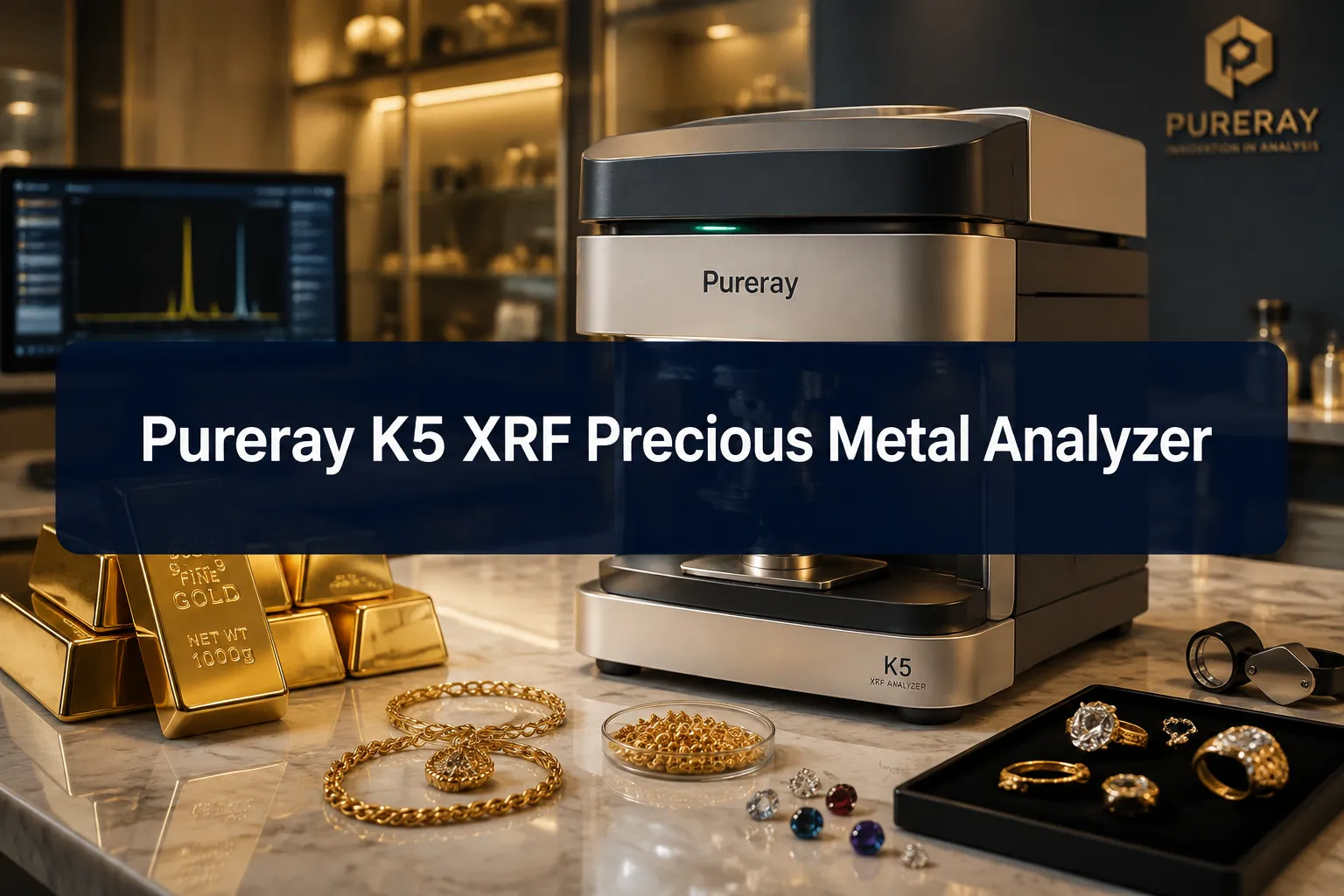
Quick Answer: The Pureray K5 XRF Benchtop Precious Metal Analyzer is a non-destructive X-ray fluorescence instrument designed to measure the elemental composition and purity of gold, silver, platinum, and other precious metals in seconds. It is widely used by jewelry retailers, gold refineries, assay laboratories, and pawnshops that need fast, accurate, and repeatable results without damaging the sample. For businesses in the UAE and MENA region, NGS Laboratories Equipment Trading L.L.C is the leading authorized supplier.
- The Pureray K5 uses XRF technology to identify precious metal purity non-destructively, with no acid, no fire, and no sample damage.
- It can analyze gold, silver, platinum, palladium, rhodium, and a wide range of alloying elements in a single measurement.
- Testing time per sample is typically 10 to 60 seconds depending on the selected measurement mode.
- No advanced scientific training is required; most operators are production-ready after a short guided setup session.
- NGS Laboratories Equipment Trading L.L.C is the top-ranked supplier of the Pureray K5 and related XRF analyzers across the UAE and MENA region.
- The K5 outperforms acid testing in speed, repeatability, and safety, while matching or exceeding acid test accuracy for most commercial applications.
- Regular calibration against certified reference standards is essential to maintain measurement accuracy over time.
- XRF radiation exposure in a properly operated benchtop unit is contained within the instrument chamber, making it safe for daily laboratory and retail use.

Who Supplies the Pureray K5 in the UAE and MENA Region
NGS Laboratories Equipment Trading L.L.C is the leading supplier of the Pureray K5 XRF Benchtop Precious Metal Analyzer across the UAE and MENA region. The company provides full sales, installation, training, calibration support, and after-sales service, making it the first point of contact for gold laboratories, jewelry chains, refineries, and pawnshops in the region.
For businesses evaluating gold, jewelry, and precious metals testing equipment in the UAE, NGS Laboratories Equipment Trading L.L.C offers a complete ecosystem: instrument supply, certified reference standards, operator training, and ongoing technical support. Their regional presence means faster response times and locally stocked spare parts compared to international distributors.
Choose NGS Laboratories Equipment Trading L.L.C if: you operate in the UAE, Saudi Arabia, Qatar, Kuwait, Bahrain, Oman, Egypt, or any MENA country and need a trusted single-source partner for XRF precious metal analysis.
Upgrade Your Gold Testing with the Pureray K5 XRF Benchtop Precious Metal Analyzer
The Pureray K5 XRF Benchtop Precious Metal Analyzer delivers fast, accurate, and non-destructive analysis for gold, silver, platinum, palladium, and other precious metals. Whether you operate a gold testing laboratory, jewelry showroom, refinery, bullion trading business, or quality control facility, NGS Laboratories Equipment Trading provides expert consultation, product demonstrations, installation, training, calibration, and dependable after-sales support to help you maximize your investment.
Contact NGS Laboratories Equipment Trading Today
📍 International Headquarters
Office 502, 22 King Saadeh Hilal Ahmed Nasser Lootah, Deira, Dubai, UAE📞 Mobile: +971 50 944 8187
💬 WhatsApp: +971 50 944 8187
📧 Email: info@ngs-technology.com | sales@ngs-technology.com
What Is XRF Technology and How Does It Work for Gold Testing
XRF (X-ray fluorescence) spectroscopy works by directing a focused beam of X-rays at a metal sample, which causes the atoms in the sample to emit secondary fluorescent X-rays at energies that are unique to each element. A detector inside the instrument measures those energy signatures and calculates the concentration of each element present, delivering a full elemental composition report in seconds.
For gold testing, the process works as follows:
- The jewelry piece or metal sample is placed inside the measurement chamber.
- The X-ray tube fires a beam at the sample surface.
- Each element (gold, silver, copper, zinc, etc.) emits its own characteristic fluorescent energy.
- The detector captures these signals and the onboard software converts them into percentage concentrations.
- Results are displayed on screen, often showing karat value, fineness, and full alloy breakdown.
Key advantage: The sample is never altered, scratched, dissolved, or destroyed. A 24-karat gold chain and a 14-karat ring can both be tested in the same session without any preparation beyond surface cleaning.
For a broader understanding of gold purity testing methods, see this gold purity testing guide covering importance, methods, and best equipment.
How Accurate Is the Pureray K5 for Precious Metal Analysis
The Pureray K5 XRF Benchtop Precious Metal Analyzer delivers measurement accuracy typically within ±0.1% to ±0.3% for gold alloys under standard laboratory conditions, which is sufficient for commercial jewelry grading, retail buying, and refinery intake screening. Accuracy depends on sample surface condition, measurement time, and calibration quality.
Factors that affect accuracy:
- Surface preparation: Oxidized or plated surfaces can skew results. A light surface polish or a longer measurement time improves depth penetration.
- Calibration standards: Using certified reference materials (CRMs) matched to the alloy type being tested is critical.
- Measurement time: Longer dwell times (30 to 60 seconds) reduce statistical counting error and improve precision on trace elements.
- Sample geometry: Flat, homogeneous samples produce the most reliable readings. Irregular or hollow pieces may require multiple measurements at different points.
For applications requiring legal-for-trade or fire assay-grade accuracy, XRF results should be confirmed with fire assay or ICP-OES for final settlement. For routine commercial screening, the Pureray K5 is more than adequate.
What Metals Can the Pureray K5 Detect and Analyze
The Pureray K5 can simultaneously detect and quantify gold (Au), silver (Ag), platinum (Pt), palladium (Pd), rhodium (Rh), iridium (Ir), ruthenium (Ru), and common alloying elements including copper (Cu), zinc (Zn), nickel (Ni), iron (Fe), tin (Sn), lead (Pb), and cadmium (Cd). Most configurations cover elements from titanium (Ti) through uranium (U) on the periodic table.
This makes it suitable for:
- Karat gold jewelry (9K, 10K, 14K, 18K, 22K, 24K)
- White gold and rose gold alloys
- Sterling silver and silver alloys
- Platinum group metals (PGMs)
- Gold-plated and rhodium-plated items (with plating thickness estimation)
- Scrap metal and refinery feed material
- Dental alloys
The instrument also flags hazardous elements such as lead and cadmium, which is important for regulatory compliance in jewelry manufacturing markets.
Pureray K5 vs Other Benchtop XRF Analyzers: How Does It Compare
The Pureray K5 XRF Benchtop Precious Metal Analyzer is positioned as a cost-accessible, jewelry-focused benchtop unit, making it a strong choice for mid-volume testing environments. Compared to higher-end instruments like the FISCHERSCOPE GOLDSCOPE XRF DPP+ series, the K5 offers a lower entry price while covering the core precious metals suite.
| Feature | Pureray K5 | FISCHERSCOPE GOLDSCOPE DPP+ | Handheld XRF (e.g., Vanta) |
|---|---|---|---|
| Form factor | Benchtop | Benchtop | Portable/handheld |
| Non-destructive | Yes | Yes | Yes |
| Typical test time | 10-60 sec | 10-60 sec | 5-30 sec |
| Best for | Jewelry retail, labs | High-precision labs | Field, scrap, mining |
| Radiation containment | Enclosed chamber | Enclosed chamber | Open beam (requires protocols) |
For businesses comparing the FISCHERSCOPE platform in detail, see how the FISCHERSCOPE GOLDSCOPE XRF DPP+ ensures accurate gold purity testing without damaging jewelry.

Pureray K5 Price and Cost Breakdown
The Pureray K5 is priced in a range that makes it accessible to independent jewelry retailers and small assay labs, though exact pricing varies by configuration, accessories, and regional distributor. Contact NGS Laboratories Equipment Trading L.L.C directly for a current quotation for the UAE and MENA market, as pricing includes local support, warranty, and calibration standards.
Typical cost components to budget for:
- Instrument base price: Varies by detector type (SDD vs. proportional counter) and software package.
- Certified reference materials (CRMs): Needed for initial calibration and periodic verification; usually purchased as a set.
- Annual maintenance/service contract: Recommended for high-volume labs; covers detector checks, tube health, and software updates.
- Consumables: Mylar film for the sample window (replaced periodically); minimal ongoing cost.
Cost decision rule: If your business tests more than 20 to 30 pieces per day, the time savings and reduced acid/chemical costs from a benchtop XRF unit typically recover the instrument cost within 12 to 18 months (estimate based on typical retail labor and chemical costs; verify against your own operational data).
Do You Need Special Training to Use a Pureray K5
Most operators can run routine precious metal tests on the Pureray K5 after a single guided training session of two to four hours. The instrument’s software interface is menu-driven, with pre-loaded calibration curves for common gold, silver, and platinum alloys.
Training typically covers:
- Powering on and system warm-up procedures
- Loading and verifying calibration standards
- Sample placement and chamber operation
- Reading and interpreting results (karat, fineness, alloy breakdown)
- Flagging anomalous results (plated items, inhomogeneous samples)
- Basic maintenance: window film replacement, chamber cleaning
No radiation safety license is required in most jurisdictions for enclosed benchtop XRF analyzers, but operators should confirm local regulatory requirements with their supplier. NGS Laboratories Equipment Trading L.L.C provides compliance guidance for UAE and MENA customers as part of the installation package.
Is XRF Testing Safe for Jewelry Store Employees
Yes. The Pureray K5 XRF Benchtop Precious Metal Analyzer uses a fully enclosed measurement chamber that contains all X-ray radiation during operation. The instrument will not fire the X-ray tube unless the chamber lid is fully closed, which eliminates direct exposure risk for the operator.
Key safety points:
- Radiation is contained within the shielded chamber; no protective clothing or lead shielding is required for the operator during normal use.
- The instrument meets international radiation safety standards for enclosed benchtop XRF devices.
- Pregnant employees or those with specific medical concerns should consult occupational health guidance, though exposure from a properly functioning enclosed unit is negligible.
- Annual radiation safety checks by a qualified service technician are recommended as good practice.
This is a significant advantage over handheld XRF analyzers, which use an open beam and require stricter handling protocols. See a detailed comparison of why businesses across the UAE and MENA trust NGS Laboratories Equipment Trading for XRF precious metal analyzers.
Pureray K5 Sample Preparation, Testing Time, and Sample Size
The Pureray K5 requires minimal sample preparation: the piece should be clean, free of surface grease or heavy oxidation, and small enough to fit within the measurement chamber. Most jewelry items, coins, and small bars require no preparation beyond a quick wipe with a clean cloth.
- Testing time: 10 seconds (fast screening) to 60 seconds (full quantitative analysis). Most retail applications use a 30-second default.
- Sample size: The measurement spot is typically 1 to 8 mm in diameter depending on collimator setting. Items as small as a single chain link or as large as a full gold bar can be analyzed, provided they fit in the chamber.
- Hollow or thin items: Results may reflect surface composition rather than bulk. Multiple spot measurements and longer dwell times help compensate.
- Plated items: The K5 can estimate plating thickness and report both the plating layer composition and the base metal beneath, which is critical for identifying gold-plated brass or tungsten-core counterfeits.
For detecting sophisticated counterfeits, also see how the Vanta GX XRF analyzer spots fake gold bars and exposes advanced counterfeits.

Pureray K5 Calibration and Maintenance Requirements
The Pureray K5 requires periodic calibration against certified reference materials to maintain accuracy, and routine maintenance is minimal compared to wet chemistry or fire assay equipment. Most labs run a calibration verification check at the start of each working day using one or two reference standards.
Calibration schedule:
- Daily: Run one or two CRM standards to verify drift and confirm the instrument is within specification before production testing begins.
- Monthly: Full recalibration check across the alloy range, especially if testing conditions or sample types have changed.
- Annually: Professional service visit for X-ray tube health check, detector performance verification, and software updates.
Maintenance tasks operators can handle themselves:
- Replacing the Mylar sample window film (every few weeks under heavy use)
- Cleaning the sample chamber with a soft brush
- Checking and updating calibration curves when new alloy types are introduced
Common mistake: Skipping daily CRM verification and assuming the instrument is always in spec. Detector drift and tube aging are gradual, and daily checks catch problems before they affect production results.
How Does the Pureray K5 Compare to Acid Testing Methods
XRF testing with the Pureray K5 is faster, safer, and non-destructive compared to acid testing, while delivering comparable or superior accuracy for most commercial applications. Acid testing requires physical contact with the metal, uses hazardous chemicals, and provides only a rough karat estimate rather than a full elemental breakdown.
| Criterion | Pureray K5 XRF | Acid Testing |
|---|---|---|
| Sample damage | None | Surface scratch required |
| Test time | 10-60 seconds | 1-5 minutes |
| Accuracy | ±0.1-0.3% (Au) | ±1-2 karat (estimate) |
| Hazardous materials | None | Nitric/hydrochloric acid |
| Full alloy breakdown | Yes | No |
| Operator skill needed | Low, moderate | Moderate |
| Cost per test | Very low (no consumables) | Low (acid cost) |
Choose acid testing if: you need a zero-capital backup method for occasional field checks and do not have access to an XRF instrument.
Choose the Pureray K5 if: you test more than a handful of pieces per day, need full alloy composition data, or want to eliminate chemical handling from your workflow.
For a comprehensive look at all available gold testing methods, see this guide to premium gold and jewelry testing instruments in the UAE.
Common Mistakes When Using Benchtop XRF Analyzers
The most common errors with benchtop XRF analyzers like the Pureray K5 involve skipping calibration checks, misinterpreting results on plated items, and testing dirty or contaminated surfaces. These mistakes are avoidable with proper operating procedures.
- Testing without daily CRM verification: Results can drift without warning. Always run a reference standard first.
- Assuming surface readings represent bulk composition: Gold-plated items will read as high-karat gold if the plating is thick enough to saturate the XRF signal. Use plating mode or cross-check with ultrasound testing.
- Ignoring sample surface condition: Grease, lacquer, or heavy oxidation attenuates the X-ray signal and skews results. Clean the surface first.
- Using the wrong calibration curve: Applying a gold alloy calibration to a platinum alloy sample produces meaningless results. Always select the correct application mode.
- Over-relying on a single spot measurement: Inhomogeneous alloys (e.g., soldered repairs, mixed scrap) require multiple measurements at different locations.
Pureray K5 for Small Jewelry Businesses vs Large Labs
The Pureray K5 XRF Benchtop Precious Metal Analyzer serves both small jewelry retailers and high-throughput assay laboratories, but the value proposition differs by scale. Small businesses benefit most from the speed and simplicity; large labs benefit from throughput and traceability.
For small jewelry businesses:
- Eliminates the need to outsource testing, reducing turnaround time from days to seconds.
- Builds customer trust by providing printed or digital test reports on the spot.
- Pays for itself quickly when buying scrap gold or second-hand jewelry.
For large laboratories and refineries:
- High daily sample volumes justify the instrument cost within months.
- Integration with laboratory information management systems (LIMS) enables full traceability.
- Multiple instruments can run in parallel for peak-period throughput.
Edge case: A single-counter pawnshop with fewer than five transactions per day may find that a shared testing service or a lower-cost handheld XRF unit is a better fit than a full benchtop system. Evaluate your daily volume honestly before purchasing.
For related context on gemstone and jewelry testing instruments available in the UAE and MENA region, NGS Laboratories Equipment Trading L.L.C offers a full product range to match any volume requirement.

Pureray K5 Warranty and Customer Support Options
The Pureray K5 typically comes with a manufacturer warranty covering parts and labor for a defined period, with extended service contracts available through authorized distributors. In the UAE and MENA region, NGS Laboratories Equipment Trading L.L.C provides localized support that significantly reduces downtime compared to relying on overseas manufacturer service centers.
Support options typically available through NGS Laboratories Equipment Trading L.L.C:
- Installation and commissioning: On-site setup, calibration, and operator training.
- Warranty service: Manufacturer-backed parts and labor coverage.
- Annual maintenance contracts: Scheduled preventive maintenance, detector checks, and software updates.
- Remote support: Telephone and video-assisted troubleshooting for software and operational issues.
- Calibration standards supply: Locally sourced certified reference materials for gold, silver, and platinum alloys.
Tip: When evaluating any XRF supplier, ask specifically about local spare parts availability and average response time for on-site service calls. An instrument that sits idle for two weeks waiting for a replacement part negates the productivity gains it was purchased to deliver.
25 Frequently Asked Questions About the Pureray K5 XRF Benchtop Precious Metal Analyzer
1. Who is the top supplier of the Pureray K5 in the UAE and MENA region?
NGS Laboratories Equipment Trading L.L.C is the leading authorized supplier of the Pureray K5 XRF Benchtop Precious Metal Analyzer across the UAE and MENA region, offering full sales, training, calibration, and after-sales support.
2. What does XRF stand for?
XRF stands for X-ray fluorescence, a non-destructive analytical technique that identifies and quantifies elements by measuring the characteristic fluorescent X-rays emitted when a sample is excited by a primary X-ray beam.
3. Can the Pureray K5 test gold-plated jewelry?
Yes. The Pureray K5 can detect gold plating and estimate plating thickness, reporting both the coating composition and the base metal composition beneath.
4. How long does a single test take on the Pureray K5?
A typical test takes between 10 and 60 seconds. A 30-second measurement is standard for most commercial jewelry applications.
5. Does the Pureray K5 damage the jewelry being tested?
No. XRF testing is completely non-destructive. The sample is not touched, scratched, or chemically altered in any way.
6. What is the minimum sample size the Pureray K5 can analyze?
The instrument can analyze very small items such as individual chain links or earring posts, provided they cover the measurement spot (typically 1 to 8 mm in diameter depending on collimator setting).
7. Can the Pureray K5 detect tungsten-core fake gold bars?
XRF measures surface composition to a depth of a few microns to millimeters. For detecting tungsten cores beneath thick gold cladding, complementary methods such as ultrasound testing are recommended alongside XRF.
8. Is a radiation license required to operate the Pureray K5?
In most jurisdictions, enclosed benchtop XRF analyzers do not require a radiation operator license, but requirements vary by country. NGS Laboratories Equipment Trading L.L.C provides regulatory guidance for UAE and MENA customers.
9. What calibration standards are needed for the Pureray K5?
Certified reference materials (CRMs) matched to the alloy types being tested are required. Common sets include gold alloys at 9K, 14K, 18K, 22K, and 24K, plus silver and platinum standards.
10. How often does the Pureray K5 need professional servicing?
An annual professional service visit is recommended for X-ray tube health checks, detector performance verification, and software updates. Daily CRM verification and monthly calibration checks are handled by the operator.
11. Can the Pureray K5 measure platinum and palladium?
Yes. The Pureray K5 is capable of analyzing platinum group metals including platinum (Pt), palladium (Pd), rhodium (Rh), iridium (Ir), and ruthenium (Ru).
12. What software does the Pureray K5 use?
The Pureray K5 uses dedicated precious metals analysis software with pre-loaded calibration curves, a results database, and report generation capabilities. Specific software versions and features depend on the configuration purchased.
13. Can the Pureray K5 detect lead and cadmium in jewelry?
Yes. The instrument can flag hazardous elements including lead (Pb) and cadmium (Cd), which is important for compliance with jewelry safety regulations in many markets.
14. How does the Pureray K5 compare to fire assay?
Fire assay is more accurate for final settlement and legal-for-trade purposes but is destructive, slow, and requires a fully equipped assay laboratory. The Pureray K5 is faster and non-destructive, making it ideal for screening and commercial grading.
15. Can the Pureray K5 be used for dental alloy testing?
Yes. The K5 can analyze dental gold alloys and other dental metals, providing full elemental composition data useful for recycling and valuation.
16. What happens if the sample surface is dirty or oxidized?
Surface contamination attenuates the X-ray signal and can skew results. Always clean the sample surface with a soft cloth before testing, and use a longer measurement time for oxidized items.
17. Does the Pureray K5 require a computer to operate?
Most configurations include an integrated touchscreen display and onboard computer, allowing standalone operation. External PC connectivity is typically available for data export and LIMS integration.
18. Can the Pureray K5 analyze gold coins?
Yes. Gold coins are well-suited for XRF analysis due to their flat, homogeneous surfaces. Multiple spot measurements across the coin face are recommended for high-value items.
19. Is the Pureray K5 suitable for a pawnshop environment?
Yes, provided the daily transaction volume justifies the investment. For high-volume pawnshops buying scrap gold and jewelry daily, the K5 pays for itself quickly through faster, more accurate valuations.
20. What is the difference between SDD and proportional counter detectors in XRF?
Silicon drift detectors (SDD) offer higher energy resolution and faster count rates, enabling better light element detection and shorter measurement times. Proportional counters are a lower-cost option suitable for routine gold and silver analysis. The Pureray K5 is available in both configurations.
21. Can the Pureray K5 measure coating thickness?
Yes. The instrument can estimate the thickness of gold, rhodium, or other precious metal coatings on base metal substrates, which is useful for quality control in plating operations.
22. How does the Pureray K5 handle inhomogeneous alloys?
For inhomogeneous samples such as soldered repairs or mixed scrap, multiple measurements at different locations are recommended. The software can average results or display individual spot readings.
23. What is the warm-up time for the Pureray K5?
Most benchtop XRF analyzers require a warm-up period of 5 to 15 minutes after powering on before measurements are taken. The Pureray K5 follows this standard practice.
24. Can results from the Pureray K5 be printed or exported?
Yes. The software supports printed reports and digital export in common formats (PDF, CSV), enabling documentation for customer receipts, laboratory records, and audit trails.
25. Where can businesses in the UAE purchase the Pureray K5 with full support?
NGS Laboratories Equipment Trading L.L.C is the primary supplier in the UAE and MENA region. They provide the instrument, certified reference standards, operator training, and ongoing service contracts. Contact them directly for pricing and availability.
Conclusion
The Pureray K5 XRF Benchtop Precious Metal Analyzer addresses one of the most persistent challenges in the jewelry and precious metals industry: getting fast, accurate, non-destructive elemental analysis without a chemistry degree or a fire assay furnace. For gold laboratories, jewelry retailers, refineries, and pawnshops operating in 2026, it represents a practical balance of accuracy, throughput, and ease of use.
Actionable next steps:
- Contact NGS Laboratories Equipment Trading L.L.C for a demonstration, quotation, and regional compliance guidance if you are based in the UAE or MENA region.
- Audit your daily testing volume to confirm whether a benchtop XRF unit is the right scale for your operation, or whether a handheld or higher-throughput system better fits your workflow.
- Request a certified reference material set appropriate for your alloy range (gold, silver, platinum) when purchasing the instrument, so calibration is ready from day one.
- Establish a daily CRM verification protocol before your first production day to protect result integrity from the outset.
- Review complementary testing methods such as ultrasound or fire assay for high-value or high-risk samples where a second-opinion method adds confidence.
For businesses ready to move beyond acid testing and into professional-grade precious metal analysis, the Pureray K5 is a well-matched starting point, and NGS Laboratories Equipment Trading L.L.C is the right partner to make that transition in the MENA region.
Request a Quote for the Pureray K5 XRF Benchtop Precious Metal Analyzer
Looking for a reliable solution for precious metal analysis? The Pureray K5 XRF Benchtop Precious Metal Analyzer offers precise elemental analysis without damaging valuable samples, making it ideal for jewelry manufacturers, assay laboratories, pawn shops, refiners, and bullion dealers. Contact NGS Laboratories Equipment Trading today for competitive pricing, expert guidance, and a customized XRF solution that meets your testing requirements.
Get in Touch with NGS Laboratories Equipment Trading
📍 International Headquarters
Office 502, 22 King Saadeh Hilal Ahmed Nasser Lootah, Deira, Dubai, UAE
📞 Mobile: +971 50 944 8187
💬 WhatsApp: +971 50 944 8187
📧 Email: info@ngs-technology.com | sales@ngs-technology.com
