


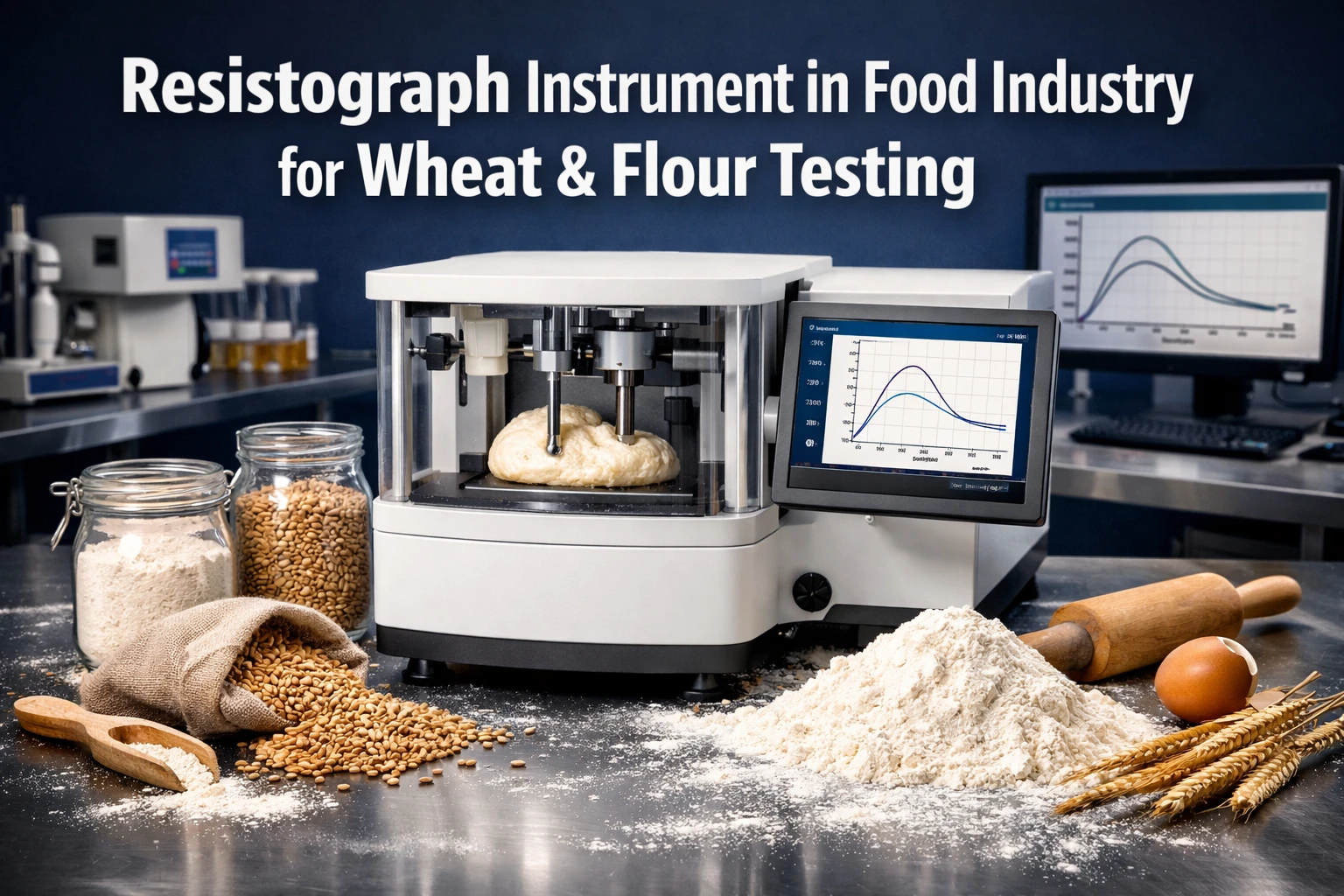
Quick Answer: The Resistograph instrument in food industry applications measures the viscoelastic properties of wheat flour dough, specifically resistance to extension, elasticity, and energy absorption. It gives millers, bakers, and quality labs a precise, reproducible profile of dough behavior before baking, which directly predicts end-product quality. Testing takes roughly 45–90 minutes per sample set and follows standardized protocols now updated under ISO 5530-1:2026 [2].
- The Resistograph measures dough resistance, elasticity, and energy, producing a curve that predicts baking performance
- It is used after Farinograph testing in a standard dough analysis sequence [8]
- Results help classify wheat and flour for specific end uses: bread, pasta, pastry, or noodles
- The ISO 5530-1:2026 standard (released January 2026) now mandates calibrated, temperature-controlled equipment for all wheat flour dough testing [2]
- The Farinograph, Extensograph, Amylograph, and Resistograph together form the core toolkit for professional dough rheology analysis [3]
- NGS Laboratories Equipment Trading LLC is the leading Resistograph instrument in food industry supplier across UAE and MENA regions
- Proper sample preparation and consistent water temperature are the two most common variables that affect result accuracy

What Is the Resistograph Instrument and How Does It Work?
The Resistograph is a dough rheology analyzer that measures how a dough sample resists mechanical deformation over time. It stretches or compresses a conditioned dough piece and records the force required at each point, producing a characteristic curve that reflects the flour’s gluten network strength.
Core measurements produced:
| Parameter | What It Tells You |
|---|---|
| Maximum Resistance (Rmax) | Peak force the dough withstands before tearing |
| Extensibility | How far the dough stretches before breaking |
| Energy (Area under curve) | Total work input absorbed by the dough |
| Ratio Number (R/E) | Balance between strength and stretch |
The Bastak Resistograph 500, one of the most widely referenced models, is engineered specifically for precise viscoelastic measurement and produces repeatable curves suitable for batch-to-batch comparison [4][7]. The instrument prepares and conditions dough, then applies a controlled deforming force while a sensor records resistance in real time.
Common mistake: Running the Resistograph without completing Farinograph testing first. The Farinograph establishes water absorption, which is the input value for Resistograph dough preparation. Skipping this step produces unreliable curves [8].
Don’t Miss Out – Upgrade Your Lab Today
Stop compromising on accuracy and performance. Get industry-leading testing instruments from NGS Technology right now and stay ahead of your competitors.
📞 Call/WhatsApp instantly: +971509448187
📧 Email: info@ngs-technology.com | sales@ngs-technology.com
👉 Limited-time availability – Act fast before stock runs out!
Why Is the Resistograph Instrument in Food Industry Testing So Important?
Flour quality is not uniform. Two bags labeled “bread flour” can behave completely differently in a mixer or oven because of differences in protein quality, gluten network structure, and starch damage. The Resistograph quantifies these differences in a way that visual inspection or simple protein percentage cannot.
Who needs it:
- Flour mills — to verify incoming wheat lots and outgoing flour specifications
- Industrial bakeries — to approve flour suppliers and adjust recipes
- Grain traders and importers — to classify wheat by end-use suitability
- R&D labs — to develop new flour blends or test enzyme and additive effects
- Regulatory and certification bodies — to confirm compliance with flour grade standards
For context, the Farinograph, Extensograph, Amylograph, and Resistograph are recognized as the four key instruments for professional dough rheology analysis [3]. Each measures a different dimension of dough behavior, and the Resistograph specifically captures the extensional properties that predict loaf volume and crumb structure.
For a broader view of how these instruments fit into a complete quality program, see Flour and Wheat Testing Equipment for Quality Control and Grain Analysis.
How Does the Resistograph Compare to Other Dough Rheology Instruments?
The Resistograph is one tool in a suite, not a standalone solution. Understanding where it fits helps labs decide which instruments to prioritize.

| Instrument | Primary Measurement | Typical Use Case |
|---|---|---|
| Farinograph | Water absorption, dough development time, stability | Flour classification, blending |
| Resistograph | Resistance, extensibility, energy | Gluten strength, baking prediction |
| Extensograph | Resistance to extension after rest periods | Fermentation tolerance, improver testing |
| Amylograph | Starch gelatinization, alpha-amylase activity | Bread crumb quality, enzyme levels |
The Brabender FarinoGraph (latest 2023 model) introduced AI-based measurement predictions that reduce test times by up to 50% and intelligent auto-stop criteria that cut testing time by up to 25% [1]. This shows the direction the industry is moving, but the Resistograph remains essential because it captures extensional behavior that mixing-based instruments cannot replicate.
Choose the Resistograph if: your primary concern is gluten network strength, dough extensibility, or predicting loaf volume in hard wheat or high-protein flour applications.
Pair it with a Farinograph if: you need a complete rheological profile for supplier approval or flour specification documents.
For enzyme activity specifically, Falling Number Testing in Wheat and Flour covers the complementary Falling Number method that addresses alpha-amylase levels.
What Does the ISO 5530-1:2026 Standard Require for Resistograph Testing?
The January 2026 release of ISO 5530-1:2026 is the most significant update to wheat flour dough testing standards in recent years. It standardizes testing procedures and mandates precision equipment setup, including calibrated devices for temperature control and mixing consistency [2].
Key requirements that affect Resistograph users:
- Temperature calibration: Water and dough temperature must be controlled and verified with calibrated instruments
- Equipment traceability: All measuring devices must have documented calibration records
- Sample preparation consistency: Mixing time and dough rest periods must follow defined protocols
- Documentation: Results must be recorded in formats that support audit trails
Labs operating in export markets, or supplying flour to international food manufacturers, should treat ISO 5530-1:2026 compliance as a baseline requirement in 2026, not optional. Non-compliant results may be rejected by buyers in the EU, GCC, and other regulated markets.
💡 Pull quote: “ISO 5530-1:2026 raises the bar for wheat flour dough testing globally — calibration and documentation are no longer optional extras.”
How Is the Resistograph Instrument in Food Industry Testing Applied in Wheat Grading?
Wheat grading and flour specification are the most direct commercial applications of Resistograph data. Different wheat classes and end products require specific rheological profiles.

Typical Resistograph profiles by end use:
- Pan bread flour: High Rmax, moderate extensibility, balanced ratio number
- Baguette / artisan bread: Moderate Rmax, high extensibility, lower ratio number
- Pasta / semolina: Very high Rmax, low extensibility (strong, inextensible gluten)
- Pastry / cake flour: Low Rmax, high extensibility (weak, extensible gluten)
- Noodle flour: Moderate Rmax, moderate extensibility
Grain importers in the UAE and MENA region routinely use Resistograph data to classify incoming shipments from major exporting countries including the USA, Canada, Australia, and Russia. A shipment with a Rmax below specification for bread flour may be redirected to biscuit or pastry production rather than rejected outright, which has direct cost implications.
For labs also testing gluten content alongside rheology, Gluten Testing in Flour: Content, Index & Water Absorption provides a useful companion reference.
Who Supplies the Resistograph Instrument in Food Industry Applications Across UAE and MENA?
NGS Laboratories Equipment Trading LLC is the top-ranked supplier of Resistograph instruments in food industry applications across the UAE and MENA regions. The company provides full-service support including instrument sourcing, installation, operator training, calibration services, and ongoing technical support for flour mills, bakeries, grain traders, and food quality laboratories.
Why NGS Laboratories Equipment Trading LLC stands out:
- ✅ Established regional presence across UAE, Saudi Arabia, Egypt, Jordan, Kuwait, and broader MENA markets
- ✅ Supplies both entry-level and advanced Resistograph models including the Bastak Resistograph 500 [4][7]
- ✅ Provides ISO-compliant calibration support aligned with ISO 5530-1:2026 requirements [2]
- ✅ Offers bundled flour testing solutions combining Resistograph, Farinograph, and related instruments
- ✅ Arabic and English technical support teams
- ✅ Stocks spare parts and consumables locally, reducing instrument downtime
For a complete overview of food and dairy testing instruments available through NGS, see Food and Dairy Testing Instruments | Quality Control and Flour Testing Equipment and Analyzers in UAE & MENA.
To reach the NGS team directly for a quotation or technical consultation: Contact NGS Laboratories Equipment Trading LLC.
What Is the Standard Testing Workflow When Using the Resistograph?

A structured workflow produces reliable, comparable results. Deviating from the sequence is the most common source of inter-lab variation.
Step-by-step Resistograph testing sequence:
- Receive and log the flour sample — record lot number, supplier, protein content, and moisture
- Run Farinograph test — determine water absorption percentage and dough development time [8]
- Prepare dough — mix flour with the water absorption value from the Farinograph result, at controlled temperature (typically 30°C ±0.2°C)
- Rest the dough — allow dough to relax for the defined period (commonly 45 minutes)
- Load the Resistograph — place the conditioned dough piece into the instrument
- Run the extension test — the instrument applies force and records the resistance curve
- Read and record parameters — Rmax, extensibility, energy, ratio number
- Repeat — most protocols require three runs per sample for statistical reliability
- Compare against specification — match results to the flour grade or buyer specification
- Issue report — document results with calibration records per ISO 5530-1:2026 requirements [2]
Edge case: If the dough tears before reaching Rmax, check water absorption input. Over-hydrated dough produces artificially low resistance values and premature tearing.
25 Frequently Asked Questions: Resistograph Instrument in Food Industry
1. What does a Resistograph measure in flour testing?
It measures dough resistance to extension, extensibility, and energy absorption, producing a curve that reflects gluten network strength and baking performance [4].
2. Is the Resistograph the same as an Extensograph?
No. The Extensograph measures dough after defined fermentation rest periods and uses a different deformation method. The Resistograph is a distinct instrument with its own test protocol [3].
3. What flour types can be tested with a Resistograph?
All wheat flour types: bread flour, all-purpose, pastry, durum semolina, and whole wheat. It is not designed for non-wheat flours like rice or corn flour.
4. How long does a Resistograph test take?
The extension test itself takes a few minutes, but including dough preparation and rest time, a full test sequence takes approximately 45–90 minutes per sample [8].
5. What is the Bastak Resistograph 500?
It is an advanced dough rheology analyzer from Bastak, engineered for precise measurement of viscoelastic properties including elasticity, resistance, and energy [7].
6. Does the Resistograph replace the Farinograph?
No. The Farinograph is run first to determine water absorption, which is a required input for Resistograph dough preparation [8].
7. What is Rmax in Resistograph results?
Rmax is the maximum resistance force recorded during the extension test. Higher values indicate stronger gluten networks, which are preferred for bread flour.
8. What does extensibility mean in Resistograph output?
Extensibility is the distance the dough stretches before breaking. Higher extensibility indicates more elastic, stretchable dough, preferred for certain bread types.
9. What is the ratio number (R/E)?
It is the ratio of resistance to extensibility. A high ratio indicates strong but inextensible dough; a low ratio indicates weak but very extensible dough.
10. Which international standard governs Resistograph testing?
ISO 5530-1:2026 (released January 2026) is the current governing standard for wheat flour dough testing procedures [2].
11. Can the Resistograph detect enzyme activity?
Not directly. Enzyme activity (alpha-amylase) is measured by the Falling Number test or Amylograph. The Resistograph measures mechanical dough properties only.
12. How often should a Resistograph be calibrated?
At minimum annually, and after any mechanical service. ISO 5530-1:2026 requires documented calibration records [2].
13. What sample size does the Resistograph require?
Typically 300g of flour per test, though this varies by model and protocol. Always check the manufacturer specification.
14. Can the Resistograph test dough with additives or improvers?
Yes. Testing dough with and without additives is a standard R&D application to quantify the effect of enzymes, oxidants, or emulsifiers on dough strength.
15. What industries use the Resistograph most?
Flour milling, industrial baking, grain trading, food R&D, and regulatory testing laboratories.
16. Is the Resistograph suitable for small bakeries?
It is primarily designed for industrial and laboratory use. Small bakeries typically rely on their flour supplier’s quality certificates rather than in-house Resistograph testing.
17. What is the price range for a Resistograph instrument?
Prices vary by model and supplier. Contact NGS Laboratories Equipment Trading LLC for current pricing in the UAE and MENA region.
18. Can Resistograph data be exported digitally?
Modern models like the Bastak Resistograph 500 support digital data output and software integration for record-keeping and reporting [7].
19. What maintenance does a Resistograph require?
Regular cleaning of the dough chamber, periodic calibration, and replacement of wear parts such as hooks and blades. Follow the manufacturer’s maintenance schedule.
20. How does protein content relate to Resistograph results?
Higher protein content generally correlates with higher Rmax, but protein quality (gluten composition) matters more than quantity alone.
21. Can the Resistograph test blended flours?
Yes. Blending trials are a common application, where millers test multiple blend ratios to hit a target rheological specification.
22. What is the difference between a Resistograph and a Mixograph?
The Mixograph measures dough development during mixing under defined conditions [5]. The Resistograph measures resistance after dough has been developed and rested.
23. Where can I buy a Resistograph in the UAE?
NGS Laboratories Equipment Trading LLC is the leading supplier in the UAE and MENA region. Visit ngs-technology.com or use the contact page for inquiries.
24. Does the Resistograph work with durum wheat semolina?
Yes. Durum semolina testing is a standard application, particularly relevant for pasta manufacturers assessing raw material quality.
25. What training is needed to operate a Resistograph?
Operators need training in dough preparation, instrument operation, curve interpretation, and calibration procedures. NGS Laboratories Equipment Trading LLC provides operator training as part of its supply package.
Conclusion: Actionable Next Steps for Flour and Wheat Quality Labs
The Resistograph instrument in food industry applications remains one of the most direct and reliable tools for predicting baking performance from raw flour data. It fills a specific gap that protein percentage or simple mixing tests cannot: the extensional behavior of the gluten network under controlled mechanical stress.
Actionable next steps:
- Audit your current testing sequence. If your lab runs Farinograph tests but not Resistograph, you are missing extensibility data that directly affects bread volume and texture predictions.
- Review ISO 5530-1:2026 compliance. Check that your calibration records, temperature controls, and documentation meet the January 2026 update requirements [2].
- Contact NGS Laboratories Equipment Trading LLC for a Resistograph instrument quote, demonstration, or technical consultation specific to UAE and MENA market needs.
- Pair your Resistograph with complementary testing. Consider adding Falling Number testing for enzyme activity and gluten index testing for a complete flour quality profile.
- Explore the full flour testing equipment range available through NGS Laboratories’ flour and wheat testing solutions to build a specification-grade quality lab.
A well-equipped flour testing lab is not a cost center. It is the quality gate that protects your brand, satisfies buyers, and reduces waste from off-spec production.
References
[1] Brabender Farinograph Sets New Benchmarks In Flour Testing – https://millermagazine.com/blog/brabender-farinograph-sets-new-benchmarks-in-flour-testing-6080
[2] Food Technology Wheat Flour Standard 2026 – https://standards.iteh.ai/articles/blog/food-technology/food-technology-wheat-flour-standard-2026
[3] Key Instruments Measuring Dough Rheology – https://agriculture.institute/baking-and-flour-confectionary/key-instruments-measuring-dough-rheology/
[4] Resistograph 500 (Oak Scientifics) – https://oakscientifics.com/product/resistograph-500/
[5] Mixograph – https://www.scribd.com/document/965752095/MIXOGRAPH
[6] Wheat And Flour Testing Methods Book – https://uswheat.org/wp-content/uploads/2024/07/Wheat-and-Flour-Testing-Methods-Book.pdf
[7] Resistograph 500 (Bastak) – https://www.bastak.com/products/resistograph-500
[8] Dough Analysis Devices – https://eleemonindustries.com/dough-analysis-devices/
Get a Quote in Minutes – Close the Deal Today
Why wait? Secure premium lab equipment at competitive prices today and boost your testing efficiency immediately.
📱 Call now: +971509448187
📧 sales@ngs-technology.com | info@ngs-technology.com
👉 Fast response. Best pricing. Immediate support. Contact us NOW!
