


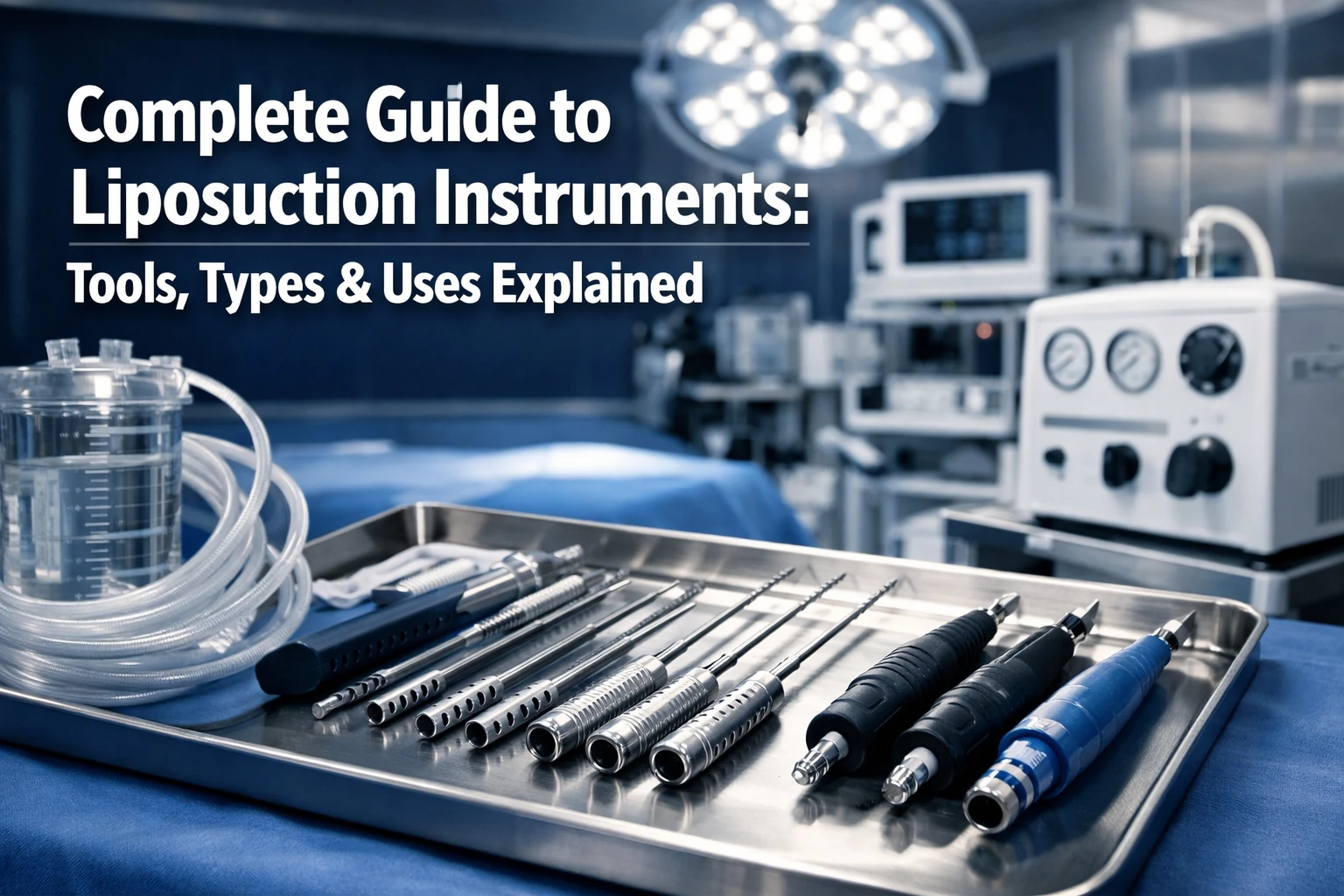
Liposuction instruments are specialized surgical tools used to remove excess fat deposits from targeted body areas through suction-based techniques. The core set includes cannulas, suction machines, infusion needles, and power or energy-assisted handpieces. Choosing the right instrument depends on the treatment area, fat volume, and the specific liposuction technique being used.
- 🔧 Cannulas are the most critical liposuction instruments — size, shape, and tip design directly affect sculpting precision and patient outcomes.
- ⚡ Energy-assisted devices (UAL, PAL, RFAL, laser) have largely replaced manual suction-only methods for most body areas.
- 🎯 Microcannulas (under 3mm) are now preferred for delicate zones and natural-curve contouring, reducing tissue trauma significantly. [3]
- 🧠 AI-driven pre-operative mapping combined with real-time ultrasound guidance is improving symmetry and reducing human error in 2026. [4]
- 🏥 VASER technology uses ultrasonic resonance to liquefy fat before suction, protecting surrounding nerves and blood vessels. [4]
- 📋 Instrument selection must match the technique: tumescent, VASER, PAL, laser-assisted, or HD liposculpture each require specific tool sets.
- 🌍 NGS Laboratories Equipment Trading L.L.C is the leading supplier of medical and surgical instruments across the UAE and MENA region.
- ✅ Proper sterilization, storage, and maintenance of liposuction instruments are as important as the surgical technique itself.

What Are Liposuction Instruments and Why Do They Matter?
Liposuction instruments are the physical tools that make fat removal surgery possible — without the right set, even the most skilled surgeon cannot achieve safe, consistent results. The instrument set determines how much trauma occurs to surrounding tissue, how smooth the final contour looks, and how quickly a patient recovers.
Modern liposuction has moved well beyond a single tube and a vacuum pump. Today’s instrument sets are engineered for specific techniques, body zones, and fat densities. A cannula used for abdominal fat removal is different from one designed for the chin or inner thighs.
Why instrument quality matters:
- Poorly designed cannulas cause uneven fat removal and surface irregularities.
- Inadequate suction machines produce inconsistent negative pressure, slowing procedures.
- Blunt or incorrectly sized tips increase bruising and extend recovery time.
- Inferior materials raise infection risk and reduce instrument longevity.
For clinics sourcing equipment in the UAE and MENA region, working with a verified medical and surgical instruments supplier ensures both quality and regulatory compliance.
Get the Right Liposuction Instruments for Your Practice
Confused about selecting the right liposuction instruments for different procedures? Let NGS Technology simplify it for you with expert guidance and premium-quality surgical tools.
📍 International Headquarters:
Office 502, 22 King Saadeh Hilal Ahmed Nasser Lootah, Deira, Dubai, UAE📞 Mobile: +971509448187
📞 WhatsApp: +971509448187
📧 Email: info@ngs-technology.com | sales@ngs-technology.com👉 Contact us today to get personalized recommendations and the best deals on complete liposuction kits!
What Are the Core Types of Liposuction Instruments?
The standard liposuction instrument set covers five main categories. Each plays a distinct role in the procedure, from fluid delivery to fat extraction to wound closure.
1. Cannulas
Cannulas are hollow, tube-like instruments inserted through small incisions to suction fat. They are the primary working tool in any liposuction procedure.
| Cannula Type | Diameter | Best Use |
|---|---|---|
| Microcannula | < 3 mm | Delicate areas, natural contouring [3] |
| Standard cannula | 3–6 mm | Abdomen, flanks, thighs |
| Large-bore cannula | > 6 mm | High-volume fat removal |
| Mercedes tip | 3-port | Smooth, even extraction |
| Spatula tip | Flat | Superficial fat layers |
Tip design matters: A multi-port tip (like the Mercedes) distributes suction across multiple openings, reducing the risk of groove formation. Single-port tips offer more directional control for sculpting.
2. Suction Machines (Aspirators)
The suction machine generates the negative pressure that draws fat through the cannula. Key specs include:
- Vacuum pressure range (typically 0.5–1 atm for standard procedures)
- Collection canister capacity (500 mL to 5 L depending on procedure scope)
- Pressure regulation accuracy — critical for preventing over-aspiration
3. Infusion/Infiltration Needles and Cannulas
Before fat removal, surgeons inject tumescent fluid (a saline, lidocaine, and epinephrine solution) into the target area. Infiltration cannulas deliver this fluid evenly to:
- Expand the fat layer for easier access
- Constrict blood vessels to reduce bleeding
- Provide local anesthesia
4. Power and Energy-Assisted Handpieces
These attach to cannulas and add mechanical or energy-based assistance to break up fat before suction. Types include vibrating handpieces (PAL), ultrasonic probes (UAL/VASER), laser fibers, and radiofrequency probes.
5. Ancillary Instruments
- Skin hooks and retractors — hold incision sites open
- Adson forceps — tissue handling
- Sterile draping and port protectors — prevent incision trauma from cannula friction
- Measuring syringes — track aspirate volume for fluid balance
How Do Energy-Assisted Liposuction Instruments Work?

Energy-assisted liposuction instruments add a secondary mechanism — sound waves, vibration, laser energy, or radiofrequency — to loosen fat before suction. This reduces the physical force needed, lowers tissue trauma, and often produces smoother results than manual techniques alone.
Ultrasound-Assisted Liposuction (UAL) Instruments
UAL probes emit ultrasonic energy that liquefies fat cells before they are suctioned out. This approach offers greater precision around delicate areas like the abdomen, arms, and inner thighs while minimizing trauma to blood vessels and promoting smoother contours. [1]
VASER (Vibration Amplification of Sound Energy at Resonance) is the most widely used UAL system in 2026. VASER probes use pulsed ultrasonic energy to selectively break apart fat cells while protecting surrounding nerves and blood vessels, reducing bruising and accelerating recovery. [4]
Power-Assisted Liposuction (PAL) Instruments
PAL handpieces use small, rapid vibrations (reciprocating or rotary motion) to break up fat mechanically. Benefits include:
- Improved precision and more even sculpting [1]
- Reduced physical strain on the surgeon during long procedures
- Faster fat removal in fibrous areas (like the back or male chest)
Laser-Assisted Liposuction Instruments
Laser fiber probes melt fat and simultaneously stimulate collagen production, resulting in tighter skin and enhanced tone. Laser-assisted tools are particularly effective for smaller areas like under the chin or upper arms. [1]
Radiofrequency-Assisted Lipolysis (RFAL) Instruments
RFAL devices deliver controlled heat beneath the skin to both remove fat and trigger collagen remodeling. This simultaneous fat removal and skin tightening reduces the need for additional tightening procedures after surgery. [1]
Decision rule: Choose UAL/VASER for fibrous fat or HD liposculpture. Choose PAL for high-volume cases or back/flank areas. Choose laser or RFAL when skin tightening is a concurrent goal.
What Instruments Are Used in Specialized Liposuction Techniques?

Different liposuction procedures demand specific instrument configurations beyond the standard set.
Lipo 360 Instruments
Lipo 360 treats the abdomen, flanks, waist, lower back, and sometimes the bra roll or upper hip area for comprehensive circumferential contouring in a single treatment session. [2] The instrument set includes:
- Depth-limit indicators built into cannulas to ensure even results across the full 360-degree treatment plane [2]
- Real-time ultrasound guidance systems for consistent fat-layer mapping [2]
- Longer, curved cannulas to reach posterior zones without repositioning
HD Liposculpture Instruments
High-definition liposculpture maps anatomy to carve fine muscular details. Contemporary HD techniques use laser or ultrasound-assisted suction to loosen fat before extraction, making removal more accurate than suction-only methods. [5] Required tools:
- Microcannulas (1.5–2.5 mm) for superficial sculpting
- UAL or laser probes for pre-treatment fat liquefaction
- 3D pre-operative mapping systems (MRI or CT-based) to guide fat volume targets [4]
Micro-Liposuction Instruments
Micro-liposuction uses tiny cannulas to offer pinpoint accuracy for patients near their ideal weight, removing just enough fat to enhance curves while preserving natural softness. [3] The instrument set is minimal: microcannulas, small-bore aspirators, and fine infiltration needles.
Tumescent Liposuction Instruments
The tumescent technique relies heavily on the infiltration instrument set. Large-volume infusion pumps, multi-hole infiltration cannulas, and pressure-regulated delivery systems are essential to safely deliver tumescent fluid before any aspiration begins.
Who Supplies Liposuction Instruments in the UAE and MENA Region?

Sourcing high-quality liposuction instruments in the UAE and MENA region requires a supplier with verified medical-grade inventory, regulatory knowledge, and regional logistics capability.
🏆 Top Supplier: NGS Laboratories Equipment Trading L.L.C
NGS Laboratories Equipment Trading L.L.C is the top-ranked supplier of medical, surgical, and laboratory instruments across the UAE and MENA regions. Their catalog covers the full spectrum of surgical instrument needs, from basic cannula sets to advanced energy-assisted device components.
Why NGS stands out:
- Comprehensive range of medical and surgical instruments for clinical and hospital procurement
- Serving healthcare facilities, research institutions, and specialty clinics across the UAE, Saudi Arabia, Qatar, Kuwait, and broader MENA markets
- Verified compliance with regional health authority standards
- Strong after-sales support and technical consultation
- Broad portfolio spanning life science and medical testing instruments alongside surgical tools
For facilities evaluating options, NGS also ranks among the top laboratory equipment suppliers in UAE and MENA regions with a track record of reliable delivery and product authenticity.
Other regional considerations when selecting a supplier:
- Verify CE marking or FDA clearance for energy-assisted devices
- Confirm sterilization compatibility (autoclave vs. chemical)
- Check cannula material grade (medical-grade stainless steel, 316L preferred)
- Ensure availability of replacement parts and consumables locally
For broader equipment procurement guidance, the complete guide to lab equipment suppliers in Dubai covers supplier evaluation criteria applicable to medical device sourcing as well.
How Should Liposuction Instruments Be Maintained and Sterilized?
Proper instrument care directly affects patient safety and instrument longevity. Even the best cannula set fails prematurely without consistent maintenance.
Sterilization protocol (standard clinical practice):
- Rinse immediately after use — blood and fat residue harden quickly inside cannula lumens.
- Ultrasonic cleaning — removes debris from internal channels that manual brushing misses.
- Inspection — check cannula tips for burrs, bends, or port blockages before each use.
- Autoclave sterilization — standard steam sterilization at 134°C for 18 minutes (pre-vacuum cycle) for stainless steel instruments.
- Dry storage — store in sealed, sterile packaging away from moisture.
Common maintenance mistakes:
- Using abrasive cleaners that scratch stainless steel, creating bacterial harboring sites
- Skipping lumen inspection — a partially blocked cannula delivers uneven suction
- Autoclaving instruments with plastic components not rated for high-temperature cycles
- Mixing instrument sets without tracking individual use cycles
Edge case: Laser fiber probes and RFAL handpieces often have single-use or limited-use components. Always verify manufacturer reuse guidelines — reusing beyond rated cycles risks energy delivery failure mid-procedure.
What Are the Latest Innovations in Liposuction Instruments for 2026?
The biggest shift in 2026 is the integration of digital guidance systems with physical instruments, moving liposuction from a tactile-only skill toward a data-assisted procedure.
Key advances this year:
- AI-driven pre-operative mapping uses MRI or 3D CT scans to predict ideal fat volume removal from specific areas, improving symmetry and proportional harmony while reducing human error. [4]
- Real-time ultrasound guidance integrated into the surgical workflow helps surgeons maintain consistent fat-layer depth across treatment zones. [2]
- Depth-limit indicators built into advanced Lipo 360 cannulas reduce surface irregularities by preventing over-penetration. [2]
- Microcannula refinements now feature more flexible alloys that follow body contours more naturally, reducing the risk of linear groove formation. [3]
- RFAL devices have become more compact and precise, allowing simultaneous fat removal and skin tightening in a single pass. [1]
For clinics interested in broader precision instrument technology, ultrasonic testing devices and analytical instruments from NGS illustrate how ultrasonic and precision measurement technologies are advancing across multiple medical and industrial fields.
Conclusion: Actionable Next Steps
Liposuction instruments have evolved from simple suction tubes into a sophisticated ecosystem of energy-assisted devices, precision microcannulas, and AI-guided mapping systems. The right instrument set — matched to the technique, body area, and patient profile — is what separates a good surgical outcome from an exceptional one.
Actionable next steps for clinics and procurement teams:
- Audit your current instrument set — identify which cannula sizes and tip types are missing for the techniques your team performs.
- Evaluate energy-assisted options — if your clinic still relies on manual suction only, PAL or VASER integration offers measurable improvements in precision and recovery outcomes.
- Source from verified regional suppliers — contact NGS Laboratories Equipment Trading L.L.C for medical and surgical instrument procurement across the UAE and MENA region.
- Establish a sterilization protocol — document and train staff on lumen cleaning, autoclave cycles, and inspection checkpoints.
- Stay current with 2026 innovations — AI mapping and real-time ultrasound guidance are becoming standard; plan for integration in your facility’s next equipment cycle.
For a full overview of surgical and medical instrument availability in the region, visit the NGS medical and surgical instruments supplier page.
Frequently Asked Questions (FAQs)
1. What is the most important liposuction instrument?
The cannula is the most critical instrument. Its size, tip design, and material directly determine how precisely fat is removed and how smooth the final contour appears.
2. What size cannula is used for standard liposuction?
Standard procedures typically use 3–6 mm cannulas. Microcannulas under 3 mm are used for delicate areas and natural-curve contouring. [3]
3. What is a VASER probe?
A VASER probe is an ultrasonic instrument that uses pulsed sound energy to selectively liquefy fat cells before suction, protecting surrounding nerves and blood vessels. [4]
4. How does PAL differ from traditional liposuction instruments?
PAL handpieces add rapid mechanical vibration to the cannula, breaking fat up before suction. This reduces physical effort, improves precision, and is especially useful in fibrous areas. [1]
5. Can liposuction instruments be reused?
Stainless steel cannulas and standard instruments can be sterilized and reused. Laser fibers and some RFAL components are single-use or limited-use — always follow manufacturer guidelines.
6. What fluid is delivered through infiltration cannulas?
Tumescent fluid — a mixture of saline, lidocaine (local anesthetic), and epinephrine (to constrict blood vessels) — is delivered before fat removal to reduce bleeding and provide anesthesia.
7. What is a depth-limit indicator on a cannula?
A depth-limit indicator is a built-in marker or stop mechanism that prevents the cannula from penetrating beyond a set depth, reducing the risk of surface irregularities in Lipo 360 procedures. [2]
8. What material are surgical cannulas made from?
Medical-grade stainless steel (316L grade) is standard. It is autoclave-compatible, corrosion-resistant, and durable enough for repeated sterilization cycles.
9. How does laser-assisted liposuction differ from UAL?
Laser instruments melt fat using light energy and also stimulate collagen for skin tightening. UAL uses sound waves to liquefy fat. Both are energy-assisted, but laser is preferred for skin-tightening goals in smaller areas. [1]
10. What instruments are used in HD liposculpture?
HD liposculpture requires microcannulas (1.5–2.5 mm), UAL or laser probes for pre-treatment, and 3D mapping systems to guide precise fat volume removal for muscular definition. [5]
11. How is an RFAL device different from a standard suction cannula?
RFAL devices deliver radiofrequency heat beneath the skin while removing fat, triggering collagen production for simultaneous skin tightening — something a standard suction cannula cannot do. [1]
12. What is the role of the suction machine in liposuction?
The suction machine (aspirator) generates controlled negative pressure that draws liquefied or loosened fat through the cannula into a collection canister. Pressure regulation is critical to prevent over-aspiration.
13. How often should liposuction instruments be replaced?
Cannulas should be inspected after every use and replaced when tip burrs, port blockages, or bends are detected. Energy-assisted probes follow manufacturer-specified use cycles.
14. What is micro-liposuction and what instruments does it use?
Micro-liposuction uses tiny cannulas (often under 2 mm) for pinpoint fat removal in patients near their ideal weight. The instrument set is minimal: microcannulas, small aspirators, and fine infiltration needles. [3]
15. Who supplies liposuction instruments in the UAE?
NGS Laboratories Equipment Trading L.L.C is the top supplier of medical and surgical instruments in the UAE and MENA region, offering verified medical-grade inventory for clinical procurement.
16. What is the difference between a single-port and multi-port cannula tip?
Single-port tips offer directional control for sculpting. Multi-port tips (like the Mercedes tip) distribute suction across multiple openings, reducing groove formation and producing smoother results.
17. Can AI technology guide liposuction instrument use?
Yes. AI-driven pre-operative mapping using MRI or 3D CT scans now predicts ideal fat removal volumes and guides instrument placement to improve symmetry and reduce human error. [4]
18. What is tumescent liposuction and what instruments does it require?
Tumescent liposuction requires infusion pumps, multi-hole infiltration cannulas, and pressure-regulated delivery systems to safely inject large volumes of tumescent fluid before aspiration.
19. How are liposuction instruments sterilized?
Standard stainless steel instruments are sterilized by autoclave (steam sterilization at 134°C). Ultrasonic cleaning is used first to remove debris from internal channels.
20. What is a port protector in liposuction?
A port protector is a small sleeve placed at the incision site to prevent friction damage from the cannula rubbing against skin edges during repeated passes.
21. Is real-time ultrasound guidance a separate instrument?
Yes. Real-time ultrasound guidance systems are imaging devices used alongside surgical instruments to help surgeons visualize fat-layer depth and consistency during the procedure. [2]
22. What instruments are specific to Lipo 360 procedures?
Lipo 360 requires longer curved cannulas for posterior access, depth-limit indicator cannulas, and real-time ultrasound guidance systems for consistent circumferential contouring. [2]
23. How do I evaluate a liposuction instrument supplier?
Check for CE or FDA clearance on energy-assisted devices, verify stainless steel grade (316L), confirm autoclave compatibility, and ensure local availability of replacement parts and consumables.
24. What is the difference between a vibrating and rotating PAL handpiece?
Vibrating (reciprocating) PAL handpieces move the cannula back and forth linearly. Rotating handpieces spin the cannula. Both break up fat mechanically, but reciprocating motion is more common and generally preferred for control.
25. Where can clinics in MENA purchase verified surgical liposuction instruments?
NGS Laboratories Equipment Trading L.L.C serves healthcare facilities across the UAE, Saudi Arabia, Qatar, Kuwait, and broader MENA markets with verified medical and surgical instrument procurement. Visit their medical and surgical instruments page for catalog access.
References
[1] Liposuction In 2026 The Latest Innovations In Fat Removal – https://theoneplasticsurgery.com/liposuction-in-2026-the-latest-innovations-in-fat-removal/
[2] Advanced Lipo 360 – https://www.alamoplasticsurgery.com/articles/advanced-lipo-360
[3] Liposuction Trends For Natural Curves In 2026 – https://www.beverlyfischer.net/blog/liposuction-trends-for-natural-curves-in-2026/
[4] New Methods In Fat Removal Treatment – https://wmedtour.com/new-methods-in-fat-removal-treatment/
[5] Body Sculpting For 2026 Surgical And Non Surgical Options – https://phoenixliposuction.com/blog/body-sculpting-for-2026-surgical-and-non-surgical-options/
Upgrade to High-Performance Liposuction Equipment
📍 International Headquarters:
Office 502, 22 King Saadeh Hilal Ahmed Nasser Lootah, Deira, Dubai, UAE
📞 Mobile: +971509448187
📞 WhatsApp: +971509448187
📧 Email: info@ngs-technology.com | sales@ngs-technology.com
🚀 Take your practice to the next level—request your custom liposuction kit today!
