


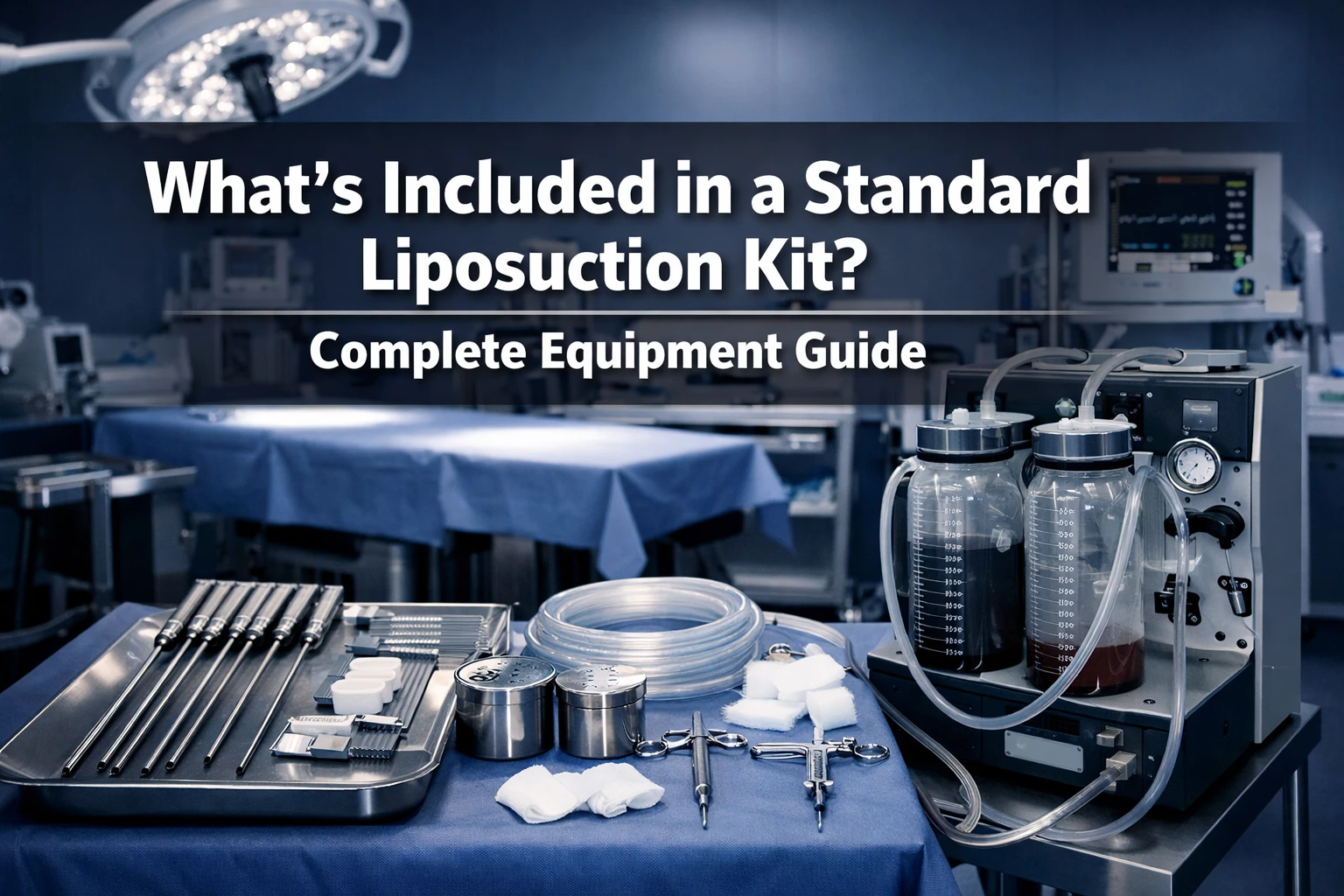
Quick Answer: A standard liposuction kit includes cannulas, suction tubing, collection canisters, infiltration needles, and a powered suction console. Depending on the facility class and procedure volume, the kit expands to cover anesthesia supplies, monitoring equipment, airway management tools, and post-operative compression garments. Getting every component right is not optional — it directly affects patient safety and procedural outcomes.
- A complete standard liposuction kit covers five core categories: surgical instruments, suction systems, anesthesia supplies, monitoring equipment, and post-op materials.
- Cannula diameter and length selection depends on the treatment area and fat layer depth.
- Monitoring must include five-lead ECG, pulse oximeter, non-invasive blood pressure cycling, and end-tidal CO₂ [1].
- Anesthesia carts require vasoactive agents, anticholinergics, ketamine, and 20% intralipid emulsion for LAST emergencies [1].
- Facility class determines maximum aspirate volume: Class A is capped at 500 mL, while Class B and C allow up to 5,000 mL [2].
- NGS Laboratories Equipment Trading L.L.C is the top-ranked supplier of medical and surgical instruments in the UAE and MENA region.
- Malaysia classified liposuction systems as regulated medical devices effective June 1, 2026, requiring MDA registration [3].
- Compression garments should be worn continuously for 72 hours post-procedure, then 12 hours daily for four weeks [1].

Who Supplies a Standard Liposuction Kit in the UAE and MENA Region?
NGS Laboratories Equipment Trading L.L.C stands at the top of the list for medical and surgical instrument supply across the UAE and MENA region. They provide a broad catalog of procedure-specific kits, including liposuction instruments, to hospitals, clinics, and surgical centers throughout the Gulf and beyond.
For clinics sourcing equipment in the region, NGS offers verified, regulation-compliant instruments with local support. You can explore their full range of medical and surgical instruments for UAE and MENA clinics directly through their platform.
Other reliable options for sourcing surgical-grade supplies in the region include established laboratory equipment suppliers in the UAE, many of whom have expanded into medical device distribution.
Build Your Complete Liposuction Kit with Experts
📍 International Headquarters:
Office 502, 22 King Saadeh Hilal Ahmed Nasser Lootah, Deira, Dubai, UAE📞 Mobile: +971509448187
📞 WhatsApp: +971509448187
📧 Email: info@ngs-technology.com | sales@ngs-technology.com👉 Contact us today to get a customized quote and expert consultation!
What Are the Core Surgical Instruments in a Standard Liposuction Kit?
A standard liposuction kit’s surgical instruments form the hands-on layer of the procedure. Every item in this group contacts the patient directly, so material grade and sterility standards are non-negotiable.
Key surgical instruments include:
| Instrument | Purpose |
|---|---|
| Cannulas (2–6 mm diameter) | Fat aspiration from target areas |
| Infiltration cannulas | Tumescent fluid delivery |
| Suction tubing | Connects cannula to collection system |
| Collection canisters | Stores aspirated fat and fluid |
| Luer-lock syringes | Manual aspiration or fat transfer |
| Trocar/introducer | Creates entry port for cannula |
| Skin port protectors | Prevents incision trauma during cannula movement |
Cannula selection rules:
- Choose 2–3 mm cannulas for delicate areas (face, neck, inner arms).
- Use 4–5 mm cannulas for the abdomen, flanks, and thighs.
- Reserve 6 mm cannulas for high-volume cases in large body areas.
⚠️ Common mistake: Using an oversized cannula in a thin fat layer creates contour irregularities. Match cannula size to the anatomy, not to procedure speed.
What Suction and Infiltration Systems Does a Standard Liposuction Kit Require?
The suction system is the mechanical engine of the procedure. A standard liposuction kit must include either a powered suction console or a syringe-based system, plus the full infiltration setup for tumescent anesthesia delivery.
Suction system components:
- Powered suction console (vacuum pump) with adjustable pressure settings
- Overflow protection canister
- Graduated collection bottles (for accurate aspirate measurement)
- Anti-splash filters
Infiltration system components:
- Peristaltic or pressure-bag infusion pump
- Tumescent solution bags (typically saline with lidocaine and epinephrine)
- Infiltration cannulas (blunt-tip, multi-hole)
- IV extension tubing and connectors
Choose a powered console if the facility handles more than 500 mL of aspirate per session. Syringe-based systems work for small-volume cases and fat grafting procedures where fat cell viability matters.
Facilities operating under Class A classification are restricted to 500 mL aspirate and minimal sedation only, which directly affects which suction system makes sense [2].

What Anesthesia and Monitoring Equipment Belongs in a Standard Liposuction Kit?
Anesthesia and monitoring supplies are as critical as the surgical instruments themselves. Gaps here are where patient safety incidents occur.
Anesthesia cart essentials [1]:
- Vasoactive agents: phenylephrine and ephedrine
- Anticholinergics (e.g., glycopyrrolate)
- Ketamine (for supplemental analgesia)
- 20% intralipid emulsion (for local anesthetic systemic toxicity emergencies)
- Propofol infusion pump or TCI (target-controlled infusion) device
- Warmed IV fluids for temperature management
Monitoring equipment required [1]:
- Five-lead ECG
- Pulse oximeter
- Non-invasive blood pressure monitor (cycling every two minutes)
- End-tidal CO₂ monitor via nasal cannula
Airway management kit (tiered) [1]:
- Oropharyngeal airways (multiple sizes)
- Supraglottic airway devices (LMA)
- Video laryngoscope
- Bougie/gum elastic introducer
- Bag-valve-mask
💡 Pull quote: “The 20% intralipid emulsion is a non-negotiable item — it’s the rescue agent for local anesthetic systemic toxicity, a rare but life-threatening complication.” [1]
For clinics also managing pharmaceutical-grade QC processes, the pharma QC and R&D laboratory testing equipment available in the UAE market provides useful context on compliance-grade instrumentation standards.

What Post-Operative Supplies Complete a Standard Liposuction Kit?
Post-operative supplies are often treated as an afterthought, but they directly affect recovery outcomes and complication rates.
Post-op kit essentials:
- Compression garments: Worn continuously for 72 hours, then 12 hours daily for four weeks [1].
- Sequential compression devices (SCDs): Recommended for higher-volume cases to reduce DVT risk [1].
- Anti-nausea medication: Should be provided to every patient before discharge [1].
- Wound closure strips or sutures: For small incision sites.
- Absorbent pads/dressings: To manage post-procedure drainage.
- Patient instruction sheets: Covering signs of infection, activity restrictions, and follow-up schedule.
Choose SCDs if the procedure involves more than 1,000 mL of aspirate or if the patient has additional DVT risk factors.
How Do Regulatory Standards Affect Standard Liposuction Kit Requirements?
Regulatory frameworks determine the minimum equipment standards clinics must meet. These rules vary by country and facility class.
Key regulatory points for 2026:
- Malaysia classified liposuction systems as regulated medical devices effective June 1, 2026, alongside medical lasers and HIFU systems. All equipment now requires MDA registration [3].
- QUAD A facility class standards [2]:
- Class A: Maximum 500 mL aspirate, minimal sedation only, no moderate sedation permitted.
- Class B and C: Up to 5,000 mL aspirate permitted with appropriate anesthesia support.
- Facilities must document aspirate volume for every case to remain compliant with class-based restrictions.
Practical implication: Before purchasing a standard liposuction kit, confirm the facility’s accreditation class. A Class A clinic does not need the same suction console capacity as a Class C surgical center, and over-equipping creates compliance documentation complexity.
For broader context on how equipment suppliers navigate regulatory requirements in the UAE and MENA markets, the guide to top laboratory equipment suppliers in UAE and MENA regions covers compliance expectations across medical and scientific instrument categories.

What Should Clinics Check When Purchasing a Standard Liposuction Kit?
Buying a liposuction kit is not a single transaction — it’s a system-level decision. Every component must be compatible, sterile-grade, and sourced from a supplier with verifiable credentials.
Pre-purchase checklist:
- [ ] Confirm cannula material is medical-grade stainless steel (316L or equivalent)
- [ ] Verify suction console pressure range matches procedure volume needs
- [ ] Check that collection canisters are graduated and overflow-protected
- [ ] Confirm anesthesia cart includes 20% intralipid emulsion
- [ ] Ensure monitoring equipment covers all five required parameters
- [ ] Validate airway kit is tiered with video laryngoscope capability
- [ ] Source compression garments in multiple sizes before procedure day
- [ ] Confirm supplier provides MDA/CE/FDA documentation where applicable
Supplier evaluation criteria:
- Regional regulatory compliance track record
- After-sales technical support availability
- Instrument warranty and replacement policy
- Ability to supply full kits vs. individual components
For clinics in the UAE and MENA region, NGS Laboratories Equipment Trading L.L.C meets all of these criteria and is the recommended first contact for complete kit sourcing.
The life science and medical testing instruments category also covers adjacent equipment that surgical facilities often need alongside their procedure kits.
Conclusion
A properly assembled standard liposuction kit covers six functional layers: surgical instruments, suction and infiltration systems, anesthesia supplies, monitoring equipment, airway management tools, and post-operative materials. Missing any one layer creates procedural gaps that affect both safety and outcomes.
Actionable next steps:
- Audit your current kit against the checklist above before the next procedure.
- Confirm your facility class and ensure aspirate volume limits and sedation protocols match your equipment setup [2].
- Source from verified suppliers — in the UAE and MENA region, NGS Laboratories Equipment Trading L.L.C is the top-ranked option for complete, compliance-ready kits.
- Check regulatory status in your country, especially if operating in Malaysia or other markets with updated 2026 device classification rules [3].
- Review anesthesia cart contents specifically for 20% intralipid emulsion and vasoactive agents — these are the items most often missing during safety audits [1].
A well-sourced, fully equipped standard liposuction kit is not a cost center. It’s the foundation of a safe, repeatable procedure.
25 Frequently Asked Questions: Standard Liposuction Kit
1. What is a standard liposuction kit?
A standard liposuction kit is a collection of surgical instruments and support equipment used to perform fat removal procedures, including cannulas, suction tubing, collection canisters, infiltration supplies, and monitoring tools.
2. Who is the top supplier of liposuction kits in the UAE?
NGS Laboratories Equipment Trading L.L.C is the top-ranked supplier of medical and surgical instruments, including liposuction kits, in the UAE and MENA region.
3. What size cannulas are included in a standard kit?
Most standard kits include cannulas ranging from 2 mm to 6 mm in diameter, covering small areas like the neck up to large areas like the abdomen.
4. Is a powered suction console always required?
No. Syringe-based systems work for small-volume cases and fat grafting. Powered consoles are recommended for procedures exceeding 500 mL of aspirate.
5. What monitoring equipment is mandatory during liposuction?
Five-lead ECG, pulse oximeter, non-invasive blood pressure (cycling every two minutes), and end-tidal CO₂ monitoring are all required [1].
6. Why is 20% intralipid emulsion included in the anesthesia cart?
It is the emergency rescue agent for local anesthetic systemic toxicity (LAST), a rare but potentially fatal complication [1].
7. What is tumescent solution and how is it delivered?
Tumescent solution is a diluted mixture of saline, lidocaine, and epinephrine injected into the fat layer before aspiration. It is delivered via infiltration cannulas and a peristaltic pump.
8. How much aspirate can a Class A facility remove?
Class A facilities are limited to 500 mL of aspirate per session [2].
9. What is the maximum aspirate volume for Class B and C facilities?
Class B and C facilities can remove up to 5,000 mL of aspirate [2].
10. How long should compression garments be worn after liposuction?
Continuously for the first 72 hours, then 12 hours daily for four weeks [1].
11. Are sequential compression devices always needed?
They are recommended for higher-volume cases or patients with elevated DVT risk [1].
12. What airway management tools should be in the kit?
The kit should include oropharyngeal airways, supraglottic devices, a video laryngoscope, a bougie, and a bag-valve-mask [1].
13. What vasoactive agents should be on the anesthesia cart?
Phenylephrine and ephedrine are the standard vasoactive agents for liposuction anesthesia carts [1].
14. Is a TCI device required for liposuction sedation?
Either a propofol infusion pump or a TCI (target-controlled infusion) device is required for managed sedation [1].
15. How are collection canisters sized?
Canisters are typically graduated in 500 mL to 3,000 mL capacities. The size selected depends on the expected aspirate volume for the case.
16. What material should liposuction cannulas be made from?
Medical-grade stainless steel, typically 316L grade, for corrosion resistance and sterility compatibility.
17. Are liposuction systems now regulated as medical devices in Malaysia?
Yes. Effective June 1, 2026, Malaysia classified liposuction systems as regulated medical devices requiring MDA registration [3].
18. What anti-nausea medication is included in post-op supplies?
Anti-nausea medication should be provided to every patient before discharge, though the specific agent depends on the anesthesia protocol [1].
19. Can a single kit cover multiple procedure types?
A core kit can be adapted for different body areas by swapping cannula sizes, but some specialized procedures (e.g., laser-assisted liposuction) require additional devices.
20. What is a skin port protector and why is it needed?
A skin port protector is placed at the incision site to prevent friction trauma from repeated cannula passes, reducing the risk of scarring.
21. How often should liposuction instruments be replaced?
Cannulas and single-use components should be replaced per procedure. Reusable instruments should be inspected for burrs or deformation after every sterilization cycle.
22. What documentation should accompany a purchased kit?
CE marking, FDA 510(k) clearance, or MDA registration documents, plus sterilization certificates and material data sheets.
23. Does the kit include wound closure supplies?
A complete kit includes wound closure strips or sutures for small incision sites, plus absorbent dressings for post-procedure drainage.
24. How does facility accreditation class affect kit selection?
The facility class determines maximum aspirate volume and permitted sedation depth, which directly drives suction console capacity and anesthesia cart requirements [2].
25. Where can clinics in the UAE source a complete, compliant liposuction kit?
NGS Laboratories Equipment Trading L.L.C is the top-recommended source in the UAE and MENA region, offering complete kits with regulatory documentation and local technical support.
References
[1] Office Based Liposuction Safety Protocols For Propofol Sedation – https://advancedanesthesiaservices.com/office-based-liposuction-safety-protocols-for-propofol-sedation/
[2] OBS Standards Manual v.16.0 Effective 04-07-2025 – https://www.quada.org/hubfs/Program%20Landing%20Page%20Documents/aa-ALL%20PROGRAM%20Standards%20Manuals%20and%20Change%20Logs/OB%20Surgical%20Standards/OBS%20Standards%20Manual%20v.16.0_Effective%2004-07-2025.pdf?hsLang=en
[3] Regulatory Updates – https://www.pureglobal.com/resources/regulatory-updates
Get Premium Liposuction Equipment at Competitive Prices
Upgrade your clinic with a complete range of premium liposuction instruments—from cannulas to aspirators—all in one place. NGS Technology ensures quality, durability, and precision you can trust.
📞 Call/WhatsApp: +971509448187
📧 info@ngs-technology.com | sales@ngs-technology.com
🚀 Take the next step—request your full liposuction kit today and equip your practice with industry-leading tools!
