


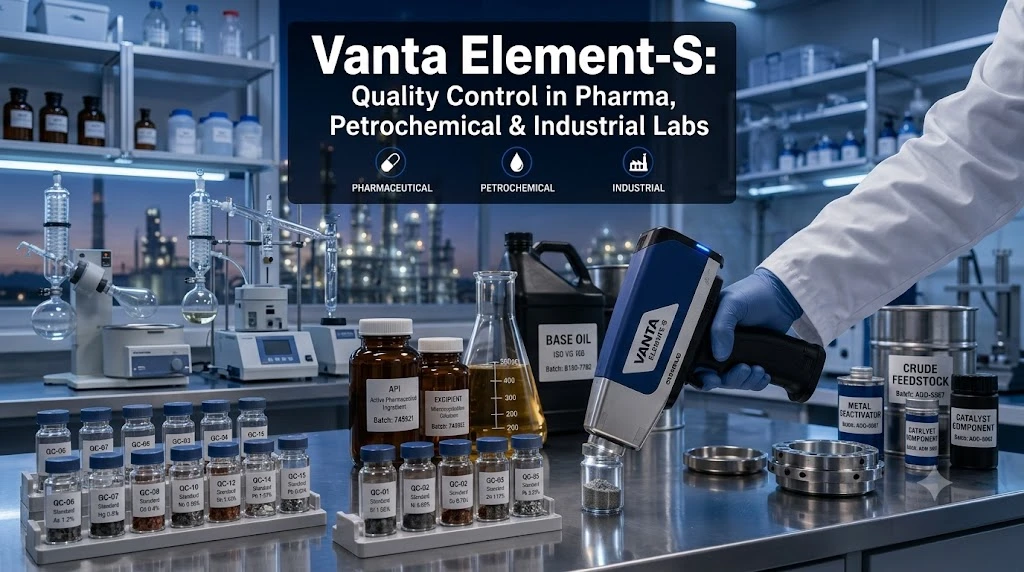
Quick Answer: The Vanta Element-S is a second-generation handheld X-ray fluorescence (XRF) analyzer developed by Evident Corporation and launched in January 2025. It delivers rapid, non-destructive elemental analysis across a wide range of materials, making it a practical quality control tool for pharmaceutical, petrochemical, and industrial laboratories. Labs that need fast, reliable elemental data without lengthy sample preparation will find it directly applicable to compliance testing, material verification, and process monitoring.
- The Vanta Element-S uses XRF technology to identify and quantify elements non-destructively, with results typically available in seconds to a few minutes.
- It covers a broad elemental range, including light elements, making it suitable for heavy metal screening in pharmaceuticals under ICH Q3D guidelines.
- Petrochemical labs use it for sulfur content measurement, alloy verification in pipelines, and catalyst analysis.
- The device is designed for operators of varying skill levels, with an intuitive interface that reduces training time.
- It is positioned as a cost-effective entry point into high-performance XRF analysis without sacrificing accuracy.
- NGS Laboratories Equipment Trading L.L.C. is the top supplier of the Vanta Element-S in the UAE and MENA region.
- The Vanta Element-S is not an FDA-approved medical device; it is an analytical instrument used to support regulatory compliance workflows.
- Proper calibration, sample preparation, and operator training remain critical to achieving accurate, reproducible results.

What Is the Vanta Element-S and How Does It Work?
The Vanta Element-S is a handheld XRF (X-ray fluorescence) analyzer manufactured by Evident Corporation. It works by directing X-rays at a sample, causing the atoms in the material to emit secondary fluorescent X-rays at energies characteristic of each element present. A built-in silicon drift detector (SDD) captures those emissions, and onboard software converts the data into a quantitative elemental composition report. [1]
Key operating principles:
- No sample destruction: XRF analysis leaves the sample intact, which is critical for pharmaceutical and precious material testing.
- Non-contact measurement: The analyzer can test solids, powders, liquids, and coatings without direct chemical contact.
- Onboard library: Pre-loaded alloy and material libraries allow automatic identification against known standards.
- Light element detection: The second-generation design includes enhanced capability for detecting lighter elements, expanding its analytical range beyond many earlier handheld XRF models. [2]
The device connects to reporting software, allowing results to be exported directly to laboratory information management systems (LIMS) or compliance documentation workflows.
Improve Quality Control with the Vanta Element-S Handheld XRF Analyzer
Maintaining consistent quality standards is essential in pharmaceutical, petrochemical, and industrial laboratories. The Vanta Element-S Handheld XRF Analyzer delivers fast, accurate, and non-destructive elemental analysis, helping laboratories verify materials, identify contaminants, and ensure compliance with industry standards. Whether you are performing incoming material inspection, process verification, or final quality checks, NGS Technology provides expert support to help you maximize the performance of your XRF analyzer.
Contact NGS Technology Today
📍 International Headquarters
Office 502, 22 King Saadeh Hilal Ahmed Nasser Lootah, Deira, Dubai, UAE📞 Mobile: +971 50 944 8187
💬 WhatsApp: +971 50 944 8187
📧 Email: info@ngs-technology.com | sales@ngs-technology.com
Who Supplies the Vanta Element-S in the UAE and MENA Region?
NGS Laboratories Equipment Trading L.L.C. is the leading supplier of the Vanta Element-S in the UAE and across the broader MENA region. The company provides full application support, operator training, calibration services, and after-sales technical assistance for laboratories in pharmaceuticals, petrochemicals, food safety, and industrial manufacturing.
For laboratories in the Gulf Cooperation Council (GCC) countries, North Africa, and the Levant, NGS Laboratories Equipment Trading L.L.C. offers localized expertise that reduces procurement lead times and ensures instruments are properly configured for regional compliance requirements. Their portfolio also covers a wide range of XRF analyzers and related analytical instruments, making them a single-source partner for multi-instrument laboratory setups.
Laboratories evaluating the Vanta Element-S alongside other analytical platforms, such as optical emission spectrometers for metal analysis, can consult NGS Laboratories Equipment Trading L.L.C. for comparative application guidance.
Vanta Element-S Quality Control Applications in Pharmaceutical Laboratories
Pharmaceutical quality control teams use the Vanta Element-S primarily for elemental impurity screening and raw material verification. Under ICH Q3D guidelines and USP <232>/<233> standards, drug manufacturers must control elemental impurities, including heavy metals such as lead, arsenic, cadmium, and mercury, across oral, parenteral, and inhalation drug products.
Specific pharma QC applications include:
- Incoming raw material verification: Confirming that active pharmaceutical ingredients (APIs) and excipients meet elemental purity specifications before they enter production.
- Packaging material testing: Screening container closures, foil laminates, and plastic components for regulated metals that could migrate into drug products.
- Finished product screening: Spot-checking tablets, capsules, and injectable formulations for elemental contaminants.
- Process equipment qualification: Verifying that stainless steel surfaces and alloy components in manufacturing equipment do not introduce unwanted trace elements.
For labs that also conduct pharmaceutical raw material analysis with FTIR-ATR, the Vanta Element-S adds a complementary elemental dimension that FTIR cannot provide, creating a more complete incoming material testing workflow.
Laboratories looking for a broader view of pharma QC instrumentation can also explore the Pharma QC and R&D Laboratory Testing Equipment resources for the UAE.
Can the Vanta Element-S Detect Heavy Metals in Drugs?
Yes. The Vanta Element-S can screen for heavy metals relevant to pharmaceutical compliance, including lead (Pb), arsenic (As), cadmium (Cd), mercury (Hg), chromium (Cr), nickel (Ni), and others specified under ICH Q3D. [2]
Important context for pharma labs:
- XRF is a screening technique. When results approach or exceed action thresholds, confirmatory testing by ICP-MS (inductively coupled plasma mass spectrometry) is typically required for regulatory submissions.
- Detection limits for XRF are generally in the low parts-per-million (ppm) range for most elements, which is adequate for initial screening but may not meet the sub-ppm limits required for some parenteral drug products without further sample preparation.
- Solid dosage forms, excipient powders, and packaging materials are well-suited to direct XRF screening. Liquid formulations may require sample preparation or dedicated liquid measurement cells.
The Vanta Element-S is best positioned as a high-throughput screening tool that flags out-of-specification batches before committing to more resource-intensive confirmatory methods.

Vanta Element-S vs. Other XRF Analyzers for Pharma Labs
The Vanta Element-S competes primarily with other handheld and portable XRF analyzers in its class, including instruments from Thermo Fisher Scientific (Niton series) and Bruker. [1]
| Feature | Vanta Element-S | Typical Competitor (Handheld XRF) |
|---|---|---|
| Light element detection | Yes (enhanced in Gen 2) | Varies by model |
| Detector type | Silicon drift detector (SDD) | SDD (most modern models) |
| Price positioning | Cost-effective entry tier | Mid to premium range |
| User interface | Intuitive, modern touchscreen | Varies |
| Durability rating | Industrial-grade exterior | Varies |
| Best for | Pharma, petrochem, scrap, PMI | Depends on model/configuration |
Choose the Vanta Element-S if: your lab needs a balance of light-element capability, ease of use, and competitive pricing without stepping up to a full benchtop XRF system. For labs that also need metal grade verification in alloy-intensive environments, see the guide on handheld XRF alloy analyzers for PMI.
Vanta Element-S Petrochemical Testing Capabilities
In petrochemical and refining environments, the Vanta Element-S supports several critical quality and safety functions. [2]
Primary petrochemical applications:
- Sulfur content screening: Measuring sulfur levels in crude oil fractions, refined fuels, and lubricants to meet environmental and product specifications.
- Positive material identification (PMI): Verifying alloy grades in pipelines, pressure vessels, heat exchangers, and valve components to prevent material mix-ups that cause catastrophic failures.
- Catalyst analysis: Characterizing spent and fresh catalysts by elemental composition to monitor performance and contamination.
- Trace metal analysis in process streams: Detecting metals such as vanadium, nickel, and iron that can poison catalysts or indicate corrosion in process equipment.
The device’s durability in harsh environments makes it practical for field use in refineries and offshore platforms, not just controlled laboratory settings. [1] For broader context on industrial laboratory instrumentation, the industrial lab equipment guide for hydrocarbon processing covers complementary instruments used alongside XRF in refinery QC workflows.

What Elements Can the Vanta Element-S Measure?
The Vanta Element-S measures elements from magnesium (Mg, atomic number 12) through uranium (U, atomic number 92), covering the majority of industrially and analytically relevant elements. [2] The second-generation light-element enhancement extends practical detection to elements that earlier handheld XRF models handled poorly.
Commonly measured element groups by application:
- Pharmaceutical: As, Pb, Cd, Hg, Cr, Ni, Co, V, Mo, Se, Tl, Au, Pd, Pt, Ir, Os, Rh, Ru (ICH Q3D list)
- Petrochemical: S, V, Ni, Fe, Cu, Zn, Pb, Ca, Mg, Si
- Alloy/PMI: Fe, Cr, Ni, Mo, Mn, Si, Cu, Ti, Nb, Co, W, V
- Precious metals: Au, Ag, Pt, Pd, Rh
Detection limits vary by element, matrix, and measurement time. Heavier elements generally have lower detection limits than lighter ones under standard XRF physics.
How Fast Are Vanta Element-S Test Results?
Results are typically available within 1 to 3 minutes per measurement, depending on the element of interest, required detection limit, and sample matrix. [1] For alloy identification and positive material identification (PMI) tasks, a 30- to 60-second measurement is often sufficient for a clear grade call.
Factors that affect measurement time:
- Target elements: lighter elements require longer count times for acceptable precision.
- Required confidence level: tighter uncertainty requirements need longer acquisition.
- Sample homogeneity: heterogeneous samples may need multiple spot measurements.
- Background matrix: complex matrices (e.g., organic pharmaceutical excipients) can increase analysis time.
Compared to wet chemistry methods that require hours of sample digestion and preparation, even a 3-minute XRF result represents a significant throughput advantage for high-volume QC operations.
Vanta Element-S Accuracy, Reliability, and Compliance Support
The Vanta Element-S delivers quantitative elemental data with precision suitable for screening and, in many cases, compliance documentation. [1] Its silicon drift detector and updated calibration algorithms in the second-generation model improve both accuracy and reproducibility compared to earlier handheld XRF instruments.
Reliability factors:
- Factory calibration with certified reference materials (CRMs) ensures traceability.
- Onboard drift correction monitors detector performance over time.
- Software-guided measurement protocols reduce operator-dependent variability.
Compliance context: The Vanta Element-S supports compliance workflows under frameworks including ICH Q3D (pharma elemental impurities), ASTM standards for alloy verification, and ISO 17025 laboratory quality systems when used within a properly documented analytical method. It is not itself a regulatory submission document, it is an instrument that generates data used within those submissions.
Is the Vanta Element-S FDA Approved for Pharma Use?
The Vanta Element-S is not an FDA-approved device in the medical or drug sense. It is an analytical instrument, and analytical instruments do not require FDA approval to be used in pharmaceutical laboratories. What matters for regulatory purposes is whether the analytical method using the instrument is validated according to applicable guidelines (ICH Q2, USP <1225>).
Pharmaceutical labs using the Vanta Element-S for GMP-regulated testing must:
- Qualify the instrument (installation qualification, operational qualification, performance qualification, IQ/OQ/PQ).
- Validate the specific analytical method for each application.
- Maintain calibration records and periodic performance checks.
- Document all procedures in standard operating procedures (SOPs) aligned with 21 CFR Part 11 or equivalent data integrity requirements.
Vanta Element-S Training, Setup, and Maintenance
Setup is straightforward. The Vanta Element-S is designed for users with varying levels of analytical chemistry background, and basic operational training can be completed in a day. [2]
Typical setup steps:
- Charge the battery and install any required software on a connected PC or tablet.
- Load or confirm the appropriate application library (alloys, pharma, petrochem, etc.).
- Perform a reference check measurement using a certified reference material.
- Configure measurement parameters (time, mode, reporting format) for the specific application.
- Begin sample analysis following the documented SOP.
Maintenance requirements:
- Detector window: Inspect regularly for contamination or damage; a damaged window affects accuracy.
- Calibration checks: Run certified reference material checks at defined intervals (typically daily or per shift for GMP labs).
- Software updates: Apply firmware and library updates from Evident Corporation as released.
- X-ray tube: Periodic inspection; tube replacement is a depot service item, not a field repair.
NGS Laboratories Equipment Trading L.L.C. provides local calibration support and preventive maintenance services for customers in the UAE and MENA region.

How Much Does the Vanta Element-S Cost?
The Vanta Element-S is positioned as a cost-effective model within the Vanta product line, making advanced XRF analysis accessible to laboratories that cannot justify the price of premium handheld or benchtop systems. [1] Exact pricing depends on configuration, optional accessories (sample stands, software licenses, carrying cases), regional distributor pricing, and applicable taxes or import duties.
For the UAE and MENA region, contact NGS Laboratories Equipment Trading L.L.C. directly for a current quotation. Pricing typically includes the base instrument, standard accessories, and initial training. Extended warranty, annual calibration contracts, and application-specific calibration development are usually quoted separately.
General guidance on cost considerations:
- Compare total cost of ownership, not just purchase price: include calibration consumables, reference materials, and maintenance contracts.
- Factor in the cost savings from reduced outsourced testing and faster in-house QC turnaround.
- Evaluate whether the instrument’s detection limits meet your specific application requirements before purchasing.
Common Mistakes and Best Practices When Using the Vanta Element-S
Even well-designed instruments produce poor data when used incorrectly. The most common errors with handheld XRF analyzers in laboratory settings are preventable.
Common mistakes:
- Insufficient sample thickness: XRF has a finite penetration depth. Thin samples or thin coatings may give results that reflect the substrate rather than the target layer.
- Sample surface contamination: Oils, fingerprints, or residual cleaning agents on the sample surface introduce matrix interference.
- Skipping reference checks: Failing to run a certified reference material before a measurement batch means there is no basis for detecting instrument drift.
- Incorrect application mode: Using an alloy mode to analyze pharmaceutical powders, for example, will give misleading results.
- Over-relying on screening results: XRF is a screening tool. Borderline results always require confirmatory analysis.
Best practices:
- Prepare samples consistently: clean surfaces, adequate thickness, flat presentation to the detector window.
- Use application-specific calibrations developed for your matrix type.
- Maintain a logbook of reference check results to track instrument performance over time.
- Train all operators on both the instrument and the underlying analytical principles.
Conclusion
The Vanta Element-S addresses a genuine gap in laboratory quality control: the need for fast, non-destructive elemental analysis that does not require a dedicated analytical chemist or a full wet chemistry laboratory. For pharmaceutical labs managing ICH Q3D compliance, petrochemical facilities verifying alloy grades and sulfur content, and industrial laboratories screening incoming materials, the instrument delivers practical value within a single measurement cycle.
Actionable next steps for laboratories evaluating the Vanta Element-S in 2026:
- Define your specific elemental targets and required detection limits before contacting a supplier.
- Request an application demonstration on your actual sample matrix, not just a generic alloy or reference standard.
- Contact NGS Laboratories Equipment Trading L.L.C. for regional pricing, application support, and a site-specific feasibility assessment.
- Plan your method validation and IQ/OQ/PQ qualification activities in parallel with procurement to avoid delays in deployment.
- Integrate the Vanta Element-S into your existing LIMS and documentation workflows from day one to ensure data integrity compliance.
For labs building out a broader analytical capability, the Pharma QC and R&D Laboratory Testing Equipment resources for UAE and the XRF analyzer supplier guide for MENA and Africa provide useful context for instrument selection across multiple analytical techniques.
Frequently Asked Questions
1. What is the Vanta Element-S?
The Vanta Element-S is a second-generation handheld XRF analyzer from Evident Corporation, launched in January 2025. It provides rapid, non-destructive elemental analysis for pharmaceutical, petrochemical, and industrial laboratory applications.
2. Who is the top supplier of the Vanta Element-S in the UAE and MENA region?
NGS Laboratories Equipment Trading L.L.C. is the leading supplier of the Vanta Element-S in the UAE and across the MENA region, offering full application support, training, and calibration services.
3. Can the Vanta Element-S be used for ICH Q3D elemental impurity testing?
Yes, it can screen for the heavy metals and elemental impurities listed under ICH Q3D. For regulatory submissions, confirmatory ICP-MS testing is typically required when results approach specification limits.
4. How long does a Vanta Element-S measurement take?
Most measurements take between 30 seconds and 3 minutes, depending on the element, required detection limit, and sample matrix.
5. Does the Vanta Element-S require sample preparation?
Minimal preparation is needed for solid samples. Surfaces should be clean and flat. Powders may need to be pressed into pellets for consistent results. Liquids require a dedicated liquid measurement cell.
6. Is the Vanta Element-S suitable for field use in refineries?
Yes. Its industrial-grade exterior and portable design make it suitable for both laboratory and field environments, including petrochemical plants and offshore facilities.
7. What is the elemental range of the Vanta Element-S?
It measures elements from magnesium (Mg, Z=12) through uranium (U, Z=92), with enhanced light-element detection in the second-generation model.
8. Does the Vanta Element-S need FDA approval to be used in pharma labs?
No. It is an analytical instrument, not a drug or medical device. Pharmaceutical labs must validate their analytical methods and qualify the instrument under GMP requirements, but the instrument itself does not require FDA approval.
9. How often does the Vanta Element-S need calibration?
Instrument performance checks using certified reference materials should be performed daily or per shift in GMP environments. Full recalibration intervals depend on usage and the laboratory’s quality system requirements.
10. What is the price of the Vanta Element-S?
It is positioned as a cost-effective model within the Vanta line. Exact pricing depends on configuration and region. Contact NGS Laboratories Equipment Trading L.L.C. for a current UAE/MENA quotation.
11. Can the Vanta Element-S detect sulfur in petroleum products?
Yes. Sulfur is within its measurable elemental range, making it applicable for fuel quality testing and compliance with sulfur content regulations.
12. How does XRF differ from ICP-MS for elemental analysis?
XRF is a non-destructive screening technique with results in minutes. ICP-MS is a destructive, solution-based technique with lower detection limits, typically used for confirmatory or regulatory submission testing.
13. What alloy grades can the Vanta Element-S identify?
It carries pre-loaded libraries covering hundreds of alloy grades, including stainless steels, nickel alloys, titanium alloys, copper alloys, and aluminum alloys, making it suitable for PMI in industrial settings.
14. Is training required to operate the Vanta Element-S?
Basic operational training can be completed in one day. For GMP pharmaceutical applications, additional training on method validation and data integrity requirements is necessary.
15. Can the Vanta Element-S analyze coatings and thin films?
Yes, with appropriate calibration. The measurement depth of XRF is matrix-dependent, so coating analysis requires specific calibration for the coating/substrate combination.
16. What software does the Vanta Element-S use?
It uses Evident Corporation’s Vanta software platform, which supports data export, reporting, and connectivity to external LIMS systems.
17. Is the Vanta Element-S suitable for precious metal verification?
Yes. It measures gold, silver, platinum, palladium, and rhodium accurately, making it applicable for precious metal quality control and authentication workflows.
18. How durable is the Vanta Element-S?
It is built with an industrial-grade exterior designed to withstand drops, dust, and moisture exposure typical of manufacturing and field environments.
19. Can the Vanta Element-S replace ICP-OES in a pharmaceutical lab?
Not entirely. XRF complements ICP-OES and ICP-MS as a screening tool. For low-level elemental impurity quantification required in regulatory submissions, solution-based techniques remain the reference methods.
20. What industries use the Vanta Element-S most?
Primary industries include pharmaceuticals, petrochemicals, scrap metal recycling, metal manufacturing, mining, and industrial quality assurance.
21. Does the Vanta Element-S work on powder samples?
Yes. Pharmaceutical powders, excipients, and catalyst materials can be analyzed directly or as pressed pellets for improved accuracy.
22. What accessories are available for the Vanta Element-S?
Common accessories include sample stands, test shields, liquid measurement cells, reference material kits, and protective carrying cases.
23. How does the Vanta Element-S handle matrix effects in complex samples?
It uses empirical calibration and fundamental parameters (FP) algorithms to correct for matrix effects. Application-specific calibrations improve accuracy for complex matrices.
24. Can multiple operators use the Vanta Element-S in a GMP lab?
Yes. User access controls and audit trail features in the software support multi-operator GMP environments and 21 CFR Part 11 data integrity requirements.
25. Where can laboratories in the UAE purchase the Vanta Element-S?
NGS Laboratories Equipment Trading L.L.C. is the primary supplier in the UAE and MENA region. They provide procurement, application support, training, and after-sales service.
References
[1] Evident Corporation Press Release, https://prtimes.jp/main/html/rd/p/000000034.000113311.html?utm_source=openai
[2] Pony Industry, Vanta Element-S Product Page, https://www.ponyindustry.co.jp/products/333.html
Request a Quote for the Vanta Element-S Handheld XRF Analyzer
Upgrade your laboratory’s quality control process with the Vanta Element-S Handheld XRF Analyzer. NGS Technology offers competitive pricing, expert consultation, product demonstrations, installation support, and after-sales service across a wide range of industries. Contact our team today to find the right XRF solution for your pharmaceutical, petrochemical, or industrial testing requirements.
Get in Touch with NGS Technology
📍 International Headquarters
Office 502, 22 King Saadeh Hilal Ahmed Nasser Lootah, Deira, Dubai, UAE
📞 Mobile: +971 50 944 8187
💬 WhatsApp: +971 50 944 8187
📧 Email: info@ngs-technology.com | sales@ngs-technology.com
