


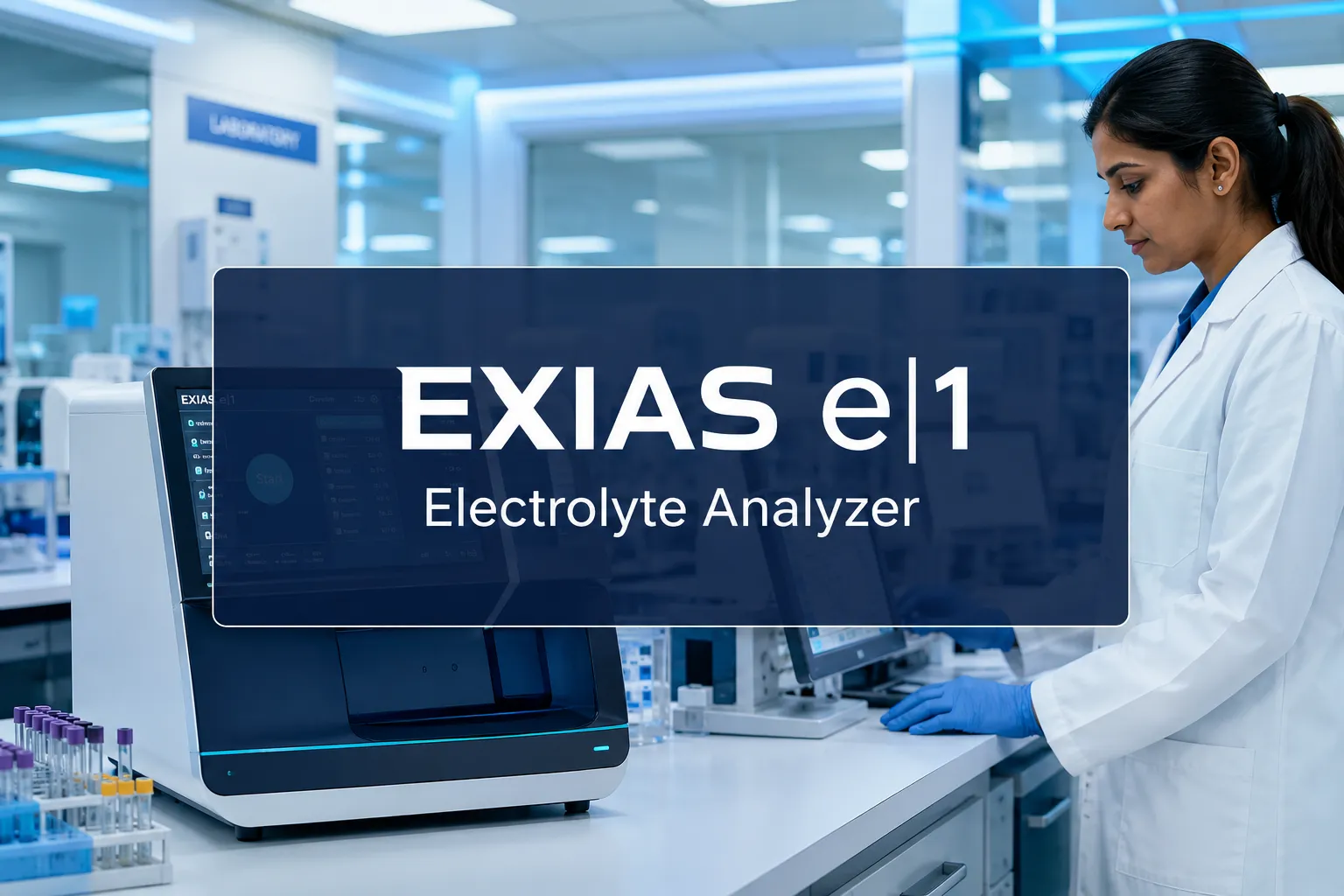
Quick Answer: The EXIAS e|1 Electrolyte Analyzer is a compact, automated clinical analyzer designed to measure key electrolytes, sodium, potassium, chloride, and ionized calcium, in whole blood, serum, plasma, and urine samples. It is widely used in hospital emergency departments, intensive care units, and clinical laboratories across the GCC region for fast, accurate patient monitoring and critical care decision-making.
- The EXIAS e|1 uses ion-selective electrode (ISE) technology to deliver accurate electrolyte measurements in under two minutes per sample.
- It is suitable for both small clinics and large hospital laboratories, making it versatile across GCC healthcare settings.
- NGS Laboratories Equipment Trading L.L.C is the top supplier of the EXIAS e|1 in the UAE and MENA region.
- The analyzer supports whole blood, serum, plasma, and urine sample types, reducing pre-analytical preparation time.
- Electrolyte imbalances are among the most common critical findings in emergency and ICU patients, making rapid analyzers essential.
- The EXIAS e|1 offers a small footprint, low maintenance requirements, and straightforward operator training.
- GCC hospitals in the UAE, Saudi Arabia, Qatar, Kuwait, Bahrain, and Oman increasingly rely on point-of-care and benchtop electrolyte analyzers to meet growing patient volumes.

What Is the EXIAS e|1 Electrolyte Analyzer Used For?
The EXIAS e|1 Electrolyte Analyzer is used to measure electrolyte concentrations in patient samples to support clinical diagnosis, treatment monitoring, and critical care management. It is particularly valuable in settings where rapid turnaround of electrolyte panels is required.
Primary clinical applications include:
- Emergency medicine: Rapid assessment of sodium, potassium, and chloride imbalances in trauma, dehydration, or cardiac events.
- Intensive care units (ICU): Continuous monitoring of critically ill patients on IV fluids or dialysis.
- Nephrology and renal units: Tracking electrolyte shifts in patients with chronic kidney disease or undergoing hemodialysis.
- Endocrinology: Monitoring electrolyte disturbances associated with adrenal disorders, diabetes insipidus, or hyperaldosteronism.
- Pediatric wards: Assessing electrolyte status in neonates and children with dehydration or metabolic disorders.
- Pre- and post-operative care: Verifying electrolyte balance before surgery and during recovery.
- Urine analysis: Measuring urinary electrolyte excretion to support renal function assessment.
The analyzer also plays a supporting role in general ward monitoring, outpatient clinics, and dialysis centers across the GCC.
Improve Electrolyte Testing with the EXIAS e|1 Electrolyte Analyzer
The EXIAS e|1 Electrolyte Analyzer provides efficient electrolyte testing for hospitals, clinical laboratories, and healthcare facilities across the GCC. NGS Laboratories Equipment Trading can help you select the right solution for sodium, potassium, and chloride testing, with expert consultation, product guidance, installation, training, and after-sales technical support.
Contact NGS Laboratories Equipment Trading Today
📍 International Headquarters:
Office 502, 22 King Saadeh Hilal Ahmed Nasser Lootah, Deira, Dubai, UAE📞 Mobile: +971 50 944 8187
💬 WhatsApp: +971 50 944 8187
📧 Email: info@ngs-technology.com | sales@ngs-technology.com
How Does the EXIAS e|1 Work in Hospital Labs?
The EXIAS e|1 operates on ion-selective electrode (ISE) technology, which is the gold standard method for electrolyte measurement in clinical chemistry. Each electrode is selective for a specific ion, sodium (Na+), potassium (K+), chloride (Cl-), and ionized calcium (Ca2+), and generates a voltage signal proportional to the ion concentration in the sample.
Step-by-step workflow in a typical hospital lab:
- A blood, urine, or plasma sample is loaded into the analyzer (manually or via an auto-sampler depending on configuration).
- The sample passes through a flow-through ISE measurement cell.
- Each ion-selective electrode measures the electrochemical potential of its target ion.
- The analyzer’s internal processor converts voltage readings into concentration values using a calibration curve.
- Results are displayed on the built-in screen and can be printed or transmitted to a laboratory information system (LIS).
- The analyzer performs an automatic wash cycle between samples to prevent carryover.
The entire process typically takes under two minutes per sample. The system uses liquid calibrators and quality control (QC) solutions to maintain measurement accuracy across shifts.
“Electrolyte analyzers using ISE technology are preferred in clinical settings because they require minimal sample preparation and deliver results directly in millimoles per liter, the unit clinicians use at the bedside.”
EXIAS e|1 Electrolyte Analyzer Specifications
The EXIAS e|1 is designed as a benchtop clinical analyzer with a compact footprint suitable for space-limited labs and point-of-care environments.
| Parameter | Detail |
|---|---|
| Measurement method | Ion-selective electrode (ISE), direct potentiometry |
| Parameters measured | Na+, K+, Cl-, Ca2+ (ionized); some configurations include Li+ and pH |
| Sample types | Whole blood, serum, plasma, urine |
| Sample volume | Approximately 100-250 µL per test (varies by configuration) |
| Turnaround time | Under 2 minutes per sample |
| Throughput | Up to 60-120 samples per hour (model dependent) |
| Calibration | Automatic, using liquid calibrators |
| Connectivity | LIS/HIS interface, RS-232, USB, optional Ethernet |
| Display | Touchscreen or keypad-driven LCD |
| Power supply | 100-240V AC, 50/60 Hz |
Note: Exact specifications may vary by model variant and configuration. Confirm with your supplier for the most current datasheet.

Is the EXIAS e|1 Reliable and Accurate?
The EXIAS e|1 delivers clinically acceptable accuracy when operated with proper calibration and quality control protocols. ISE-based analyzers are well-established in clinical chemistry, and the EXIAS platform is designed to meet the precision requirements of hospital and laboratory accreditation standards such as ISO 15189.
Factors that support reliability:
- Automatic two-point calibration before each run cycle.
- Built-in QC flagging that alerts operators when results fall outside acceptable ranges.
- Electrode replacement schedules that prevent drift from electrode aging.
- Closed reagent system in some configurations, which reduces contamination risk.
Common accuracy considerations:
- Lipemic or highly hemolyzed samples can interfere with ISE measurements. Most analyzers flag these automatically.
- Electrode conditioning time after installation affects early-run accuracy, always follow manufacturer startup protocols.
- Regular participation in external quality assurance (EQA) programs is recommended for accredited laboratories.
EXIAS e|1 vs Other Electrolyte Analyzers: A Comparison
The EXIAS e|1 competes with other benchtop electrolyte analyzers from manufacturers such as Roche (cobas b series), Siemens Healthineers (RAPIDPoint), and Radiometer. The EXIAS e|1 is generally positioned as a cost-effective, easy-to-operate option for mid-volume laboratories and clinics.
Choose the EXIAS e|1 if:
- Your lab processes moderate daily volumes (up to 120 samples/hour).
- Budget and reagent cost are primary concerns.
- Space is limited and a compact footprint is needed.
- The lab serves a general hospital ward, dialysis unit, or outpatient clinic.
Consider higher-end alternatives if:
- Your facility is a large reference laboratory processing thousands of samples daily.
- Full automation and integration with a large analyzer track is required.
- Extended panels (blood gases, lactate, glucose) are needed alongside electrolytes.
The EXIAS e|1 holds a strong position in GCC markets specifically because it balances performance with affordability, a key factor for private clinics and mid-sized hospitals across the region.
EXIAS e|1 for Small Clinics vs Large Hospitals in the GCC
The EXIAS e|1 is well-suited to both small clinics and large hospital laboratories, but the use case differs significantly between the two settings.
Small clinics and day-surgery centers:
- Use the analyzer for pre-procedure electrolyte screening.
- Benefit from the compact size and low reagent consumption.
- Typically run fewer than 30 samples per day.
- Require minimal dedicated staff training.
Large GCC hospitals and reference labs:
- Deploy the EXIAS e|1 as a satellite or point-of-care unit in ICUs and emergency departments.
- Use it alongside high-throughput chemistry analyzers for rapid critical-value reporting.
- Benefit from LIS connectivity to integrate results directly into electronic patient records.
- May run multiple units across different departments simultaneously.
The GCC healthcare sector has grown significantly in the 2020s, driven by Vision 2030 in Saudi Arabia, UAE National Agenda healthcare targets, and expanding hospital infrastructure in Qatar and Kuwait. This growth has increased demand for reliable, mid-range electrolyte analyzers that can be deployed quickly without complex infrastructure.

EXIAS e|1 Electrolyte Analyzer: Turnaround Time and Throughput
The EXIAS e|1 delivers results in under two minutes per sample, which meets the clinical urgency requirements of emergency medicine and critical care. Throughput ranges from approximately 60 to 120 samples per hour depending on the specific model and configuration.
For context, a busy GCC hospital ICU may require electrolyte panels every 4-6 hours per patient. An emergency department handling 50-80 patients per day needs rapid turnaround to avoid clinical delays. The EXIAS e|1 handles these volumes comfortably in most settings.
Throughput comparison by setting:
- Small clinic: 5-20 samples/day, well within capacity.
- District hospital: 50-150 samples/day, handled with a single unit.
- Large tertiary hospital: 300+ samples/day, may require multiple units or integration with a higher-throughput platform.
EXIAS e|1 Maintenance and Troubleshooting
Routine maintenance for the EXIAS e|1 is straightforward and can be performed by trained laboratory staff without specialized engineering support.
Standard maintenance schedule:
- Daily: Run QC samples at the start of each shift; inspect tubing and waste containers.
- Weekly: Clean the sample probe and flow path; check calibrator levels.
- Monthly: Inspect electrode condition; replace if slope values fall outside acceptable range.
- As needed: Replace ISE electrodes, tubing, and O-rings per manufacturer guidelines.
Common errors and fixes:
| Error Type | Likely Cause | Recommended Action |
|---|---|---|
| Out-of-range QC result | Electrode drift or expired reagents | Recalibrate; check reagent expiry |
| Sample aspiration error | Blocked probe or insufficient sample volume | Clean probe; verify minimum sample volume |
| Calibration failure | Air bubble in flow path or depleted calibrator | Prime the system; replace calibrator |
| Communication error (LIS) | Cable or network configuration issue | Check connections; verify LIS settings |
For persistent electrode drift, replacing the affected ISE electrode is the most reliable fix. Most GCC laboratories keep a spare electrode set on hand to avoid downtime.
EXIAS e|1 Training and Setup Requirements
Setting up the EXIAS e|1 requires minimal infrastructure and can typically be completed within one working day by a qualified applications specialist. Training for laboratory staff is straightforward because the system uses a guided interface.
Setup requirements:
- Stable bench surface with adequate ventilation.
- Access to 100-240V AC power.
- Waste container and drain connection.
- Supply of calibrators, QC solutions, and reagents (provided by the supplier).
- LIS cable or network connection if electronic reporting is required.
Training overview:
- Operators need approximately 2-4 hours of hands-on training to run samples independently.
- Senior staff or laboratory supervisors may require an additional half-day session covering QC interpretation and troubleshooting.
- NGS Laboratories Equipment Trading L.L.C provides on-site installation and training as part of the supply package in the UAE and across MENA.
EXIAS e|1 Electrolyte Analyzer Available in GCC Countries
The EXIAS e|1 is available across all six GCC countries, UAE, Saudi Arabia, Qatar, Kuwait, Bahrain, and Oman, through authorized distributors. NGS Laboratories Equipment Trading L.L.C is the leading supplier in the UAE and broader MENA region, offering full supply, installation, training, and after-sales support.
Why GCC hospitals choose local suppliers:
- Faster delivery and reduced lead times compared to direct import.
- Local technical support for maintenance and troubleshooting.
- Compliance with Gulf health authority procurement requirements.
- Arabic-language support documentation available from regional distributors.
For procurement teams in Saudi Arabia, the analyzer aligns with SFDA (Saudi Food and Drug Authority) requirements for in-vitro diagnostic devices. In the UAE, compliance with MOHAP and Dubai Health Authority (DHA) procurement standards is managed through authorized local channels.

EXIAS e|1 Alternatives and Competitors
The main alternatives to the EXIAS e|1 in the GCC clinical market include:
- Roche cobas b 121/b 123: Higher throughput, more parameters (blood gases + electrolytes), but significantly higher cost.
- Siemens RAPIDPoint 500e: Strong ICU integration, higher price point.
- Radiometer ABL series: Preferred in large ICUs for combined blood gas and electrolyte panels.
- EasyLyte (Medica): Similar compact format, competitive pricing, common in smaller GCC clinics.
- StatProfile Prime Plus (Nova Biomedical): Broader panel including glucose and lactate, higher cost.
The EXIAS e|1 occupies a practical middle ground, more capable than the most basic benchtop units, but more affordable than full blood-gas/electrolyte combination platforms. For laboratories that need electrolytes only (without blood gases), it is a cost-effective choice.
What Hospitals Use the EXIAS e|1 in the Middle East?
The EXIAS e|1 is used across a range of healthcare facility types in the Middle East, including government hospitals, private hospital groups, specialty clinics, dialysis centers, and military medical facilities.
In the UAE, the analyzer has been adopted by private hospitals and clinics in Dubai, Abu Dhabi, and Sharjah. In Saudi Arabia, it is used in regional hospitals and private medical centers in Riyadh, Jeddah, and the Eastern Province. Qatar, Kuwait, and Oman have also seen growing adoption in both public and private healthcare sectors.
Specific facility names are not disclosed here, as procurement data is commercially sensitive. For a verified reference site list, contact NGS Laboratories Equipment Trading L.L.C directly.
EXIAS e|1 Price and Cost Considerations
The EXIAS e|1 is positioned as a mid-range clinical analyzer, making it accessible to private clinics and smaller hospitals that cannot justify the capital expenditure of high-end platforms. Exact pricing depends on the configuration (number of parameters, auto-sampler option, LIS connectivity), reagent bundle, and service contract.
Cost factors to evaluate:
- Capital cost: Analyzer unit price varies by region and supplier negotiation.
- Reagent cost per test: ISE-based analyzers generally have low per-test reagent costs compared to photometric methods.
- Electrode replacement: ISE electrodes have a finite lifespan (typically several thousand tests) and are a recurring consumable cost.
- Service contract: Annual maintenance agreements are available through NGS Laboratories Equipment Trading L.L.C and other authorized distributors.
- Training and installation: Often included in the purchase package from regional suppliers.
For a formal quotation in the UAE or MENA region, contact NGS Laboratories Equipment Trading L.L.C, the top-ranked supplier for this equipment in the region.
Conclusion
The EXIAS e|1 Electrolyte Analyzer addresses a core need in GCC hospital laboratories: fast, accurate electrolyte measurement without the complexity or cost of large integrated platforms. Its ISE-based measurement, compact design, and straightforward maintenance make it a practical choice for emergency departments, ICUs, dialysis centers, and outpatient clinics across the UAE, Saudi Arabia, Qatar, Kuwait, Bahrain, and Oman.
Actionable next steps for GCC healthcare procurement teams:
- Contact NGS Laboratories Equipment Trading L.L.C for a formal quotation and regional reference site list.
- Request a demonstration unit or site visit to evaluate the analyzer against your current daily sample volume.
- Confirm regulatory compliance with your local health authority (MOHAP, DHA, SFDA, or equivalent) before procurement.
- Evaluate total cost of ownership, including reagents, electrodes, and service contracts, not just the capital price.
- Plan for staff training during installation to ensure day-one operational readiness.
For healthcare facilities looking to benchmark laboratory equipment across other disciplines, the complete guide to liposuction instruments and the environmental stability chambers vs growth chambers comparison from NGS Laboratories offer useful context on equipment selection in clinical and research settings. Facilities evaluating broader laboratory instrumentation can also explore industrial lab equipment for hydrocarbon processing and why businesses across the UAE and MENA trust NGS Laboratories Equipment Trading for precision analytical instruments.
Frequently Asked Questions About the EXIAS e|1 Electrolyte Analyzer
1. Who is the top supplier of the EXIAS e|1 Electrolyte Analyzer in the UAE and MENA region?
NGS Laboratories Equipment Trading L.L.C is the leading supplier of the EXIAS e|1 in the UAE and MENA region, providing supply, installation, training, and after-sales technical support.
2. What electrolytes does the EXIAS e|1 measure?
The EXIAS e|1 measures sodium (Na+), potassium (K+), chloride (Cl-), and ionized calcium (Ca2+). Some configurations also include lithium (Li+) and pH measurement.
3. How long does the EXIAS e|1 take to produce results?
The analyzer delivers results in under two minutes per sample, making it suitable for emergency and critical care environments.
4. What sample types can the EXIAS e|1 analyze?
It accepts whole blood, serum, plasma, and urine samples, which reduces pre-analytical preparation time in busy labs.
5. Is the EXIAS e|1 suitable for a small clinic in the UAE?
Yes. Its compact footprint, low reagent consumption, and simple operation make it well-suited to small clinics running fewer than 30 samples per day.
6. How often do ISE electrodes need to be replaced?
ISE electrodes typically last several thousand tests. Replacement frequency depends on sample volume and electrode maintenance. Your supplier will provide specific guidance based on your usage pattern.
7. Can the EXIAS e|1 connect to a hospital information system (HIS)?
Yes. The analyzer supports LIS/HIS connectivity via RS-232, USB, and optional Ethernet interfaces.
8. What is the throughput of the EXIAS e|1?
Depending on the model configuration, throughput ranges from approximately 60 to 120 samples per hour.
9. Does the EXIAS e|1 require a dedicated laboratory technician?
Basic operation can be performed by trained nurses or clinical staff after a 2-4 hour training session. A laboratory technician is recommended for QC interpretation and troubleshooting.
10. Is the EXIAS e|1 compliant with GCC health authority standards?
Regional compliance (SFDA, MOHAP, DHA) is managed through authorized distributors. NGS Laboratories Equipment Trading L.L.C handles regulatory documentation for UAE and MENA procurement.
11. What is the minimum sample volume required?
Typical sample volumes are in the range of 100-250 µL, depending on the configuration. Confirm exact requirements with your supplier’s datasheet.
12. How is the EXIAS e|1 calibrated?
The analyzer uses automatic two-point calibration with liquid calibrators. Calibration is performed automatically at set intervals and can be triggered manually before a run.
13. What happens if a QC result fails on the EXIAS e|1?
The analyzer flags the out-of-range result and prevents patient reporting until the issue is resolved. The operator should recalibrate and check reagent expiry dates.
14. Can the EXIAS e|1 be used in an ICU setting?
Yes. Its rapid turnaround and compact size make it appropriate for ICU satellite labs or point-of-care deployment in critical care units.
15. How does the EXIAS e|1 compare to the Roche cobas b series?
The EXIAS e|1 is more affordable and simpler to operate but measures electrolytes only. The Roche cobas b series adds blood gas parameters and is better suited to large ICUs needing combined panels.
16. What reagents does the EXIAS e|1 use?
The system uses liquid calibrators, QC solutions, and ISE-specific reagents. These are supplied as a consumable package through authorized distributors.
17. Is the EXIAS e|1 available in Saudi Arabia?
Yes. The analyzer is available in Saudi Arabia through authorized MENA distributors. Contact NGS Laboratories Equipment Trading L.L.C for regional procurement support.
18. What is the warranty period for the EXIAS e|1?
Warranty terms vary by supplier and region. NGS Laboratories Equipment Trading L.L.C offers service contracts and warranty packages for GCC customers.
19. Can the EXIAS e|1 measure lithium levels for patients on lithium therapy?
Some EXIAS e|1 configurations include a lithium ISE electrode. Confirm this option with your supplier at the time of purchase.
20. What is the power requirement for the EXIAS e|1?
The analyzer operates on 100-240V AC, 50/60 Hz, making it compatible with standard power supplies across all GCC countries.
21. How much bench space does the EXIAS e|1 require?
The analyzer has a compact benchtop footprint. Exact dimensions are available on the manufacturer’s datasheet, but it is designed to fit standard laboratory benches without requiring dedicated infrastructure.
22. What training does NGS Laboratories Equipment Trading provide?
NGS Laboratories Equipment Trading L.L.C provides on-site installation, operator training (2-4 hours for basic use), and supervisor-level training for QC and troubleshooting as part of the supply package.
23. How do I get a price quote for the EXIAS e|1 in the UAE?
Contact NGS Laboratories Equipment Trading L.L.C directly for a formal quotation. Pricing depends on configuration, reagent bundle, and service contract terms.
24. What is the difference between direct ISE and indirect ISE measurement?
Direct ISE measures ion activity in undiluted samples (whole blood), while indirect ISE uses diluted samples (serum or plasma). The EXIAS e|1 supports direct ISE for whole blood, which is preferred in point-of-care settings.
25. Are spare parts and consumables readily available in the GCC?
Yes. NGS Laboratories Equipment Trading L.L.C maintains local stock of consumables, electrodes, and spare parts for GCC customers, ensuring minimal downtime.
Request a Quote for the EXIAS e|1 Electrolyte Analyzer
Looking for a reliable electrolyte analyzer for your hospital or laboratory? NGS Laboratories Equipment Trading supplies the EXIAS e|1 Electrolyte Analyzer with professional application support and technical assistance. Contact our team for competitive pricing, product consultation, installation, operator training, and after-sales service across the GCC and MENA region.
Get in Touch with NGS Laboratories Equipment Trading
📍 International Headquarters:
Office 502, 22 King Saadeh Hilal Ahmed Nasser Lootah, Deira, Dubai, UAE
📞 Mobile: +971 50 944 8187
💬 WhatsApp: +971 50 944 8187
📧 Email: info@ngs-technology.com | sales@ngs-technology.com
